Anvajo Fluidlab R-300 Handheld Cell Counter & UV-Vis Spectrophotometer
| Brand | Anvajo |
|---|---|
| Origin | Germany |
| Model | Fluidlab R-300 |
| Detection Time | ≤20 s (cell counting) |
| Cell Concentration Range | 1×10⁴–2×10⁷ cells/mL |
| Sample Volume | <20 µL |
| Sample Throughput | 3–80 µL |
| Wavelength Range | 375–700 nm |
| Weight | 240 g |
| Sterilization Method | Alcohol-wipe compatible surface |
Overview
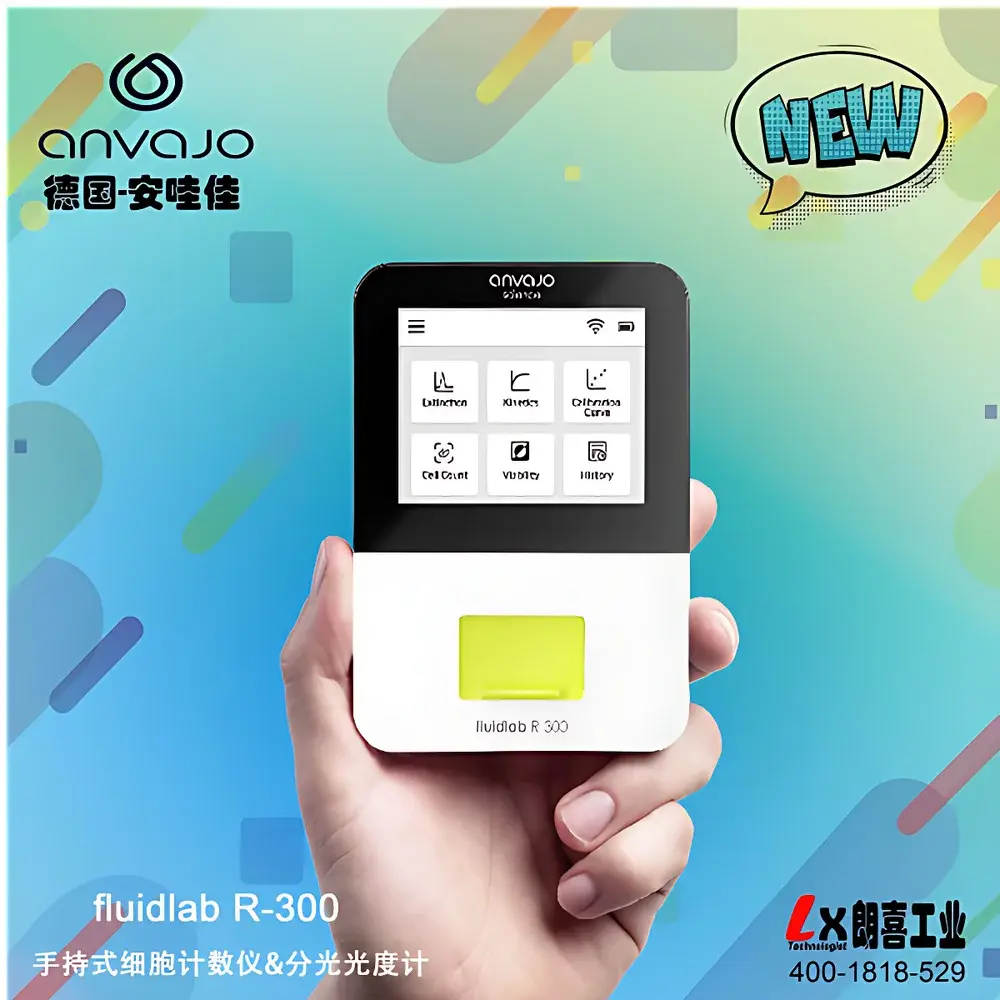
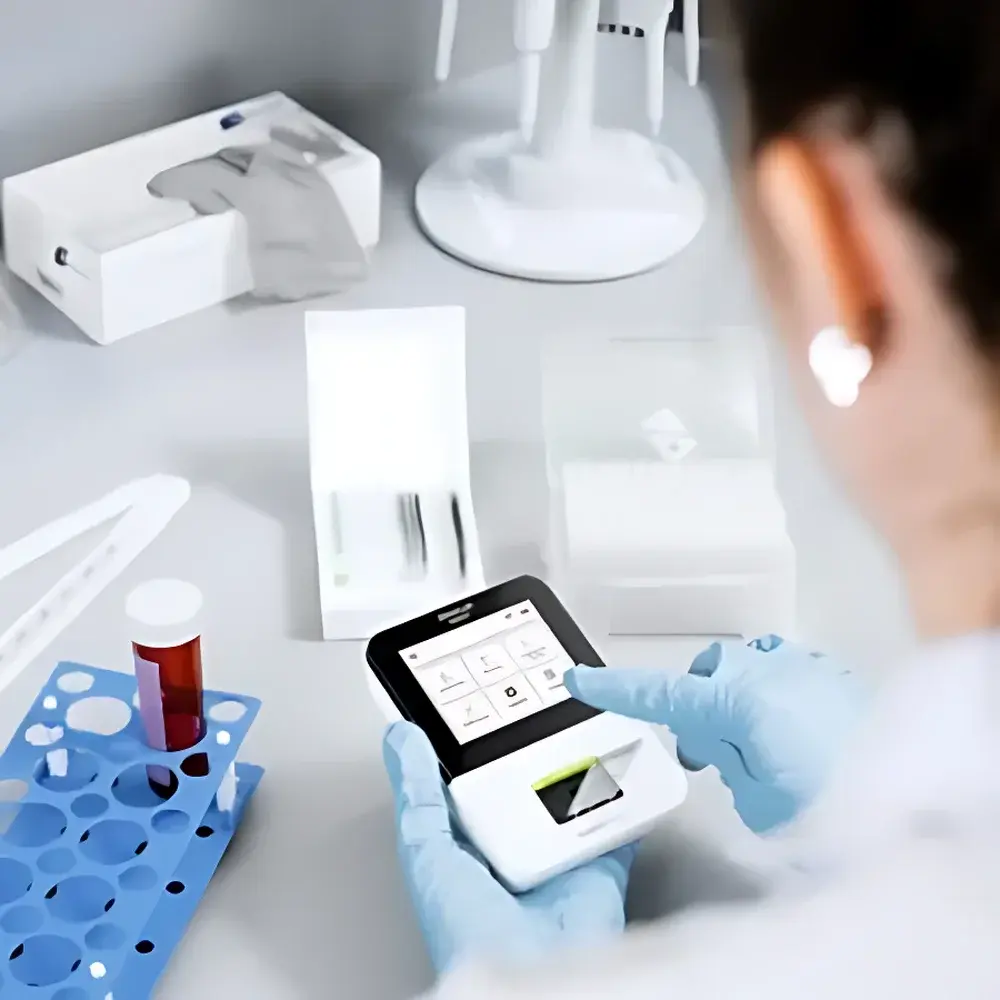
The Anvajo Fluidlab R-300 is a handheld, dual-function analytical instrument engineered for integrated cell analysis and UV-Vis absorbance measurement in life science laboratories. It combines digital holographic microscopy (DHM)—a label-free, quantitative phase imaging technique rooted in coherent laser interferometry—with broadband spectrophotometry across the visible spectrum (375–700 nm). Unlike conventional brightfield or fluorescence-based cell counters requiring vital dyes (e.g., Trypan Blue), the Fluidlab R-300 quantifies viable and non-viable cells by reconstructing 3D refractive index maps from interference patterns generated by unaltered biological samples. This enables real-time, non-invasive viability assessment without chemical perturbation, preserving native cell physiology and eliminating dye-related variability. Its compact, ergonomic form factor (240 g) supports direct operation inside biosafety cabinets, laminar flow hoods, or incubator environments—minimizing sample transfer, contamination risk, and workflow interruption.
Key Features
- Digital Holographic Microscopy (DHM) core: Enables rapid (<20 s), label-free cell counting and viability determination via quantitative phase contrast imaging.
- Broadband spectrophotometer: Measures absorbance spectra from 375 nm to 700 nm with high wavelength reproducibility; supports OD600 bacterial density assays, Bradford protein quantification, and kinetic absorbance profiling.
- Minimal sample requirement: Analyzes volumes as low as 3 µL; optimal performance achieved with <20 µL of undiluted suspension.
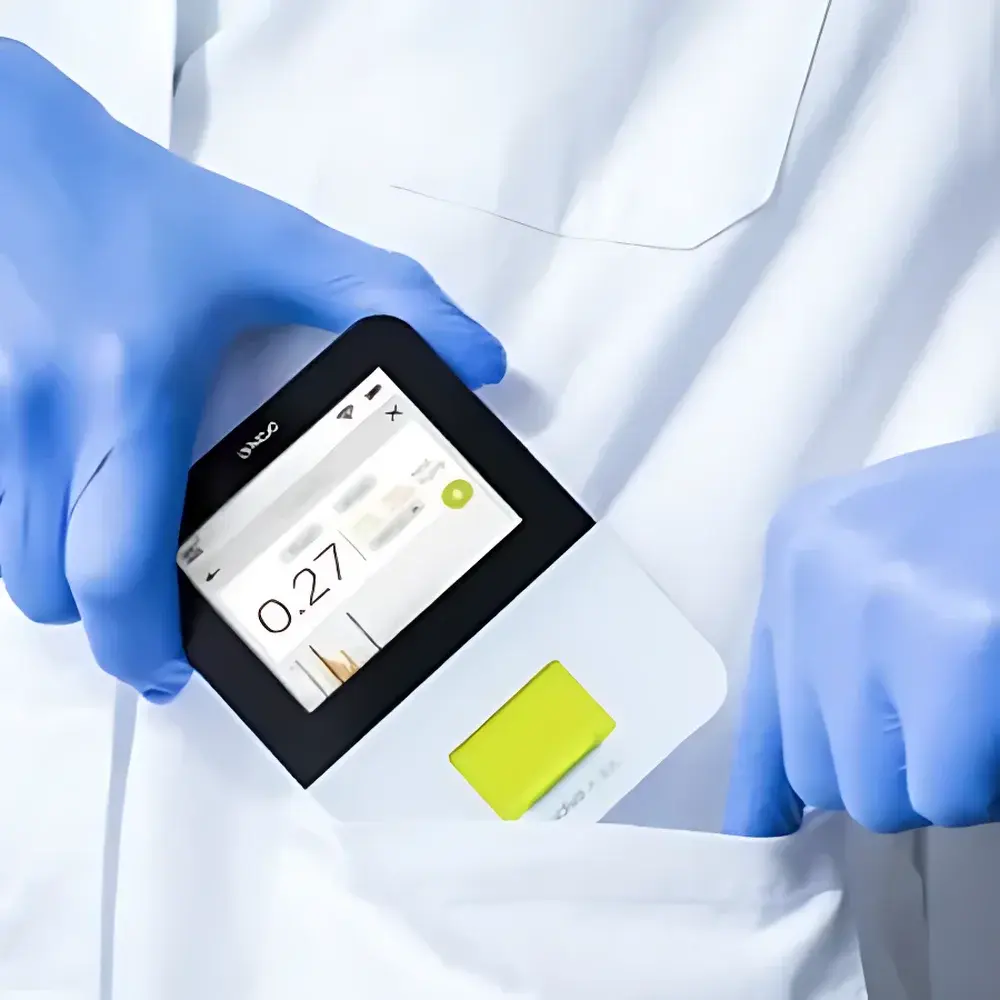
- On-device histogram generation: Real-time visualization of cell size distribution and subpopulation clustering without external software dependency.
- Alcohol-compatible housing: Entire exterior surface withstands repeated 70% ethanol wipe disinfection—validated for routine use in ISO Class 5 cleanrooms and GMP-aligned cell culture suites.
- No post-movement recalibration: Robust optical alignment and solid-state sensor architecture ensure measurement stability after transport or repositioning.
Sample Compatibility & Compliance
The Fluidlab R-300 accommodates heterogeneous suspensions including mammalian adherent and suspension lines (e.g., CHO, HEK293, Jurkat), primary isolates (PBMCs, neurons), yeast (S. cerevisiae), and bacterial cultures (E. coli, B. subtilis). It does not require centrifugation, filtration, or dilution for standard applications. The instrument complies with IEC 61010-1:2010 safety standards for laboratory equipment and meets electromagnetic compatibility (EMC) requirements per EN 61326-1:2013. While not FDA-cleared as a diagnostic device, its measurement traceability aligns with GLP documentation practices; raw DHM phase data and spectral absorbance files are timestamped and exportable in CSV and HDF5 formats to support audit-ready workflows under 21 CFR Part 11–compatible LIMS environments.
Software & Data Management
The embedded firmware provides intuitive touchscreen navigation and on-device data visualization—including live phase contrast images, viability heatmaps, and normalized absorption spectra. All measurements are stored with metadata (date/time, user ID, sample ID, instrument serial number) and exported via USB-C or Bluetooth 5.0 to Windows/macOS platforms. The optional Fluidlab Connect desktop application (v3.2+) supports batch processing, calibration curve fitting (linear, quadratic, cubic), multi-wavelength ratio analysis (e.g., A260/A280), and automated report generation compliant with ISO/IEC 17025 documentation templates. Audit trails record all parameter changes, user logins, and file exports—enabling full traceability for QA/QC validation protocols.
Applications
- Cell culture QC: Daily viability monitoring during bioreactor inoculation, passage planning, and cryopreservation recovery.
- Transfection & gene editing efficiency: Rapid post-nucleofection viability screening without dye toxicity artifacts.
- Microbial growth kinetics: Real-time OD600 tracking in shake flasks or microtiter plates using capillary sampling.
- Protein quantification: Bradford, Lowry, and BCA-compatible absorbance measurements at 595 nm, 750 nm, and 562 nm respectively.
- Exosome & EV characterization: Size-distribution profiling of nanoparticle-enriched fractions via DHM-derived phase volume metrics.
- Educational labs: Portable demonstration platform for teaching optical physics principles (interferometry, coherence length, phase retrieval) alongside practical cell biology techniques.
FAQ
Does the Fluidlab R-300 require calibration with certified reference standards?
Yes—initial factory calibration is performed using NIST-traceable polystyrene microsphere suspensions (10 µm ±0.1 µm) and neutral density filters (OD 0.3–2.0). Users may perform periodic verification using the included calibration slide and absorbance reference cuvette.
Can it measure cells smaller than 5 µm, such as bacteria or platelets?
It resolves particles down to ~3 µm diameter under optimal suspension conditions; however, accurate viability discrimination below 6 µm is limited by DHM depth-of-field constraints and requires empirical validation per strain or preparation method.
Is spectral data acquisition compatible with kinetic mode?
Yes—absorbance readings can be triggered at user-defined intervals (1 s to 60 min) for time-resolved enzyme assays or metabolic monitoring.
What file formats are supported for data export?
CSV (tabular results), PNG (annotated images), and HDF5 (raw hologram + metadata) are natively supported; third-party integration via Python API is available under commercial license.
How is instrument performance verified during routine maintenance?
Built-in self-diagnostic routines assess laser power stability, detector dark current, and stage positioning accuracy; results are logged and accessible via service menu with password protection.