
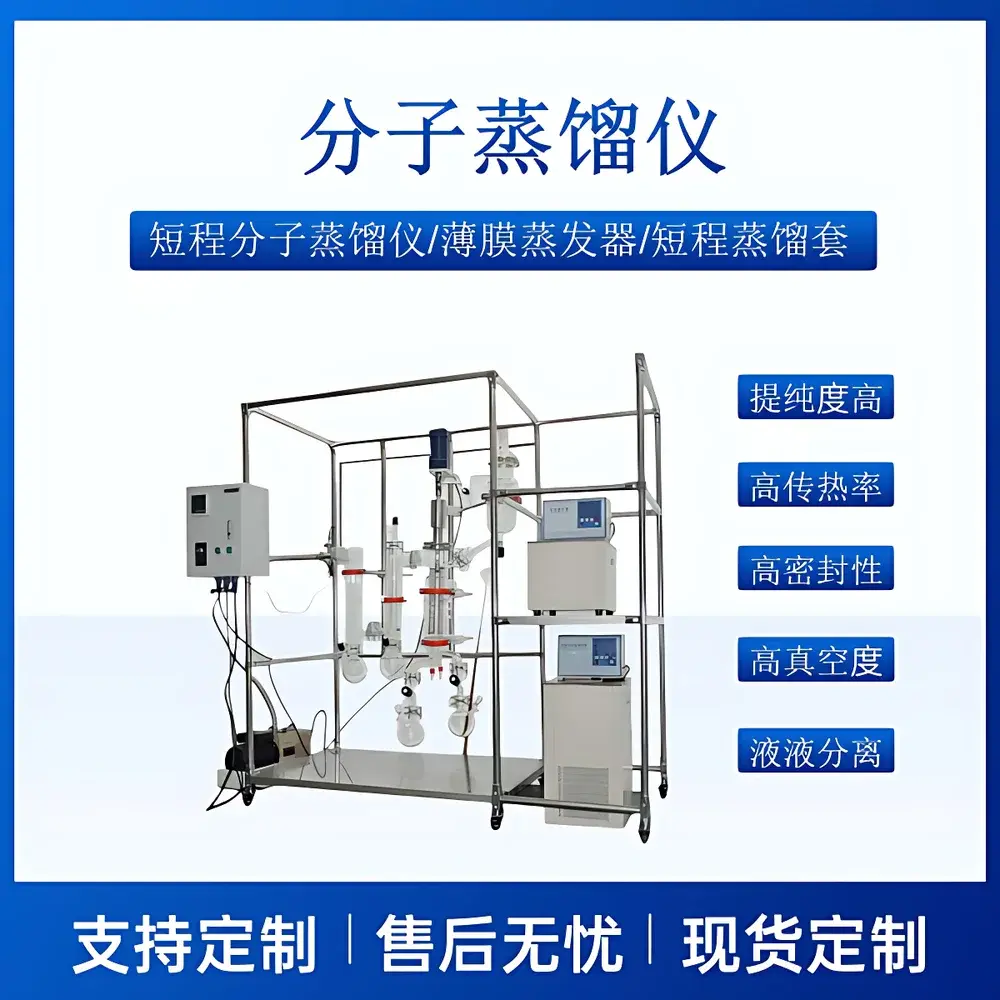
Anyan AYAN-F150 Short-Path Molecular Distillation System for Laboratory-Scale Purification
| Brand | Anyan Instruments |
|---|---|
| Origin | Zhejiang, China |
| Model | AYAN-F150 |
| Feed Capacity | 1.0–8.0 L/h |
| Effective Evaporation Area | 0.25 m² |
| Evaporator Inner Diameter | 150 mm |
| Condensation Area | 0.45 m² |
| Ultimate Vacuum | < 0.1 Pa (empty system) |
| Heating Temperature Range | Ambient to 200 °C |
| Wiper Material | PTFE + SS316L |
| Sealing | Fluoroelastomer (FKM) gaskets, optional PTFE |
| Motor Power | 120 W |
| Max Rotational Speed | ≤450 rpm |
| Film Thickness | < 0.5 mm |
Overview
The Anyan AYAN-F150 Short-Path Molecular Distillation System is a precision-engineered laboratory-scale purification instrument designed for the gentle, high-efficiency separation of thermally labile, high-boiling, or oxidation-sensitive compounds. Operating under ultra-high vacuum (< 0.1 Pa), it leverages the fundamental principle of molecular distillation: when the mean free path of vapor molecules exceeds the physical distance between the evaporating surface and the condensing surface, molecular evaporation occurs without bulk boiling. This enables separation based on differences in molecular weight and vapor pressure—rather than conventional boiling point differentials—making it uniquely suited for heat-sensitive actives such as natural vitamins (e.g., vitamin A and E), polyunsaturated fatty acids (e.g., EPA/DHA from fish oil), sterols (e.g., lanolin derivatives), and polymer intermediates. Unlike traditional distillation, the AYAN-F150 employs a thin-film wiper mechanism to generate a uniform, sub-millimeter liquid film (< 0.5 mm) on a heated cylindrical evaporator surface, minimizing thermal exposure time (typically seconds) and preventing decomposition, charring, or oxidative degradation. Its compact footprint and modular configuration support benchtop integration within ISO/IEC 17025-compliant analytical labs, GMP-aligned pilot development suites, and university research facilities focused on green chemistry and natural product isolation.
Key Features
- Ultra-high vacuum capability (< 0.1 Pa) achieved via integrated vacuum pump interface and fluorocarbon-sealed rotary feed system, ensuring minimal oxygen ingress and suppression of oxidative side reactions.
- PTFE- and SS316L-coated wiper assembly provides chemical resistance to aggressive feedstocks including organic acids, phenolics, and halogenated solvents while maintaining mechanical stability at elevated temperatures.
- Adjustable pre-heating feed tank with PID-controlled heating (ambient to 200 °C) allows precise thermal conditioning of viscous or crystalline feeds prior to film formation.
- Optimized geometry: 150 mm internal evaporator diameter paired with 0.25 m² effective evaporation area and 0.45 m² condensation area ensures high mass-transfer efficiency and low pressure drop across the short-path gap.
- Double-collection system with independently removable light-fraction and heavy-fraction receivers (standard 3 L capacity, configurable up to 5 L) supports sequential or parallel multi-component fractionation.
- Fully sealed construction using FKM gaskets; optional PTFE gasket upgrade available for HF, strong oxidizers, or highly corrosive media per ASTM D1418 and ISO 1629 specifications.
- No boiling or foaming: operation occurs exclusively via surface evaporation under molecular flow regime—eliminating nucleate boiling, entrainment, and frothing commonly observed in vacuum or steam distillation.
Sample Compatibility & Compliance
The AYAN-F150 accommodates a broad range of feed materials—including viscous oils (e.g., fish oil, lanolin, tall oil), heat-labile nutraceuticals (e.g., carotenoids, tocopherols), synthetic monomers, and post-extraction crude fractions containing residual solvents (e.g., hexane, ethanol, ethyl acetate). Its non-destructive separation mechanism complies with principles outlined in USP , ICH Q5C (stability of biotech products), and FDA guidance on solvent residue limits (ICH Q3C). While not certified to CE or UL standards out-of-the-box, the system’s electrical architecture (230 V / 50 Hz, IP20 enclosure) and vacuum integrity meet baseline requirements for installation in GLP-regulated laboratories. Documentation packages—including factory calibration records, material traceability for wetted parts (SS316L, borosilicate glass, PTFE), and vacuum leak test reports—support audit readiness per 21 CFR Part 11 Annex 11 data integrity expectations.
Software & Data Management
The AYAN-F150 operates via an embedded industrial-grade controller with local touchscreen HMI (human-machine interface), supporting real-time monitoring of key process parameters: evaporator temperature, condenser temperature, vacuum level, wiper speed, and feed rate. All operational data—including timestamped setpoints and actual values—are logged internally with ≥30-day retention and exportable via USB to CSV format. For integration into centralized lab informatics systems (e.g., LabVantage, STARLIMS), optional RS485 Modbus RTU communication enables bidirectional control and automated data ingestion. Audit trails record operator logins, parameter changes, and emergency stop events—aligned with ALCOA+ (Attributable, Legible, Contemporaneous, Original, Accurate, Complete, Consistent, Enduring, Available) data governance principles. No cloud connectivity or remote access functionality is included by default, preserving data sovereignty and cybersecurity compliance.
Applications
- Fine Chemicals: Purification of fragrance compounds (e.g., rose oxide, ionones), monomers for specialty polymers, and catalyst residues from Grignard or Suzuki coupling reactions.
- Pharmaceuticals & Nutraceuticals: Isolation of vitamin E isomers, concentration of omega-3 glycerides, deacidification of phospholipid extracts, and removal of residual solvents from botanical concentrates per USP .
- Food & Lipid Science: Deodorization and decolorization of edible oils, fractionation of medium-chain triglycerides (MCTs), recovery of phytosterols from vegetable oil deodorizer distillates, and stabilization of astaxanthin-rich algal extracts.
- Materials Research: Solvent-free purification of silicone oligomers, thermal upgrading of bio-based lubricants, and separation of epoxy resin precursors without crosslinking.
- Environmental Analysis: Cleanup of PAH-contaminated soil extracts, concentration of persistent organic pollutants (POPs) from water samples prior to GC-MS analysis, and recovery of flame retardants from e-waste leachates.
FAQ
What vacuum level is required for optimal performance?
The AYAN-F150 achieves full molecular distillation regime at pressures ≤ 0.1 Pa. A two-stage vacuum system (rotary vane + diffusion or turbomolecular pump) is recommended to reach and sustain this range, especially with high-volatility or moisture-laden feeds.
Can the system handle highly viscous feeds (e.g., >10,000 cP)?
Yes—pre-heating capability (up to 200 °C) combined with the SS316L/PTFE wiper design enables stable thin-film formation even with molasses-like materials such as hydrogenated castor oil or polymer melts. Feed pre-heating must be optimized empirically per viscosity-temperature profile.
Is validation documentation provided for GMP use?
Factory acceptance test (FAT) reports, material certifications (EN 10204 3.1), and vacuum integrity verification data are supplied standard. IQ/OQ protocols can be developed jointly with the user’s QA team using ASTM E2500 and ISPE Baseline Guide principles.
What maintenance intervals are recommended?
Wiper blade inspection every 200 operating hours; FKM gaskets replaced annually or after exposure to aggressive solvents; vacuum pump oil changed per manufacturer schedule (typically every 500 h); glass components inspected for stress cracks before each high-temperature run.



