
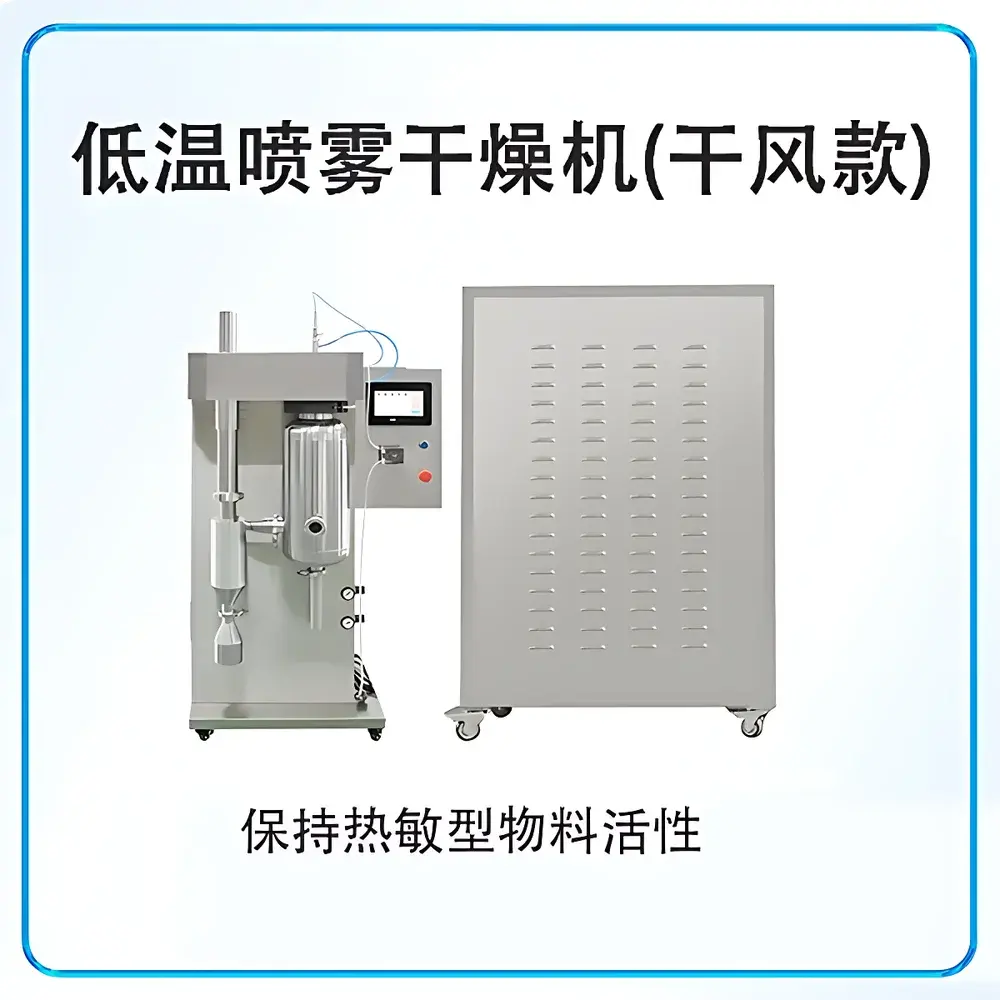
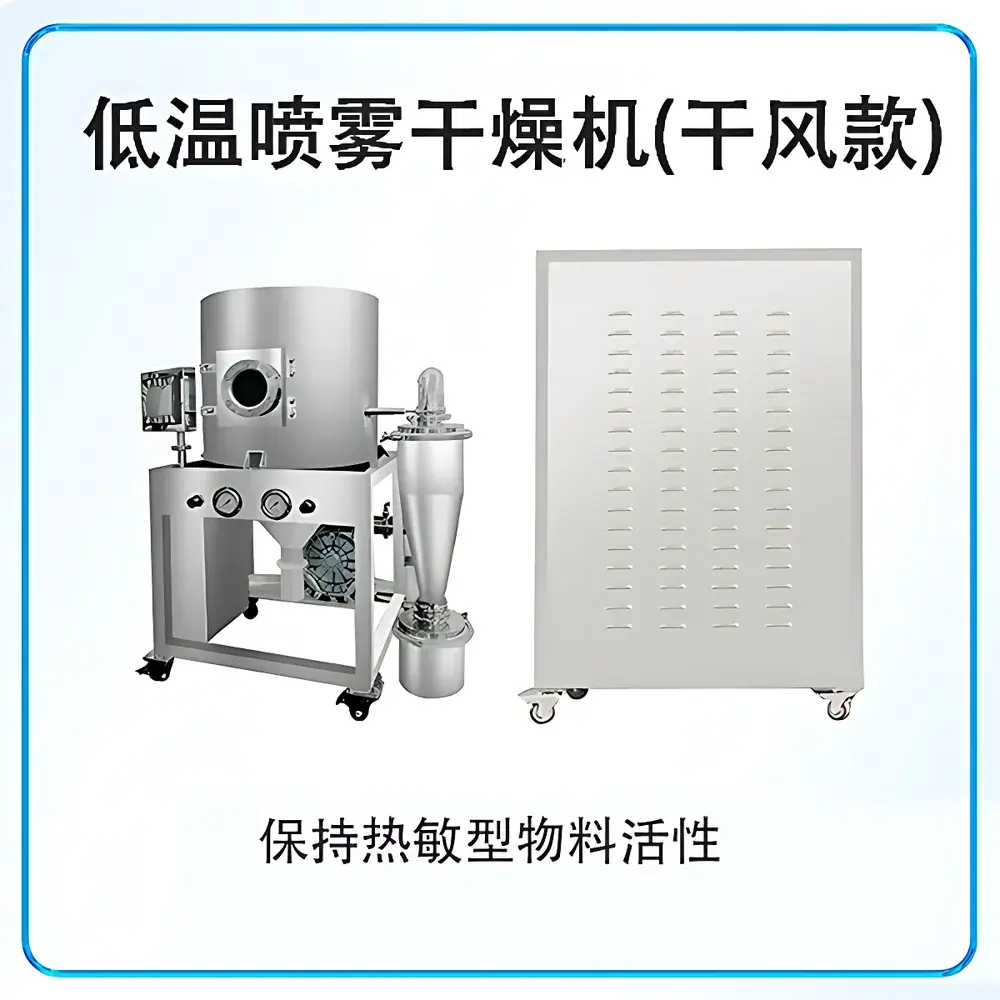
AnYuJie AYJ-GZJ5000D Low-Temperature Dry-Air Spray Dryer
| Brand | AnYuJie |
|---|---|
| Origin | Zhejiang, China |
| Model | AYJ-GZJ5000D |
| Sample Types | Aqueous solutions, emulsions, suspensions |
| Max. Feed Rate | 5000 mL/h |
| Temperature Range | Low-temp mode: ambient to 80°C (±0.5°C accuracy with temperature curve logging) |
| High-temp mode | ambient to 280°C (±0.5°C accuracy with curve logging) |
| Outlet Temperature Range | ambient to 100°C (±0.5°C) |
| Particle Size Distribution | 5–250 µm |
| Atomization Nozzle | 316 stainless steel two-fluid nozzle (interchangeable orifices: 0.5 / 0.75 / 1.0 / 2.0 mm) |
| Drying Chamber Diameter | 800 mm |
| Airflow Range | 0–420 m³/h |
| Atomization Pressure | 0–0.6 MPa |
| Heating Power | 6000 W |
| Dehumidification Power | 2 × 2000 W |
| Integrated Oil-Free Compressor | Yes |
| Built-in Condensation & Moisture Recovery System | Yes |
| Safety Protections | Overheat, overpressure, voltage stabilization, and leakage current monitoring with auto-shutdown |
Overview
The AnYuJie AYJ-GZJ5000D Low-Temperature Dry-Air Spray Dryer is an engineered laboratory-scale system designed for thermally sensitive material processing—particularly where conventional high-temperature spray drying risks degradation, denaturation, or oxidation. Unlike standard spray dryers relying on hot air convection alone, this unit integrates a dual-mode thermal management architecture: a precision-controlled low-temperature drying pathway (ambient to 80°C) combined with a high-temperature operational mode (up to 280°C), both governed by PID-driven digital regulation with ±0.5°C accuracy and real-time temperature curve memory. The core drying principle employs atomization of liquid feed into fine droplets via a two-fluid (liquid + compressed air) nozzle, followed by rapid solvent evaporation in a controlled dry-air stream within a 800 mm diameter stainless-steel drying chamber. Critical to its low-thermal-stress capability is the integrated refrigerated condensation system, which recovers evaporated moisture *in situ*, maintaining consistent dew point control and minimizing residual humidity in the drying gas—thereby enabling stable operation at sub-boiling temperatures without compromising powder yield or morphology.
Key Features
- 7-inch capacitive touchscreen HMI with RS232 interface for external data logging and remote supervision
- Full 304 stainless-steel construction—including seamless welded chamber interior and double-jacketed heating system—ensuring corrosion resistance, cleanability, and thermal uniformity
- Dual thermal mode operation: switchable between low-temperature (ambient–80°C) and high-temperature (ambient–280°C) drying profiles, each with independent calibration and curve memory
- Integrated oil-free air compressor (low-noise, maintenance-free design) supplying atomizing air up to 0.6 MPa, digitally adjustable and continuously monitored
- Automated needle-clearing mechanism with programmable frequency and pressure for unattended nozzle maintenance during extended runs
- Two-stage dehumidification: primary condensation recovery + secondary active exhaust moisture removal (2 × 2000 W), ensuring stable inlet air dew point below 10°C
- Modular cyclone separator and drying tower sections—fully disassemblable for GMP-compliant cleaning and residue inspection
- Comprehensive safety architecture: real-time leakage current detection, overtemperature cutoff, voltage fluctuation compensation, and emergency shutdown protocol compliant with IEC 61000-4 standards
- Mobile device synchronization via embedded Ethernet/Wi-Fi module—enabling remote parameter adjustment, status monitoring, and alarm notification without local operator presence
Sample Compatibility & Compliance
The AYJ-GZJ5000D accommodates a broad spectrum of heat-labile feedstocks including protein solutions, enzyme suspensions, probiotic emulsions, polymer dispersions, and pharmaceutical nanosuspensions. Its low-temperature capability supports drying of materials requiring preservation of tertiary structure (e.g., monoclonal antibodies), volatile actives (e.g., essential oils), or oxidation-prone compounds (e.g., polyphenols). All wetted surfaces conform to ASTM A240 304/316 stainless-steel specifications. The system supports audit-ready operation under GLP and cGMP environments through traceable parameter logging (timestamped temperature, pressure, airflow, and feed rate), with optional 21 CFR Part 11-compliant software add-ons available for electronic signature and data integrity validation. CE marking and RoHS compliance are certified per EN 61000-6-2/6-4 and EN 61326-1.
Software & Data Management
The embedded control firmware records all critical process variables—including inlet/outlet temperature profiles, atomization pressure, feed pump speed, airflow volume, and condensate mass—at 1-second intervals. Data export is supported in CSV and Excel-compatible formats via USB or RS232. The curve memory function stores up to 100 user-defined drying protocols with version timestamps, enabling strict batch reproducibility. Optional cloud-based dashboard integration allows centralized fleet monitoring, predictive maintenance alerts (based on compressor runtime and condenser load trends), and automated report generation aligned with ISO 9001 documentation requirements.
Applications
- Pharmaceutical R&D: Production of inhalable dry powders, amorphous solid dispersions, and lyophilization-alternative formulations
- Food & Nutraceuticals: Encapsulation of probiotics, vitamins, and omega-3 oils with minimized thermal damage
- Materials Science: Synthesis of ceramic precursors, metal-organic framework (MOF) microspheres, and battery cathode precursors
- Biotechnology: Stabilization of labile enzymes, vaccines, and extracellular vesicles for downstream characterization
- Academic Research: Parametric studies on droplet evaporation kinetics, particle morphology evolution, and glass transition behavior under controlled humidity
FAQ
Can this dryer operate continuously for >8 hours without manual intervention?
Yes—equipped with auto-clean nozzle cycling, self-regulating dehumidification, and fault-tolerant power management, it supports unattended overnight operation when pre-configured with validated protocols.
Is the particle size distribution affected by switching between low- and high-temperature modes?
No—particle size is primarily governed by feed concentration, nozzle orifice, atomization pressure, and airflow velocity; temperature mode selection influences residual moisture and crystallinity, not median diameter.
What validation documentation is provided for regulatory submissions?
Factory-installed IQ/OQ documentation packages—including as-built schematics, sensor calibration certificates (NIST-traceable), and FAT reports—are supplied. PQ support and 21 CFR Part 11 readiness can be commissioned separately.
How is moisture recovery efficiency quantified?
Condensate volume is measured gravimetrically post-run; typical recovery exceeds 85% of theoretical water content for aqueous feeds at ≤60°C inlet conditions.
Does the system meet explosion-proof requirements for organic solvent handling?
Standard configuration is rated for non-flammable aqueous systems only; ATEX-certified variants with inert gas purging and intrinsically safe controls are available under custom engineering order.
Related Products



