
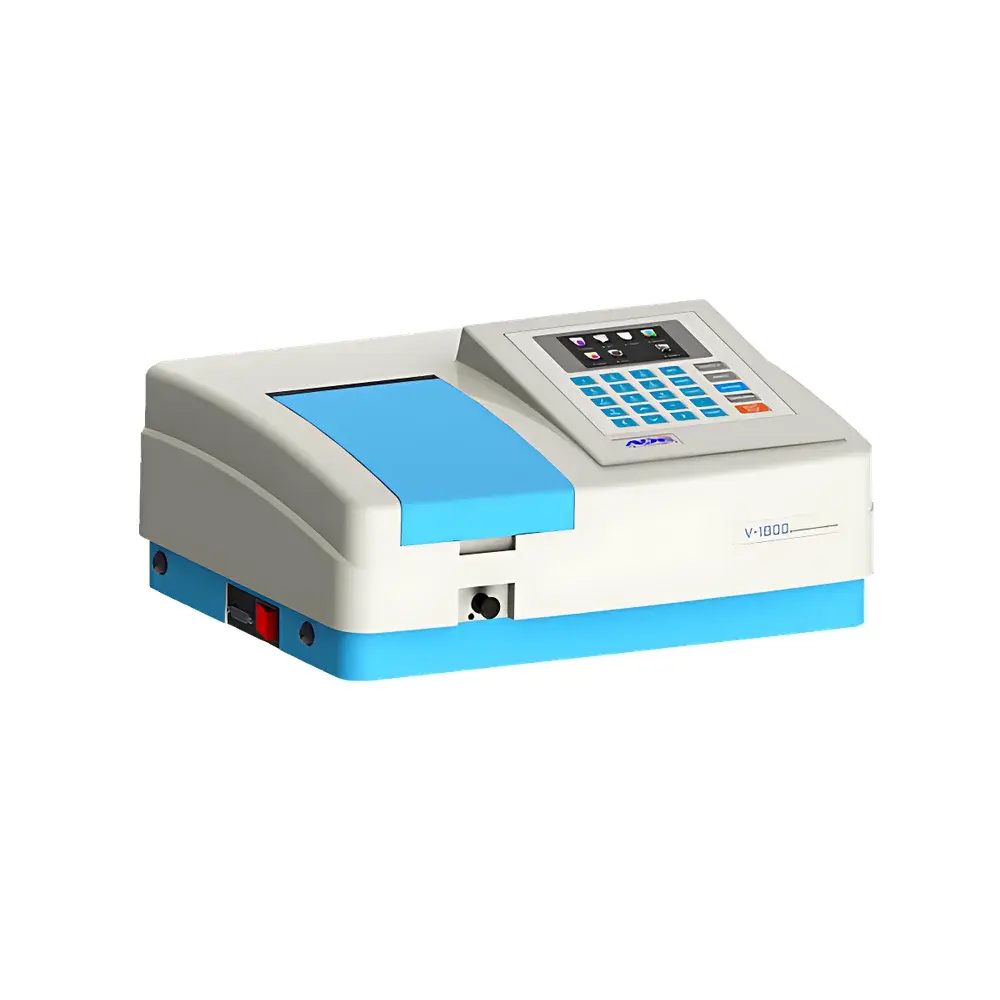
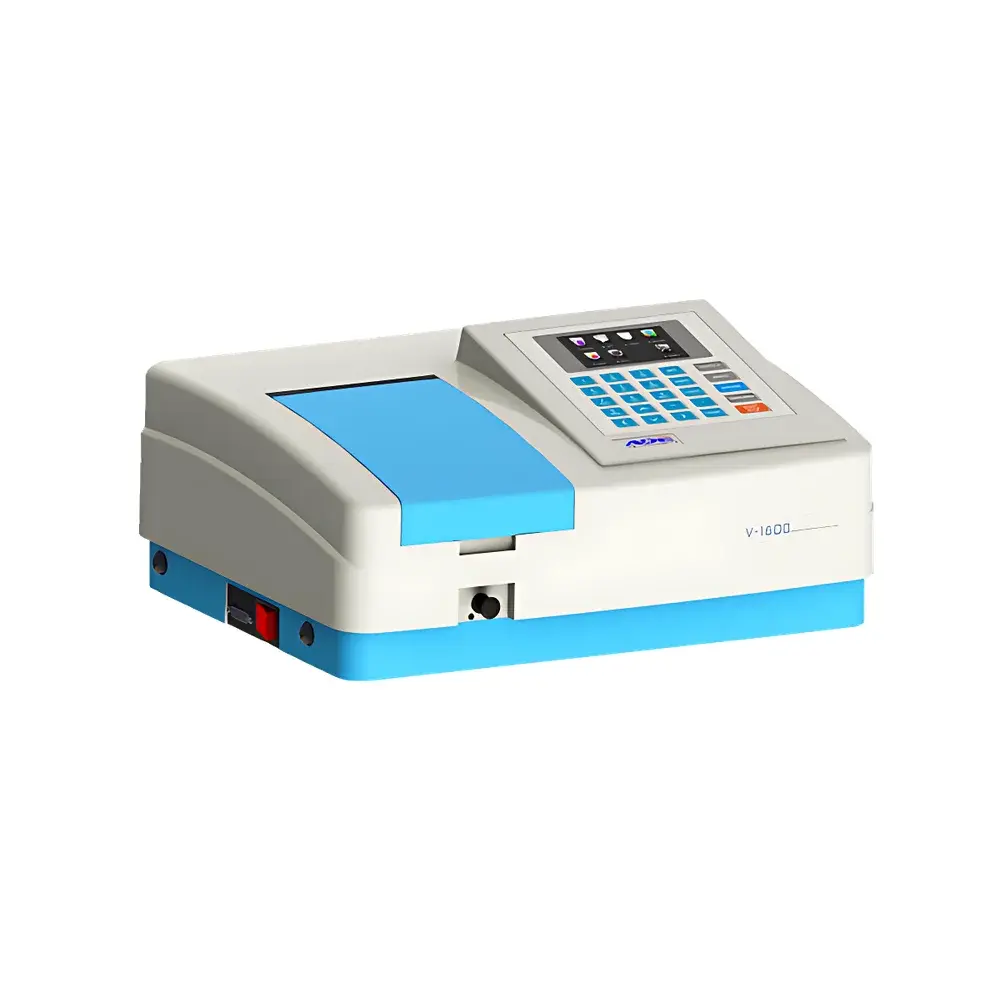
AOE V-1600 Visible Spectrophotometer
| Brand | AOE |
|---|---|
| Origin | Shanghai, China |
| Model | V-1600 |
| Optical System | Pseudo-Double-Beam |
| Detector Type | Photocell |
| Wavelength Range | 320–1100 nm |
| Wavelength Accuracy | ±0.4 nm |
| Spectral Bandwidth | 4.0 nm |
| Stray Light | ≤0.04%T |
| Wavelength Scanning Mode | Automatic |
| Display | 480 × 272 TFT Color LCD (65K colors) |
| Data Storage | 240 calibration curves (240 data points per curve) onboard |
| Interface | Dual USB 2.0 ports (data export & printer connectivity), USB 1.0 for PC communication |
| Software | AOE Basic Spectroscopy Software (certified under PRC Copyright Registration No. 2021SRXXXXXX) |
| Compliance | ISO 9001, CE, CMC, RoHS |
Overview
The AOE V-1600 Visible Spectrophotometer is a precision optical instrument engineered for quantitative absorption measurement in the visible and near-visible spectral region (320–1100 nm). It operates on a pseudo-double-beam optical architecture—utilizing a high-efficiency holographic grating (1200 lines/mm) and real-time reference beam ratio monitoring—to minimize photometric drift and enhance baseline stability during extended measurements. Unlike single-beam systems requiring manual reference correction, the V-1600 automatically compensates for lamp intensity fluctuations and detector sensitivity variations, delivering high reproducibility in absorbance (A), transmittance (T), concentration (C), and energy (E) modes. Its fixed 4.0 nm spectral bandwidth ensures adequate resolution for routine colorimetric assays while maintaining sufficient radiant throughput for low-light samples. Designed for laboratory environments with moderate throughput requirements, the V-1600 serves as a robust platform for QC testing, educational instruction, and method development in chemistry, biochemistry, environmental science, and materials characterization.
Key Features
- Pseudo-double-beam optical design with real-time reference beam compensation for improved photometric stability and reduced baseline drift
- High-resolution 480 × 272 TFT color display (65K colors) supporting intuitive menu navigation and real-time spectral preview
- Onboard data management: stores up to 240 calibration curves, each containing 240 absorbance or concentration data points
- Dual USB 2.0 interfaces: one dedicated for U-disk data export (CSV format), the other for direct connection to PCL-compatible printers supporting A4 paper output
- USB 1.0 port for host PC communication and remote control via AOE Basic spectroscopy software
- Firmware upgrade capability via USB flash drive using official firmware packages downloaded from AOE’s secure support portal (instrument serial number required)
- Compliance with international quality and safety standards including ISO 9001:2015, CE Directive 2014/30/EU (EMC), and RoHS 2011/65/EU
Sample Compatibility & Compliance
The V-1600 accommodates standard 10 mm pathlength cuvettes (glass, quartz, or plastic) and supports both liquid and solid transmission measurements. Its wavelength range (320–1100 nm) covers common chromophores used in pharmaceutical dissolution testing (e.g., paracetamol at 243 nm—note: UV extension requires optional quartz optics not included in base configuration), dye quantification (e.g., methylene blue at 664 nm), enzyme kinetics (NADH at 340 nm), and water quality analysis (nitrate at 220 nm, though UV performance is limited by optical component specifications). While the instrument meets CMC (China Metrology Certification) and complies with ISO/IEC 17025 traceability frameworks for routine calibration verification, users performing regulated work under GLP or GMP must validate its performance against ASTM E275, ISO 6059, or USP where applicable. The device does not natively support 21 CFR Part 11 audit trails; however, raw data exported via USB can be archived within validated LIMS or ELN systems meeting regulatory documentation requirements.
Software & Data Management
The AOE Basic Spectroscopy Software—registered with the China National Copyright Administration (Certificate No. 2021SRXXXXXX)—provides full instrument control, spectral acquisition, multi-point calibration, and kinetic scan functionality. It enables creation of linear and polynomial calibration curves, automatic dilution factor application, and batch reporting. All measurement metadata—including date/time stamp, operator ID (manually entered), cuvette pathlength, and wavelength settings—is embedded in exported CSV files. The software runs on Windows 7/10/11 (32- and 64-bit) and communicates exclusively via USB 1.0 virtual COM port. No cloud synchronization or network deployment options are available; all data handling remains local to ensure compliance with institutional data sovereignty policies. Firmware updates do not alter software versioning—software and firmware are maintained as independent release streams.
Applications
- Routine quantitative analysis of dyes, pigments, and colored compounds in textile, food, and cosmetic industries
- Enzyme activity assays involving NAD(P)H or DCIP-based redox indicators
- Water and wastewater testing for iron (1,10-phenanthroline method at 510 nm), phosphate (molybdenum blue at 880 nm), and turbidity (via formazin standard at 400–600 nm)
- Pharmaceutical excipient and active ingredient verification per pharmacopoeial monographs (e.g., BP, EP, ChP)
- Academic teaching labs for Beer-Lambert law validation, equilibrium constant determination, and spectral deconvolution exercises
- Quality control of optical filters, LED emission profiles, and solar cell coating transparency
FAQ
Does the V-1600 support UV measurements below 320 nm?
No. The standard configuration uses optical components optimized for visible light; UV transmission requires fused silica optics and a deuterium lamp, which are not integrated into this model.
Can the instrument perform time-scan or kinetic measurements?
Yes—when operated via AOE Basic software, the V-1600 supports time-based absorbance monitoring at fixed wavelengths with user-defined intervals (minimum 0.5 s per point).
Is the software validated for use in FDA-regulated environments?
The AOE Basic software is not pre-validated to 21 CFR Part 11. Users must perform their own risk-based validation—including electronic signature implementation, audit trail review, and backup procedures—prior to deployment in regulated workflows.
What is the maximum sampling rate for wavelength scanning?
At 4.0 nm bandwidth and default step resolution (1 nm), full-range scanning (320–1100 nm) completes in approximately 80 seconds with typical photometric settling.
How is wavelength accuracy verified during routine operation?
Users may verify calibration using NIST-traceable holmium oxide or didymium glass filters, following procedures outlined in ISO 6059 or manufacturer-recommended protocols.






