
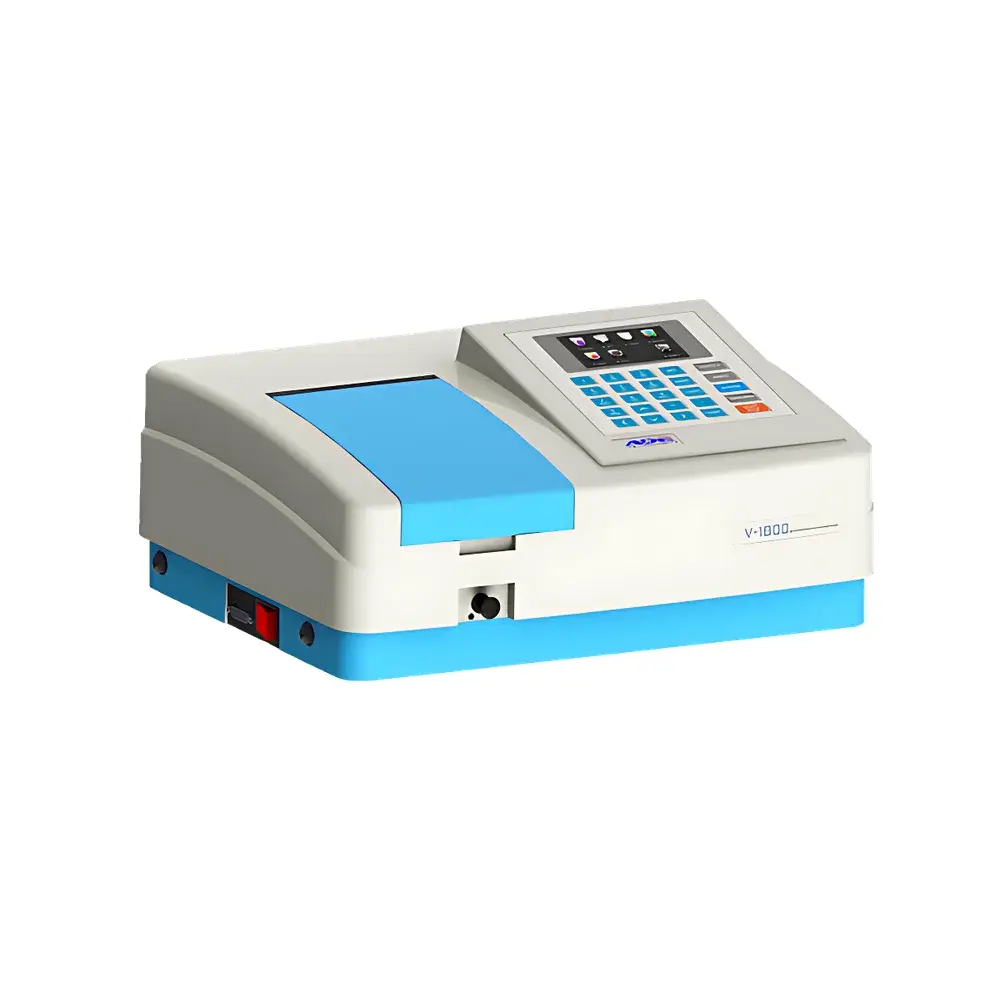
AOE V-1800 Visible Spectrophotometer
| Brand | AOE |
|---|---|
| Origin | Shanghai, China |
| Manufacturer Type | Authorized Distributor |
| Country of Origin | China |
| Model | V-1800 |
| Price Range | USD 1,400–2,800 (FOB) |
| Optical System | Pseudo-Double-Beam |
| Detector Type | Silicon Photocell |
| Wavelength Range | 320–1100 nm |
| Wavelength Scanning | Motorized Auto-Scanning |
| Spectral Bandwidth | 1.8 nm |
| Wavelength Accuracy | ±0.4 nm |
| Stray Light | ≤0.04% T @ 220 nm & 360 nm |
Overview
The AOE V-1800 Visible Spectrophotometer is a precision optical instrument engineered for quantitative and qualitative analysis in the visible and near-ultraviolet spectral region (320–1100 nm). Based on a pseudo-double-beam optical architecture—featuring a high-efficiency holographic grating (1200 lines/mm) and real-time reference beam ratio monitoring—the V-1800 compensates for source intensity drift and detector sensitivity fluctuations during measurement, significantly enhancing photometric stability and long-term reproducibility. Unlike single-beam systems requiring manual baseline correction, this design enables rapid, drift-corrected absorbance (A), transmittance (T), concentration (C), and energy (E) measurements without recalibration between samples. Its fixed 1.8 nm spectral bandwidth ensures optimal resolution for routine colorimetric assays, enzyme kinetics, and standard solution analysis in academic teaching labs, QC environments, and industrial R&D settings where regulatory compliance and method traceability are essential.
Key Features
- High-resolution 480 × 272 TFT color LCD display with 65K-color rendering, enabling intuitive graphical visualization of spectra, calibration curves, and real-time data trends.
- Onboard data storage supporting up to 240 calibration curves, each accommodating 240 individual sample measurements—eliminating dependency on external PCs for routine operation.
- Dual USB 2.0 ports: one dedicated to U-disk data export (CSV format), the other for direct connection to PCL-compatible printers capable of full A4-page reporting—including sample ID, date/time stamp, wavelength, absorbance, and curve metadata.
- Firmware upgrade capability via encrypted firmware packages downloaded from the official AOE support portal; validated by instrument serial number and applied via USB flash drive with automated integrity verification.
- Compliance-certified optical platform: certified to ISO 9001:2015 (Quality Management Systems), CE Mark (EU Machinery Directive 2006/42/EC and EMC Directive 2014/30/EU), China Metrology Certification (CMC), and RoHS 2011/65/EU for hazardous substance restriction.
- Bundled Basic Spectral Analysis Software v3.2, registered under the People’s Republic of China National Copyright Administration (Registration No.: 2022SR0128845), ensuring licensed, auditable software deployment aligned with intellectual property governance requirements in regulated laboratories.
Sample Compatibility & Compliance
The V-1800 accommodates standard 10 mm pathlength quartz or optical glass cuvettes (including matched pairs for dual-beam referencing), as well as disposable plastic cuvettes for high-throughput screening. It supports liquid, colloidal, and transparent solid film samples within optical density limits of 0–3.0 Abs (equivalent to 0–0.1% T at 360 nm). The system meets fundamental performance criteria outlined in ISO 6223:2020 (Spectrophotometers — Performance specifications for instruments used in chemical analysis) and ASTM E275-22 (Standard Practices for Describing and Measuring Performance of Ultraviolet, Visible, and Near-Infrared Spectrophotometers). While not FDA 21 CFR Part 11–compliant out-of-the-box, its audit-trail-capable firmware logging (timestamped measurement records, user ID tagging, and version-controlled calibration logs) provides foundational infrastructure for GLP/GMP-aligned validation protocols when deployed with documented SOPs.
Software & Data Management
The included Basic Spectral Analysis Software enables PC-based spectral acquisition, multi-point calibration (linear, quadratic, and polynomial fitting), kinetic time-scan mode, and peak search/analysis. All exported datasets conform to ANSI X3.4–1986 ASCII encoding and include embedded metadata headers (instrument model, serial number, lamp hours, wavelength range, bandwidth, and operator ID). USB-exported files are compatible with Microsoft Excel, OriginLab, and MATLAB for secondary statistical processing. Firmware-level data integrity safeguards include cyclic redundancy check (CRC-16) on all stored curves and write-protection for factory calibration coefficients. Software license activation requires hardware-bound authentication, preventing unauthorized duplication across instruments.
Applications
- Quantitative determination of transition metal ions (e.g., Fe²⁺/Fe³⁺, Cu²⁺, Cr⁶⁺) using established colorimetric reagents per APHA Standard Methods 3111B.
- Enzyme activity assays (e.g., LDH, ALP, AST) following IFCC-recommended reaction conditions at defined wavelengths (340 nm, 405 nm).
- Pharmaceutical excipient purity testing per USP UV-Visible Spectroscopy guidelines for identity and assay verification.
- Water quality parameter analysis (nitrate, phosphate, silicate) in environmental labs accredited to ISO/IEC 17025:2017.
- Academic instruction in analytical chemistry: Beer-Lambert law validation, spectral scanning, and method development exercises.
FAQ
What is the difference between “pseudo-double-beam” and true double-beam optics?
The V-1800 uses a single monochromator with a rotating mirror to alternate light paths between sample and reference beams at high frequency (~50 Hz), rather than splitting the beam simultaneously. This achieves comparable baseline stability to true double-beam systems while reducing optical complexity and cost.
Does the V-1800 support GLP-compliant electronic records?
While the instrument itself does not provide full 21 CFR Part 11–compliant electronic signatures or biometric login, its timestamped, user-tagged measurement logs and firmware-controlled calibration history serve as auditable raw data for GLP documentation when integrated into a validated laboratory information management system (LIMS).
Can I use third-party cuvettes with this spectrophotometer?
Yes—standard 10 mm square cuvettes with optical path tolerance ≤±0.02 mm are fully compatible. However, for highest accuracy in absorbance quantitation, matched quartz cuvettes (certified ΔA ≤0.002) are recommended for reference/sample pairing.
Is the software compatible with Windows 11 and macOS?
The Basic software is natively supported on Windows 7–11 (64-bit); macOS compatibility requires virtualization or Wine-based emulation—AOE does not provide native macOS drivers.
How often should wavelength accuracy be verified?
Per ISO 6223:2020, wavelength verification using holmium oxide or didymium filters is recommended before each analytical batch or at least daily in continuous-use environments. The V-1800 includes built-in filter-check routines accessible via service mode.




