
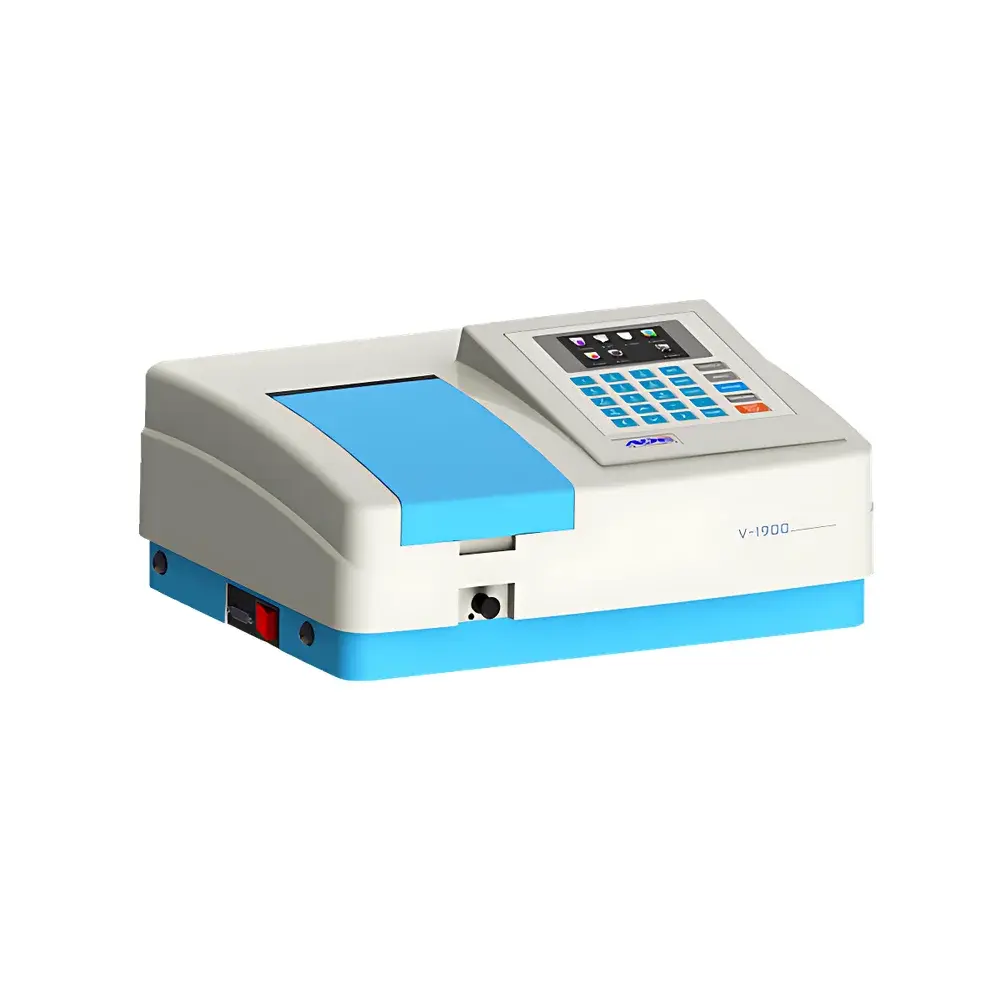
AOE V-1900 Scanning Visible Spectrophotometer
| Brand | AOE |
|---|---|
| Origin | Shanghai, China |
| Manufacturer Type | Authorized Distributor |
| Product Origin | Domestic (China) |
| Model | V-1900 |
| Price Range | USD 2,800 – 4,200 (FOB Shanghai) |
| Optical Design | Single-Beam with Dual-Beam Ratio Monitoring |
| Detector | Silicon Photocell |
| Wavelength Range | 320–1100 nm |
| Wavelength Scanning Mode | Automatic |
| Spectral Bandwidth | 1.8 nm |
| Wavelength Accuracy | ±0.4 nm |
| Wavelength Repeatability | ≤0.2 nm |
| Stray Light | ≤0.04% T @ 360 nm and 600 nm |
| Display | 480 × 272 pixel, 65K-color TFT LCD |
| Data Storage | Onboard memory for 240 calibration curves (240 data points per curve) |
| Data Export | USB 2.0 × 2 (for printer & storage), USB 1.0 for PC connectivity |
| Software | AOE Basic Spectroscopy Software (certified under China Copyright Protection Center, Registration No. 2021SRXXXXXX) |
| Compliance | ISO 9001:2015, CE, CMC (China Metrology Certification), RoHS Directive 2011/65/EU |
Overview
The AOE V-1900 Scanning Visible Spectrophotometer is a precision single-beam optical instrument engineered for quantitative and qualitative analysis in the visible and near-UV spectral region (320–1100 nm). It employs a high-efficiency holographic grating (1200 lines/mm) coupled with dual-beam ratio monitoring to compensate for source intensity drift and detector sensitivity variation—effectively delivering the stability and reproducibility expected from dual-beam architectures while retaining the optical simplicity and cost efficiency of a single-beam design. The instrument operates on Beer–Lambert law principles, measuring absorbance (A), transmittance (%T), concentration (C), and energy (E) across user-defined wavelength ranges. Its 1.8 nm spectral bandwidth ensures adequate resolution for routine applications in pharmaceutical QC, environmental water testing, food colorant analysis, and academic teaching laboratories where regulatory traceability and method robustness are essential.
Key Features
- High-resolution 480 × 272 pixel, 65K-color TFT LCD display with intuitive icon-based navigation and real-time spectral preview
- Onboard data management: stores up to 240 calibration curves, each supporting 240 measurement points—eliminating dependency on external PCs during routine operation
- Dual USB 2.0 ports: one dedicated to PCL-compatible A4 thermal or dot-matrix printers (direct report printing), the other for U-disk data export in CSV format
- Firmware upgradability via USB: users download verified firmware packages from the official AOE support portal using the instrument’s unique serial number; updates apply seamlessly without service intervention
- Compliance-ready architecture: preconfigured audit trail logging (user ID, timestamp, parameter changes, measurement events) supports GLP-aligned workflows and internal QA documentation
- Optical path sealed and purged with ambient air—no desiccant or purge gas required—reducing maintenance overhead in standard laboratory environments
Sample Compatibility & Compliance
The V-1900 accepts standard 10 mm square cuvettes (glass, quartz, or plastic) and accommodates optional 5 mm, 20 mm, and 50 mm pathlength cells via accessory holders. It complies with international metrological and safety standards including ISO 9001:2015 (quality management), CE marking per EU Machinery and EMC Directives, China Metrology Certification (CMC), and RoHS 2011/65/EU for hazardous substance restriction. While not FDA 21 CFR Part 11–validated out-of-the-box, its software architecture—including password-protected method editing, electronic signature fields in printed reports, and immutable raw data export—enables customers to implement supplementary procedural controls required for regulated environments (e.g., ISO/IEC 17025 testing labs).
Software & Data Management
The included AOE Basic Spectroscopy Software (registered with the China National Copyright Administration, Certificate No. 2021SRXXXXXX) provides full instrument control, spectral scanning, kinetic measurement, multi-wavelength quantitation, and derivative analysis. All spectral scans and calibration data are timestamped and stored with metadata (operator ID, date/time, lamp hours, wavelength calibration status). Raw absorbance and transmittance values export in ASCII-compliant CSV format—compatible with LIMS integration, Microsoft Excel, OriginLab, and Python-based analytical pipelines. The software supports method templates conforming to ASTM E275, ISO 6226, and USP spectrophotometric assay guidelines.
Applications
- Pharmaceutical: assay of active pharmaceutical ingredients (APIs) per USP monographs requiring visible-range quantification (e.g., paracetamol, riboflavin)
- Environmental: determination of nitrate, phosphate, and iron concentrations in surface and wastewater using colorimetric reagents (e.g., phenanthroline, molybdenum blue)
- Food & Beverage: measurement of anthocyanin content in fruit juices, caramel color intensity (E150), and chlorophyll degradation in processed vegetables
- Academic Research: kinetics studies of dye decolorization, enzyme-catalyzed reactions, and ligand-binding equilibria in undergraduate and graduate chemistry curricula
- Quality Control: incoming raw material verification, batch release testing, and stability-indicating assays where linearity, repeatability, and inter-laboratory comparability are critical
FAQ
Does the V-1900 support GLP-compliant data integrity requirements?
Yes—the instrument logs all critical events (calibration, measurement, parameter change) with timestamps and operator IDs. When used with defined SOPs and printed reports bearing manual signatures, it meets core GLP data recording expectations.
Can I perform wavelength calibration verification using NIST-traceable filters?
Yes. The V-1900 includes a built-in filter verification mode compatible with Holmium oxide (Ho₂O₃) and Didymium reference filters for periodic wavelength accuracy checks per ISO 17025 Clause 6.5.2.
Is the software compatible with Windows 11 and macOS?
The AOE Basic software is natively supported on Windows 7 through Windows 11 (64-bit). macOS compatibility is achieved via virtualized Windows environments (e.g., Parallels Desktop); native macOS drivers are not provided.
What is the typical warm-up time before photometric measurements meet specification?
The tungsten-halogen lamp requires ≤15 minutes to stabilize intensity and spectral output. After warm-up, photometric noise remains ≤0.002 A at 500 nm (1.000 A load), satisfying ISO 10110-5 stability criteria.
How often does the instrument require factory recalibration?
Annual verification against certified reference materials is recommended. Full recalibration—including grating alignment and detector linearity—is advised every 24 months or after mechanical shock, lamp replacement, or sustained deviation from performance specifications.



