
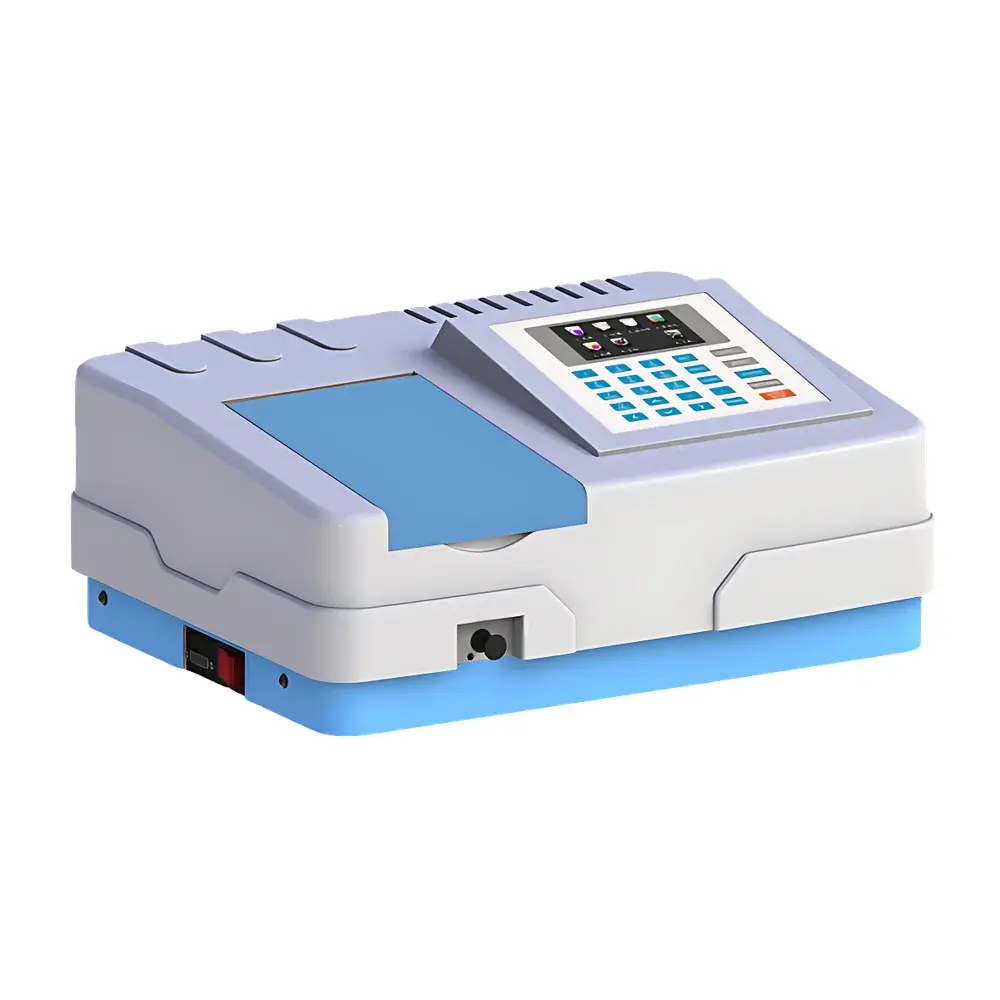
AOE A380 Scanning Ultraviolet-Visible Spectrophotometer
| Brand | AOE |
|---|---|
| Origin | Shanghai, China |
| Manufacturer Type | Authorized Distributor |
| Product Origin | Domestic (China) |
| Model | A380 |
| Price Range | USD 4,200–7,000 (FOB Shanghai) |
| Optical Design | Pseudo-Double-Beam |
| Detector Type | Silicon Photocell |
| Wavelength Range | 190–1100 nm |
| Wavelength Scanning | Motorized Auto-Scanning |
| Spectral Bandwidth | 1.8 nm |
| Wavelength Accuracy | ±0.3 nm |
| Stray Light | ≤0.03% T @ 220 nm & 360 nm |
Overview
The AOE A380 Scanning Ultraviolet-Visible Spectrophotometer is a precision optical instrument engineered for quantitative and qualitative analysis across the ultraviolet, visible, and near-infrared spectral regions (190–1100 nm). Based on a pseudo-double-beam optical architecture with real-time reference beam monitoring, the A380 compensates for source intensity drift and detector sensitivity variation during measurement—enhancing baseline stability and long-term photometric reproducibility. Its high-efficiency 1200-lines/mm holographic grating delivers consistent dispersion and minimal aberration, while the motorized wavelength drive enables programmable, step-scan or continuous spectral acquisition with ±0.3 nm absolute accuracy and ≤0.1 nm repeatability. Designed for routine laboratory use in QC, R&D, and academic teaching environments, the A380 meets fundamental performance requirements aligned with ISO 9001 quality management systems and supports compliance-ready operation under GLP and basic GMP frameworks.
Key Features
- Pseudo-double-beam optical path with dynamic reference correction, minimizing photometric drift during extended scans or multi-sample sequences
- High-resolution 6.5K-color TFT display (800 × 480 pixels) with intuitive graphical interface for real-time spectrum visualization and parameter configuration
- Onboard data storage capacity: up to 240 calibration curves, each supporting up to 240 absorbance/transmittance measurements
- Dual USB 2.0 ports: one dedicated for U-disk data export (CSV, TXT), the other for direct connection to PCL-compatible printers (A4 format support)
- Firmware upgrade capability via encrypted firmware packages downloaded from AOE’s official support portal using instrument serial number authentication
- Compliance-certified design: CE-marked, ISO 9001:2015 certified, CMC licensed (China Metrology Certification), RoHS-compliant, and registered with China’s National Copyright Administration (Software Copyright No. 2021SRXXXXXX)
Sample Compatibility & Compliance
The A380 accommodates standard 10 mm square cuvettes (quartz for UV, optical glass for visible/NIR), as well as optional micro-volume adapters and fixed-pathlength flow cells for process-compatible applications. It supports all common photometric modes: Absorbance (A), Transmittance (%T), Concentration (C), and Energy (E). The instrument’s stray light performance (≤0.03% T at 220 nm and 360 nm) satisfies ASTM E275 and ISO 6223 criteria for UV-Vis spectrophotometers used in pharmaceutical excipient testing and water quality analysis. While not pre-configured for 21 CFR Part 11 compliance, its audit-trail-capable software architecture permits integration into validated environments when deployed with controlled access protocols and external electronic lab notebook (ELN) systems.
Software & Data Management
The included Basic Spectroscopy Software (v3.2+) provides full control of scanning parameters, kinetic assays, multi-wavelength quantitation, and derivative spectroscopy. All raw spectra and processed results are timestamped and stored with metadata (operator ID, date/time, instrument SN, method name). Data export is native to CSV and plain-text formats for interoperability with MATLAB, OriginLab, or LIMS platforms. Firmware updates preserve user calibration files and method templates. Software licensing is bound to hardware serial number, preventing unauthorized duplication—a safeguard reinforced by national copyright registration in China.
Applications
- Pharmaceutical QA/QC: assay of active pharmaceutical ingredients (APIs), dissolution testing, and excipient purity verification per USP and EP 2.2.25
- Environmental analysis: nitrate, phosphate, and heavy metal ion quantification in wastewater per APHA Standard Methods 4500 series
- Food & beverage: color index measurement (e.g., AOAC 993.02), preservative concentration (e.g., benzoic acid), and antioxidant capacity (DPPH assay)
- Academic research: enzyme kinetics (e.g., NADH oxidation), polymer degradation studies, and nanoparticle size estimation via surface plasmon resonance band analysis
- Materials science: thin-film transmittance/reflectance profiling and bandgap estimation of semiconductor coatings
FAQ
Does the A380 support GLP-compliant data integrity?
Yes—the instrument logs operator ID, timestamp, method name, and calibration status for every measurement. When paired with controlled access and external ELN/LIMS, it fulfills core ALCOA+ principles (Attributable, Legible, Contemporaneous, Original, Accurate).
Can the A380 perform kinetic measurements?
Yes—time-scan mode enables up to 10,000 sequential readings at user-defined intervals (100 ms to 60 s), suitable for enzyme reaction monitoring and photochemical decay studies.
Is quartz cuvette required for all UV measurements?
Quartz (fused silica) cuvettes are mandatory for wavelengths below 340 nm; optical glass cuvettes are acceptable above 340 nm but introduce increasing absorption below 300 nm.
What is the maximum scan speed of the A380?
Standard scanning speed is 12,000 nm/min; high-speed mode reaches 24,000 nm/min with minor trade-offs in signal-to-noise ratio at narrow bandwidths.
Does the A380 include wavelength calibration verification tools?
Yes—built-in holmium oxide and didymium filters are supported for periodic wavelength accuracy validation per ISO/IEC 17025 guidelines.
Related Products





