
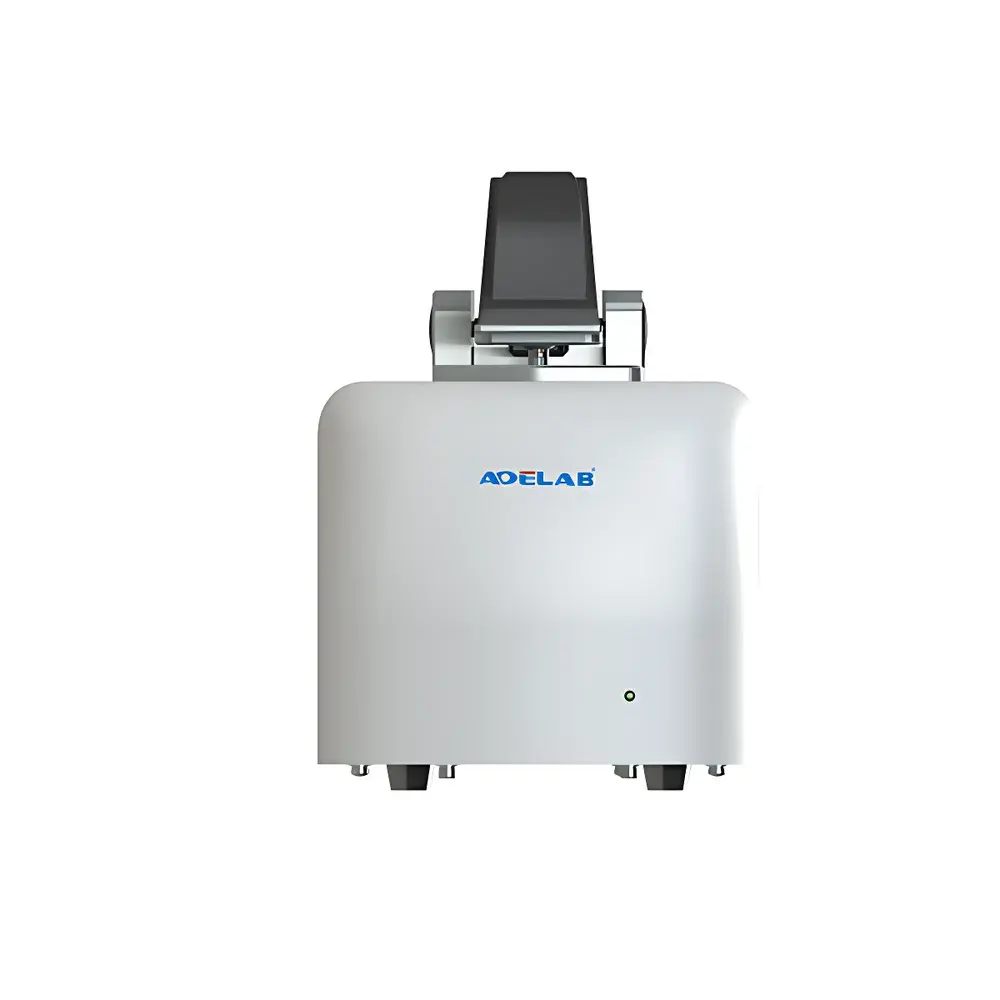
AOE ND500 Ultra-Micro Volume UV-Vis Spectrophotometer
| Brand | AOE |
|---|---|
| Origin | Shanghai, China |
| Manufacturer Type | Authorized Distributor |
| Country of Origin | China |
| Model | ND500 |
| Price Range | USD 9,500 – 13,600 (FOB Shanghai) |
| Optical Design | Single-Beam |
| Detector | 2048-Pixel Linear CCD Array |
| Wavelength Range | 185–910 nm |
| Wavelength Accuracy | ±1 nm |
| Spectral Bandwidth | 2 nm |
| Stray Light | ≤0.1% T at 220 nm and 340 nm |
| Photometric Accuracy | ±0.002 Abs (at 1 mm pathlength) |
| Minimum Sample Volume | 0.5 µL |
| dsDNA Detection Range | 2–15,000 ng/µL |
| Scan Speed | <0.5 s per full spectrum |
| Spectral Resolution | ≤1.8 nm FWHM (measured at Hg 253.7 nm line) |
| Light Source | Pulsed Xenon Lamp |
| Connectivity | USB 2.0, Wi-Fi 802.11 b/g/n |
| Software Update | USB Flash Drive–Based Firmware Upgrade (Lifetime Free) |
Overview
The AOE ND500 Ultra-Micro Volume UV-Vis Spectrophotometer is a single-beam, high-performance absorption spectrometer engineered for rapid, precise quantification and spectral characterization of nanoliter-volume biological and chemical samples. It operates on the fundamental principle of Beer–Lambert law-based absorbance measurement across a broad spectral range (185–910 nm), utilizing a pulsed xenon lamp as its broadband light source and a 2048-pixel linear CCD array detector to capture full spectra with high signal-to-noise ratio and excellent photometric linearity. Designed specifically for laboratories handling limited or high-value samples—such as purified nucleic acids, proteins, synthetic oligonucleotides, and small-molecule compounds—the ND500 eliminates the need for dilution or cuvette-based handling through its integrated microfluidic sample retention system. Its optical architecture supports both fixed-path (1.0 mm) and variable-pathlength measurements via automatic surface tension–driven liquid column formation, enabling accurate concentration determination across an exceptionally wide dynamic range (2–15,000 ng/µL for dsDNA).
Key Features
- Ultra-low sample consumption: Quantitative analysis from just 0.5 µL of undiluted sample, minimizing waste and preserving precious biosamples.
- High-fidelity spectral acquisition: Full-range scan (185–910 nm) completed in under 0.5 seconds with ≤1.8 nm spectral resolution (FWHM at Hg 253.7 nm).
- Pulsed xenon lamp: Provides stable, flicker-free illumination across deep UV to near-IR without warm-up delay or intensity drift; rated for >10⁹ flashes.
- Advanced photometric accuracy: ±0.002 Abs error at 1 mm pathlength, validated against NIST-traceable standards.
- Integrated magnetic stirring and optional temperature control (up to 45 °C) within the cuvette mode—enabling real-time kinetic monitoring and thermal stability studies.
- Wireless operational flexibility: Built-in Wi-Fi module supports remote instrument control and data streaming to tablets or laptops running Windows/macOS/iOS/Android.
- Future-proof firmware management: Lifetime-free USB flash drive–based software and firmware updates ensure compliance with evolving data integrity requirements.
Sample Compatibility & Compliance
The ND500 accommodates diverse sample types including double-stranded DNA, RNA, single-stranded oligos, proteins (A₂₈₀/A₂₆₀), peptides, dyes, nanoparticles, and small organic molecules. Its open-path microvolume mode accepts aqueous, buffered, or mildly viscous solutions (up to ~15 cP); the optional cuvette adapter supports standard 10-mm quartz cells with magnetic stirring and programmable heating. The instrument meets core optical performance criteria aligned with ISO 8579-1:2020 (UV-Vis spectrophotometer verification) and ASTM E275-22 (standard practices for UV-Vis-NIR spectrophotometry). Data output formats (CSV, PDF, XML) support traceability and integration into LIMS environments. Audit trail functionality—including user login timestamps, parameter change logs, and result export history—is configurable to align with GLP and FDA 21 CFR Part 11 readiness requirements when deployed with validated networked software.
Software & Data Management
The ND500 ships with AOE SpectraSuite™ v4.x—a modular, multi-platform application supporting quantitative analysis (nucleic acid/protein concentration, purity ratios A₂₆₀/A₂₈₀, A₂₆₀/A₂₃₀), spectral overlay, baseline correction, peak identification, and custom method storage. All data files include embedded metadata: instrument ID, date/time stamp, operator ID (optional), wavelength calibration status, and environmental conditions (if external sensor enabled). Local storage capacity is determined by host device (PC/tablet); cloud synchronization is supported via encrypted HTTPS upload to customer-controlled servers. Raw spectral data are stored in vendor-neutral CSV format with wavelength (nm) and absorbance (Abs) columns, facilitating third-party analysis in Python (NumPy/SciPy), MATLAB, or R.
Applications
- Routine QC of nucleic acid preparations in genomics core facilities and sequencing labs.
- Concentration and purity assessment of CRISPR guide RNAs, mRNA vaccines, and viral vector intermediates.
- Protein quantification and aggregation screening via A₂₈₀ and spectral shape analysis.
- Kinetic assays (e.g., enzyme activity, ligand binding) using time-resolved scanning in cuvette mode with magnetic agitation.
- Quality control of dye-labeled probes, fluorescent tags, and nanoparticle suspensions.
- Educational use in analytical chemistry and molecular biology curricula requiring hands-on UV-Vis fundamentals.
FAQ
What is the minimum detectable dsDNA concentration?
The ND500 reliably quantifies dsDNA down to 2 ng/µL using the 0.5 µL microvolume mode.
Can the instrument perform kinetic measurements?
Yes—when used with the optional thermostatted cuvette holder and magnetic stirrer, it supports time-course absorbance monitoring at user-defined intervals (100 ms to 60 min per point).
Is the firmware upgrade process validated for regulated environments?
Firmware updates are delivered as signed binary packages; installation logs record version, timestamp, and operator ID—supporting internal validation protocols for GxP environments.
Does the ND500 require annual recalibration?
No scheduled recalibration is required; however, wavelength and photometric accuracy verification using NIST-traceable holmium oxide and neutral density filters is recommended every 6–12 months per laboratory quality policy.
How is data integrity ensured during wireless transmission?
Wi-Fi communication uses TLS 1.2 encryption; all transmitted spectra and metadata are digitally signed prior to export to prevent tampering.




