
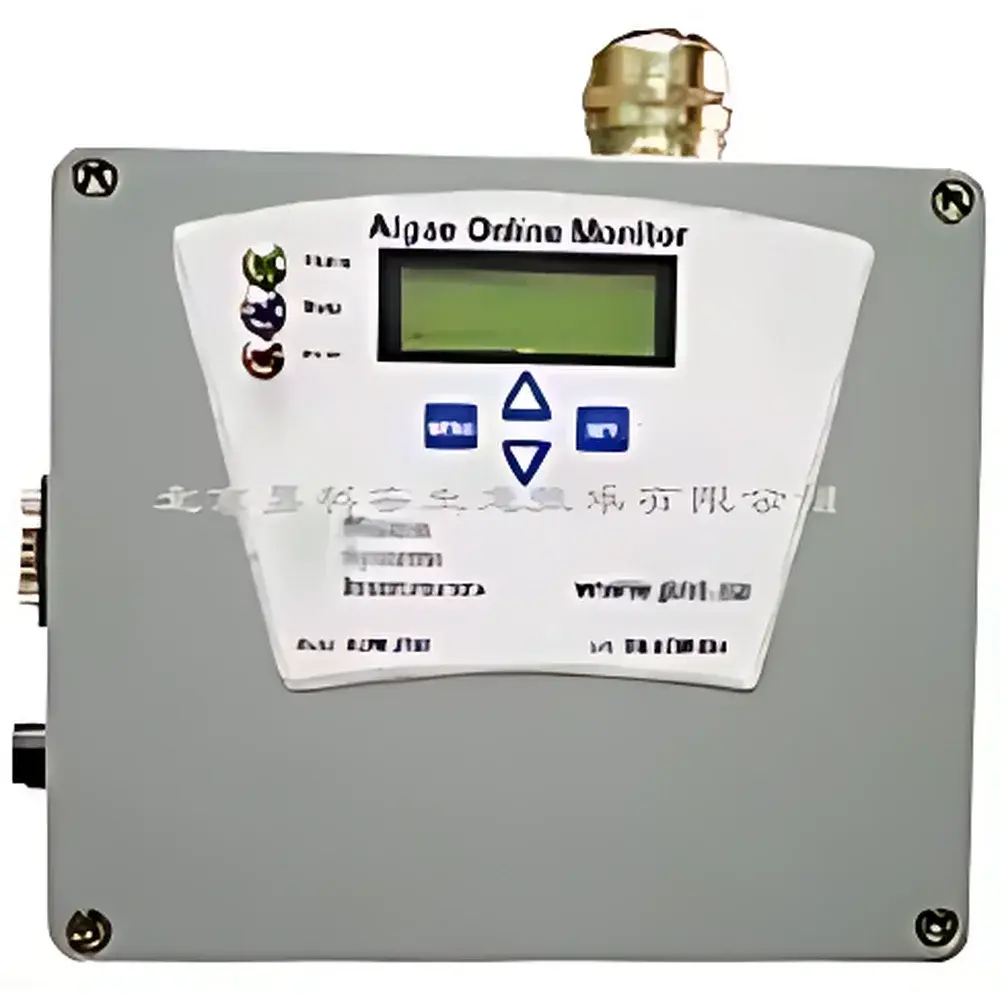
AOM Algal Fluorescence Online Monitor
| Origin | Imported |
|---|---|
| Manufacturer Type | Authorized Distributor |
| Model | AOM |
| Price | Available Upon Request |
| Detection Limit | Chlorophyll-a: 30 ng/L |
| Sensitivity | Green algae: 10 cells/mL |
| Cyanobacteria | 100 cells/mL |
| Measured Parameters | Fo, Ft, Fm, Fm′, OJIP transient, Turbidity |
| Actinic & Saturation Light Intensity | 0–3000 µE·m⁻²·s⁻¹ (adjustable) |
| Optical Detector | Photodiode with 660–750 nm bandpass filter |
| Data Interface | RS-232 or USB |
| Onboard Memory | 8 MB integrated data logger |
| IP Rating | IP65 |
| Operating Temperature | 0–45 °C |
| Dimensions | 198 × 60 × 295 mm |
| Weight | 1.8 kg |
Overview
The AOM Algal Fluorescence Online Monitor is a field-deployable, high-sensitivity instrument engineered for real-time, non-invasive quantification of phytoplankton photosynthetic activity in natural and engineered water systems. It operates on the principle of Pulse-Amplitude Modulated (PAM) fluorometry, enabling precise measurement of chlorophyll-a fluorescence kinetics—including minimal (Fo), steady-state (Ft), maximal (Fm), light-adapted maximal (Fm′), and the comprehensive OJIP transient curve. This optical methodology provides direct insight into photosystem II (PSII) photochemical efficiency, electron transport rate (ETR), and stress-induced photoinhibition—parameters critical for assessing algal physiological status, bloom dynamics, and ecosystem health. Designed for continuous operation in diverse aquatic environments—from drinking water intake channels and reservoirs to rivers, lakes, and coastal zones—the AOM delivers laboratory-grade fluorescence data without sample filtration, extraction, or reagent addition.
Key Features
- Ultra-low detection limit: Capable of resolving chlorophyll-a concentrations as low as 30 ng/L—enabling early detection of incipient algal blooms before visible scum formation.
- Multi-taxa discrimination: Simultaneous quantification and functional profiling of green algae, cyanobacteria (including Microcystis, Anabaena, and Planktothrix), diatoms, and cryptophytes via spectral response calibration and kinetic signature analysis.
- Programmable light protocol: Independent control of actinic background irradiance (0–3000 µE·m⁻²·s⁻¹) and saturating pulse intensity ensures compliance with standardized PAM protocols (e.g., ASTM D8203-20, ISO 10260:2022 Annex B).
- Ruggedized field architecture: IP65-rated enclosure with thermal management enables stable operation across 0–45 °C ambient range; compact form factor (198 × 60 × 295 mm, 1.8 kg) supports both fixed-mount deployment and handheld survey use.
- Integrated data acquisition: 8 MB onboard memory with timestamped storage of raw fluorescence transients, calculated parameters (ΦPSII, NPQ, Rfd), and concurrent turbidity readings—eliminating dependency on external loggers during extended unattended monitoring.
Sample Compatibility & Compliance
The AOM is validated for direct in-situ measurement in freshwater, brackish, and low-salinity marine matrices with turbidity ≤ 100 NTU. Its optical path design minimizes scattering interference through dual-wavelength referencing and adaptive baseline correction. Instrument performance aligns with regulatory and research-grade requirements: fluorescence parameters are traceable to NIST-traceable chlorophyll-a reference standards; data output conforms to EPA Method 445.0 (Chlorophyll-a by PAM fluorometry) and supports GLP-compliant audit trails when paired with certified software. The device meets IEC 61326-1 for electromagnetic compatibility and carries CE marking for environmental instrumentation within the EU regulatory framework.
Software & Data Management
Bundled AOM Control Suite (v3.x) provides full instrument configuration, real-time visualization of fluorescence induction curves, automated OJIP parameter derivation (VJ, VI, ABS/RC, TR0/RC), and NPQ kinetics modeling. All datasets export natively to CSV and Excel-compatible XLSX formats—with metadata fields including GPS coordinates (when connected to optional GNSS module), temperature, pressure, and operator-defined sampling event tags. Software supports 21 CFR Part 11-compliant user authentication, electronic signatures, and immutable audit logs—ensuring data integrity for regulatory submissions and peer-reviewed publication. Remote firmware updates and batch processing of multi-site time-series files are supported via secure HTTPS interface.
Applications
- Early-warning surveillance of cyanobacterial harmful algal blooms (cyanoHABs) in drinking water source protection zones.
- Long-term ecological monitoring of phytoplankton community shifts in response to nutrient loading, climate variability, or restoration interventions.
- Validation of remote sensing algorithms (e.g., Sentinel-3 OLCI) through ground-truthing of surface chlorophyll-a and photochemical efficiency.
- Process control in wastewater stabilization ponds and aquaculture recirculation systems—optimizing aeration and nutrient dosing based on real-time PSII health metrics.
- Field-based ecotoxicology studies assessing sublethal photosynthetic inhibition from herbicides, heavy metals, or nanoparticle exposure.
FAQ
Does the AOM require daily calibration with standard solutions?
No—factory-calibrated optical path and temperature-compensated photodiode eliminate routine recalibration. Users perform annual verification using supplied chlorophyll-a reference suspension (certified to ±3% uncertainty).
Can the AOM distinguish between viable and non-viable algal cells?
Yes—via dark-adapted Fo/Fm ratio and OJIP curve shape analysis. Cells with collapsed PSII reaction centers (e.g., due to senescence or toxin exposure) exhibit characteristic damping of J-I-P phases and reduced Fv/Fm (<0.35).
Is turbidity compensation applied automatically during fluorescence measurement?
Yes—real-time dual-channel signal subtraction corrects for scattering artifacts using the built-in 850 nm LED reference channel; validation data show <±5% error up to 80 NTU.
What power supply options are supported for remote deployments?
The unit accepts 10–30 V DC input and is compatible with solar-charged battery banks (e.g., 12 V LiFePO₄) for multi-week autonomous operation; average power draw is 1.2 W in continuous logging mode.
Are raw fluorescence transient files compatible with third-party analysis platforms?
Yes—exported .BIN files follow the standardized PhytoFluor binary format (IEEE 11073-10471), enabling import into MATLAB, R (phytotools package), and commercial platforms such as WinControl and Imaging PAM.







