
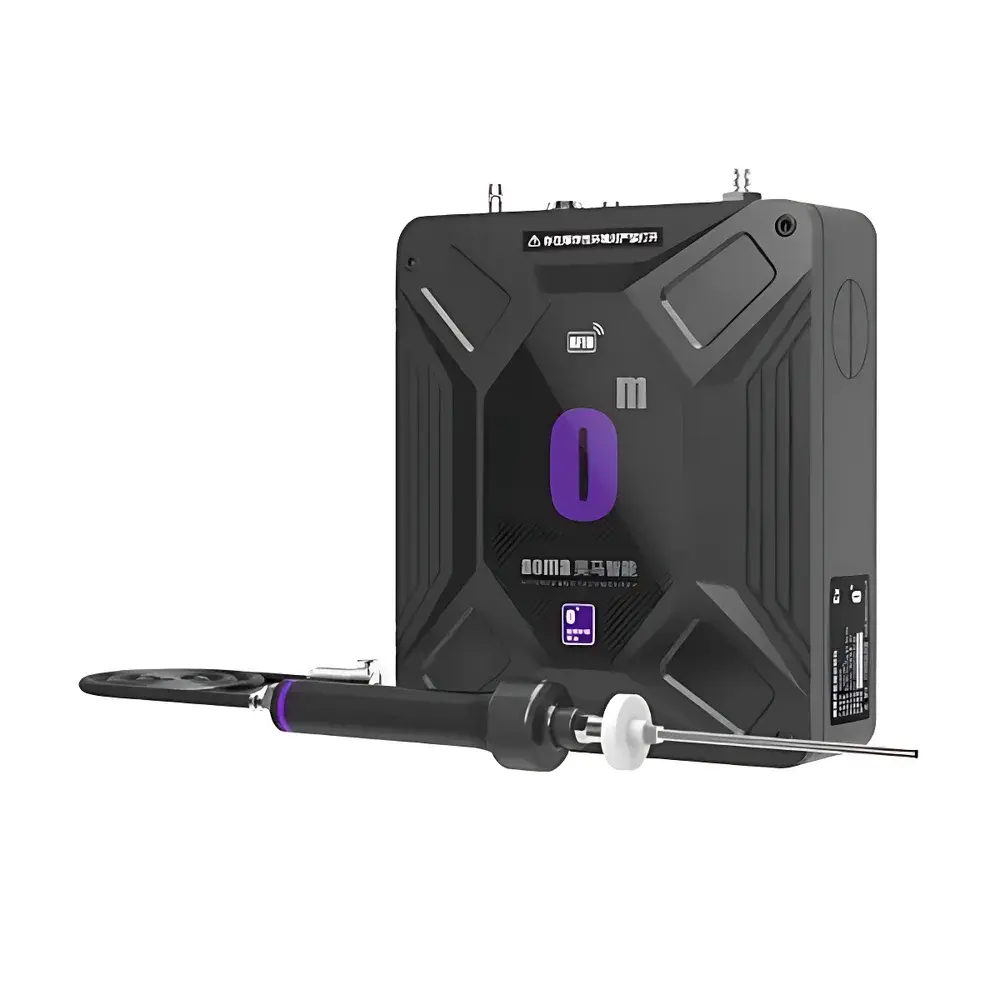
Aoma OM3000 Portable Total Hydrocarbon Analyzer
| Brand | Aoma |
|---|---|
| Origin | Anhui, China |
| Model | OM3000 |
| Detection Limits | FID: 0.5 ppm methane |
| PID | 0.5 ppm isobutylene |
| Detectors | FID, PID, CH₄, O₂, CO, CO₂ (optional) |
| Range | FID: 0–50,000 ppm methane |
| PID | 0.5–2,000 ppm isobutylene |
| Response Time | ≤3.5 s (90% of final value) |
| Repeatability & Accuracy | ≤2% for both FID (methane) and PID (isobutylene) |
| Preheat Time | ≤20 min |
| Operating Temp | −10°C to +50°C |
| RH | 0–95% RH |
| Sample Flow | 0.1–3.0 L/min (adjustable, nominal 1 L/min at probe inlet) |
| H₂ Cylinder | 100 mL, rated to 2200 psi (15.3 MPa), ≥12 h runtime |
| Battery Life | ≥10 h at ambient temperature |
| Dimensions | 229 × 200 × 74 mm |
| Weight | ≤2.5 kg |
| Ingress Protection | IP66 |
| Explosion Protection | Main unit: Ex db[ia Ga] IIC T4 Gb |
| Handheld controller | Ex ib IIC T4 Gb |
| Connectivity | Bluetooth/Wi-Fi |
Overview
The Aoma OM3000 Portable Total Hydrocarbon Analyzer is a field-deployable, dual-detection gas analysis system engineered for regulatory-compliant detection and quantification of total hydrocarbons (THC) and volatile organic compounds (VOCs) in uncontrolled emission scenarios. It employs flame ionization detection (FID) as its primary quantitative method—recognized under HJ 1012-2018 and US EPA Method 25A for its linear response, high sensitivity, and compound-independent calibration for saturated and unsaturated hydrocarbons. Complementing the FID, an optional photoionization detector (PID) extends analytical capability to lower-ionization-potential VOCs—including aromatics, ketones, aldehydes, and select inorganic odorants—without requiring compound-specific calibration curves. Designed explicitly for Leak Detection and Repair (LDAR) programs per HJ 733-2014 and HJ 1230-2021, the OM3000 delivers real-time, on-site quantification at fugitive sources such as valves, flanges, pumps, pressure relief devices, and open liquid surfaces. Its compact architecture integrates certified intrinsic safety and flameproof protection, enabling safe operation in Zone 1 hazardous areas classified under IEC 60079 and GB/T 3836.
Key Features
- Dual-Detector Architecture: Standard FID module ensures trace-level THC quantification (LOD: 0.5 ppm methane); optional PID (LOD: 0.5 ppm isobutylene) broadens coverage to polar and semi-volatile organics without sacrificing response speed (T90 ≤3.5 s).
- Field-Optimized Power & Gas Management: Integrated 100 mL high-pressure hydrogen cylinder (2200 psi / 15.3 MPa) supports ≥12 h continuous FID operation; paired with a high-capacity rechargeable battery delivering ≥10 h runtime. Dual ignition system and micro-EPC-controlled H₂ flow ensure stable combustion and minimal flameout risk—even during rapid sampling transitions.
- Robust Mechanical Design: Compact footprint (229 × 200 × 74 mm), weight ≤2.5 kg, and ergonomic backpack mounting enable extended handheld or shoulder-carried surveying. IP66-rated enclosure provides full protection against dust ingress and high-pressure water jets.
- Intelligent Maintenance System: Dual-stage filtration—visual replaceable inlet membrane + internal particulate trap—prevents column and detector contamination. Automatic post-cycle purge cycle cleans sample path upon startup/shutdown, reducing carryover and extending sensor lifetime.
- Hazardous Area Certification: Full Ex db[ia Ga] IIC T4 Gb certification (main unit) and Ex ib IIC T4 Gb (handheld controller) validate compliance with international explosion protection standards for use in petrochemical, refinery, and chemical manufacturing environments.
- Modular Sensor Expansion: Optional plug-in modules support simultaneous measurement of CH₄, O₂, CO, and CO₂—enabling comprehensive process safety and combustion efficiency assessment alongside LDAR workflows.
Sample Compatibility & Compliance
The OM3000 is validated for direct sampling of ambient air, stack effluents, and surface emissions from industrial infrastructure components. Its FID response is calibrated to methane equivalence per HJ 1012-2018 and aligns with ASTM D6348 for total gaseous hydrocarbon determination. The instrument satisfies mandatory requirements outlined in GB 37822-2019 for unorganized VOC emissions control, including minimum detection limits, repeatability (≤2%), accuracy (≤2%), and response time performance. All firmware and data handling protocols support audit-ready GLP/GMP documentation, with timestamped raw signal logging and configurable metadata tagging (e.g., GPS coordinates, operator ID, component tag number). Data export formats include CSV and XML, ensuring compatibility with enterprise LDAR management platforms such as OM-LDAR.
Software & Data Management
The OM3000 interfaces wirelessly via Bluetooth or Wi-Fi with the dedicated防爆 hand controller, enabling real-time concentration display, alarm threshold configuration, and automated report generation. All measurement sessions are stored locally with embedded cryptographic timestamps and tamper-evident file hashing. Optional RFID integration allows asset-level tracking—linking instrument usage logs to inventory management databases for ISO 17025-aligned calibration traceability. Firmware supports over-the-air updates and includes built-in diagnostics for detector health monitoring (baseline drift, flame stability, filter saturation status). Exported datasets comply with EPA 40 CFR Part 63 Subpart VV and EU IED Annex IV reporting templates, facilitating seamless import into regulatory submission portals.
Applications
- LDAR program execution across petroleum refining, petrochemical, pharmaceutical, coating, and packaging facilities
- Rapid screening of fixed emission sources—including flare stacks, storage tanks, and vapor recovery units
- Performance verification of VOC abatement technologies (e.g., thermal oxidizers, carbon adsorption beds)
- Source identification and spatial mapping of fugitive emissions using GPS-synchronized data capture
- Workplace exposure assessment in production halls, wastewater treatment basins, and loading/unloading zones
- Emergency response for hydrocarbon leaks at fuel depots, gas stations, and transport terminals
- Integration with optical gas imaging (OGI) systems for correlative point-source validation
FAQ
What regulatory standards does the OM3000 meet for LDAR applications?
It complies with HJ 733-2014, HJ 1230-2021, GB 37822-2019, and HJ 1012-2018 for methodology, performance, and reporting requirements.
Can the OM3000 operate continuously in Zone 1 classified areas?
Yes—the main unit carries Ex db[ia Ga] IIC T4 Gb certification, permitting uninterrupted use in explosive gas atmospheres per IEC 60079-0/1/11.
Is calibration traceable to national standards?
All factory calibrations are performed using NIST-traceable certified reference materials (CRMs); calibration certificates include uncertainty budgets per ISO/IEC 17025.
How is data integrity ensured during field deployment?
Each measurement record contains digital signatures, hardware-generated timestamps, and immutable audit trails—fully compliant with FDA 21 CFR Part 11 electronic record requirements.
What maintenance intervals are recommended for routine operation?
Filter replacement every 50 hours of cumulative sampling time; annual factory recalibration recommended; no scheduled detector replacement required within first 3 years under normal use conditions.




