
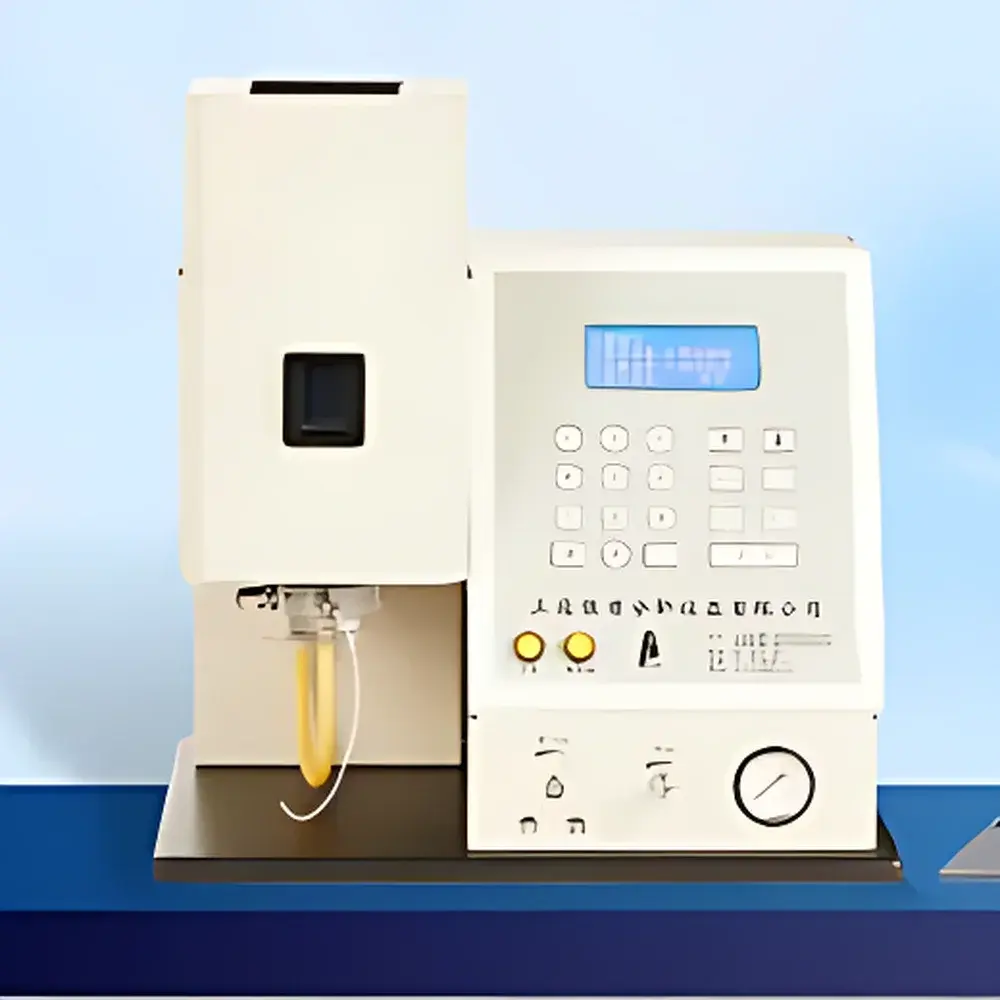
AOPU AP1301 Flame Photometer
| Brand | AOPU |
|---|---|
| Origin | Shanghai, China |
| Manufacturer Type | Direct Manufacturer |
| Model | AP1301 |
| Measurement Range | K: 0–100 µg/mL |
| Na | 0–100 µg/mL |
| Li | 0–100 µg/mL |
| Detection Limit | K ≤ 0.004 mmol/L |
| Response Time | < 8 s |
| Repeatability | ≤ 3% |
| Sample Uptake Rate | < 6 mL/min |
Overview
The AOPU AP1301 Flame Photometer is a benchtop atomic emission spectrometer engineered for quantitative determination of alkali and alkaline earth metals—specifically potassium (K), sodium (Na), and lithium (Li)—in aqueous solutions. Based on the principle of flame atomic emission spectroscopy (FAES), the instrument atomizes and excites sample aerosols in a stable hydrocarbon-air flame (using liquefied petroleum gas, propane, or butane), causing characteristic emission at element-specific wavelengths. Emitted radiation is isolated via interference filter-based optical filtering and detected by silicon photovoltaic cells. The AP1301 employs a triple-channel detection architecture with dedicated interference filters for K (766.5 nm), Na (589.0 nm), and Li (670.8 nm), enabling simultaneous multi-element quantification without sequential wavelength scanning. Designed for routine laboratory environments—including QC labs in food & beverage, clinical diagnostics, agriculture, soil science, petrochemicals, and industrial raw material testing—the AP1301 delivers robust performance under GLP-aligned operational conditions (10–35 °C, ≤85% RH, stable horizontal placement, grounded 220 V/50 Hz supply).
Key Features
- Triple-channel optical path with fixed interference filters for K, Na, and Li—enabling concurrent measurement and direct concentration readout for all three elements
- Integrated flame safety system featuring automatic ion-sensing flame monitoring: gas supply is cut off within 8 seconds upon flame extinction, followed by audible alarm; manual reset via ignition button
- Digital touch keypad with intuitive navigation and built-in calibration memory supporting up to three curve-fitting modes: linear, segmented linear, and quadratic polynomial regression
- Wet gas separator to minimize moisture-induced flame instability and signal drift
- RS232 serial interface compliant with standard PC communication protocols—enabling data export to spreadsheet software or LIMS-compatible acquisition tools
- One-button ignition with integrated piezoelectric spark generator and fail-safe thermal protection circuitry
- Optimized nebulization system delivering consistent aerosol generation at ≤6 mL/min uptake rate, compatible with standard 1–5 mL volumetric flasks and polypropylene sample vials
Sample Compatibility & Compliance
The AP1301 accepts clarified, low-viscosity aqueous samples with total dissolved solids (TDS) < 0.5%. Matrix-matched standards and internal standardization (e.g., using Cs or Rb as ionization buffers) are recommended for complex matrices such as soil digests, fertilizer extracts, biological fluids, or crude oil ash solutions. The instrument meets fundamental functional requirements outlined in ASTM D1317 (for sodium in aviation turbine fuels), ISO 9297 (potassium in fertilizers), and USP (alkali metal content in pharmaceutical excipients). While not certified for 21 CFR Part 11 compliance out-of-the-box, its RS232 audit trail capability—when paired with validated third-party data acquisition software—supports GMP/GLP documentation workflows requiring electronic record retention and operator traceability.
Software & Data Management
The AP1301 operates autonomously via embedded firmware with no proprietary software dependency. All calibration curves, sample IDs, and measured concentrations are stored in non-volatile memory (retention >10 years). Raw analog output (0–5 V DC) is available via auxiliary port for integration into PLC-controlled process analyzers. When connected to a Windows-based host via RS232, ASCII-formatted data streams (including timestamp, element ID, concentration, and %RSD) can be captured using HyperTerminal, PuTTY, or custom Python scripts. Exported .csv files conform to ISO/IEC 17025 clause 7.7.1 requirements for raw data integrity and post-acquisition traceability.
Applications
- Food & Beverage: Quantification of Na/K ratios in fruit juices, dairy products, and processed snacks per AOAC 985.27
- Agriculture & Soil Science: Rapid screening of exchangeable K⁺ and Na⁺ in Mehlich-3 or ammonium acetate extracts
- Clinical Chemistry: Monitoring serum Li⁺ levels during therapeutic drug monitoring (TDM) protocols
- Petrochemicals: Detection of sodium contamination in lubricating oils and residual fuel oils (ASTM D3229)
- Building Materials: Alkali content analysis in cement and concrete admixtures per ASTM C1777
- Fertilizer Quality Control: K₂O and Na₂O assay in NPK blends and micronutrient formulations
- Environmental Testing: Na⁺ and K⁺ profiling in surface water, leachates, and wastewater effluents
FAQ
What gases are compatible with the AP1301 flame system?
Liquefied petroleum gas (LPG), propane, and butane are approved fuel sources. All must be free of sulfur compounds, heavy hydrocarbons, and particulate contaminants to prevent burner clogging and spectral interference.
Is external air compression required?
Yes—the AP1301 requires a clean, oil-free compressed air source (≥4 bar, ≤5 µm particle filtration) for nebulizer operation. An integrated air compressor is supplied as standard equipment.
Can the AP1301 measure calcium or barium?
No. The optical design is limited to K, Na, and Li due to fixed interference filters and detector spectral response range (550–800 nm). Calcium (422.7 nm) and barium (553.6 nm) require UV-enhanced optics and different photodetectors.
What is the minimum sample volume required per analysis?
Approximately 2 mL is recommended for stable aspiration and reproducible signal averaging over the 8-second response window.
How often should the nebulizer capillary be cleaned?
Daily cleaning with 5% nitric acid followed by deionized water rinse is advised when analyzing high-salt or organic-rich samples. Ultrasonic bath treatment (10 min, 40 kHz) enhances removal of dried residue.





