
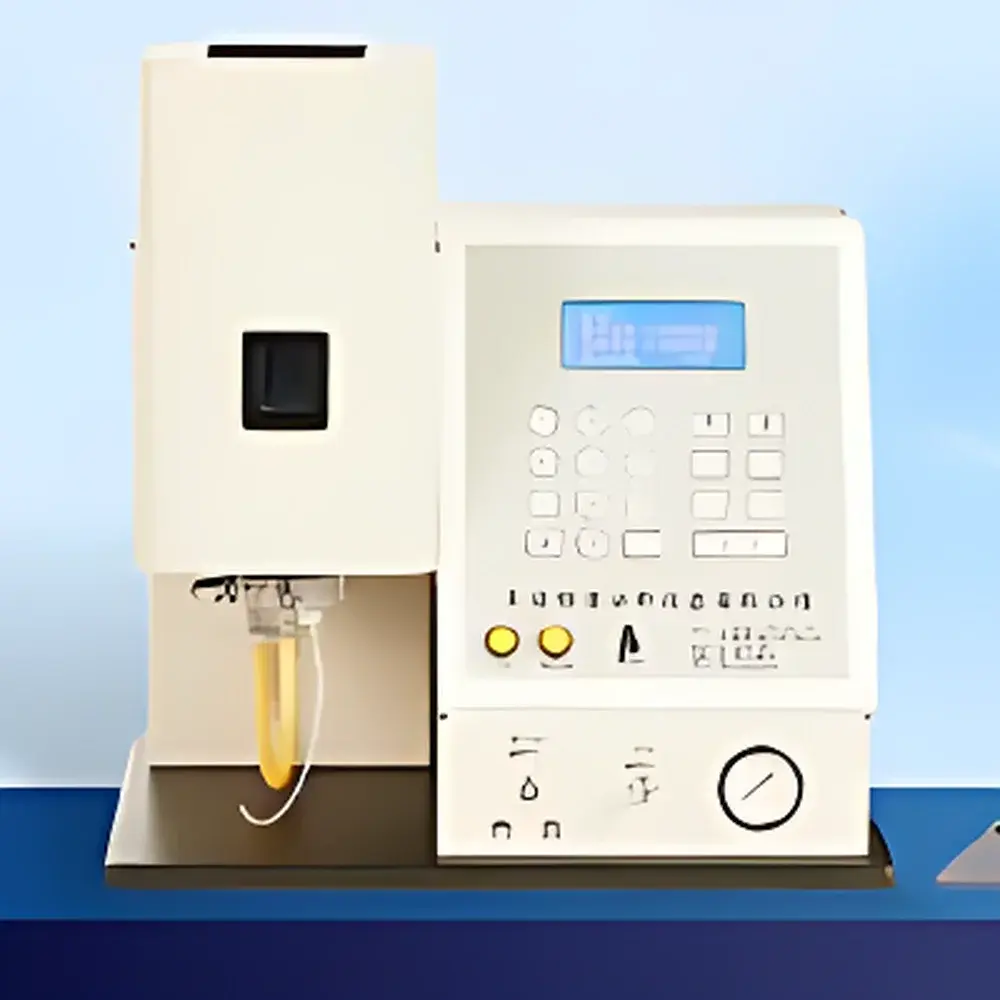
AOPU AP1401 Flame Photometer
| Brand | AOPU |
|---|---|
| Origin | Shanghai, China |
| Manufacturer | AOPU Instrument Co., Ltd. |
| Model | AP1401 |
| Detection Range | K: 0–100 µg/mL |
| Na | 0–100 µg/mL |
| Li | 0–100 µg/mL |
| Ca | 0–1000 µg/mL |
| Detection Limits | K ≤ 0.004 mmol/L |
| Response Time | < 8 s |
| Repeatability | ≤ 3% RSD |
| Sample Aspiration Rate | < 6 mL/min |
Overview
The AOPU AP1401 Flame Photometer is a benchtop atomic emission spectrometer designed for quantitative determination of alkali and alkaline earth metals—specifically potassium (K), sodium (Na), lithium (Li), and calcium (Ca)—in aqueous solutions. It operates on the principle of flame atomic emission spectroscopy (FAES): samples are nebulized into a stable, premixed air–fuel flame (liquefied petroleum gas, propane, or butane), where metal ions are thermally excited and emit characteristic wavelengths upon relaxation. Emission intensity at element-specific spectral lines is measured using interference filter-based optical detection and converted to concentration via calibrated response curves. Engineered for routine laboratory use in quality control and regulatory testing environments, the AP1401 delivers high reproducibility and operational robustness without requiring complex optics or high-purity gases. Its compact footprint (440 × 310 × 500 mm), low power consumption (250 W), and integrated safety architecture—including flame-out detection, automatic gas cutoff, and audible alarm—make it suitable for ISO/IEC 17025-accredited labs, GLP-compliant clinical chemistry workflows, and industrial QC settings where reliability and ease of validation are critical.
Key Features
- Four-channel simultaneous detection with dedicated interference filters for K, Na, Li, and Ca—enabling concurrent measurement of up to three elements per run with direct concentration readout
- Integrated flame safety system: ion-sensing electrode detects flame extinction within 8 seconds and triggers immediate fuel shutoff; manual reset required after alarm
- Three calibration curve modes—linear, segmented linear, and quadratic polynomial—supporting flexible method development per ASTM D1976 and ISO 11885 requirements
- Touch-sensitive digital keypad with LCD display for intuitive operation and real-time parameter monitoring
- RS232 serial interface compliant with standard lab data acquisition protocols; supports connection to PCs or thermal printers for audit-trail-capable reporting
- Integrated moisture separator minimizes signal drift from condensate buildup during extended analysis sessions
- One-touch ignition with auto-ignition assist and flame stabilization logic ensures consistent burner performance across ambient temperature variations (+10 °C to +35 °C)
- Stability specification: ≤3% relative variation over 15 s; ≤15% over 6 minutes (1-min intervals) using certified reference standards
Sample Compatibility & Compliance
The AP1401 accepts clarified, low-viscosity aqueous samples with total dissolved solids (TDS) < 0.5%. It is routinely deployed for analysis of beverages (juices, beer, milk), biological fluids (serum, urine), soil extracts, fertilizer digests, lubricating oils (after acid digestion), and mineral processing liquors. All measurements comply with key international standards including ASTM D1976 (sodium/potassium in water), ISO 11885 (determination of selected elements by FAES), and USP (potassium and sodium in pharmaceutical excipients). The instrument’s repeatability (≤3% RSD) and linearity error (K: ≤0.005 mmol/L; Na: ≤0.03 mmol/L; Li: ≤0.021 mmol/L; Ca: ≤0.075 mmol/L) meet minimum performance criteria outlined in CLSI EP10-A3 for analytical method verification. While not inherently 21 CFR Part 11 compliant, its RS232 output enables integration with validated LIMS or ELN systems supporting electronic signature and audit trail requirements.
Software & Data Management
The AP1401 operates as a standalone instrument with embedded firmware controlling all measurement parameters—no proprietary software installation required. Calibration curves (up to 10 stored methods) are retained in non-volatile memory and recalled via numeric key selection. Raw emission intensities and calculated concentrations are displayed in real time; values can be printed directly via RS232-connected thermal printer or exported as ASCII text files for post-processing in Excel or statistical packages (e.g., JMP, Minitab). For laboratories implementing paperless workflows, the device supports integration with third-party data acquisition software compliant with IEEE 11073 or HL7 standards. All calibration events—including date/time stamp, operator ID (manually entered), standard concentrations, and residual errors—are logged internally and retrievable via serial dump.
Applications
- Food & Beverage: Quantification of Na/K ratio in infant formula (Codex Alimentarius STAN 72-1981); Ca in fortified dairy products; Li in specialty mineral waters
- Agriculture & Soil Science: Exchangeable K⁺ and Na⁺ in Mehlich-3 soil extracts; Ca²⁺ in irrigation water per EPA Method 200.7
- Clinical Chemistry: Serum Na⁺/K⁺ monitoring per CLIA-waived test criteria; urinary Ca excretion assessment in metabolic bone disease screening
- Industrial QA/QC: Alkali metal contamination in silicon wafers (ASTM F390); Na in aviation turbine fuels (ASTM D3229); Ca in lubricant greases (ASTM D4955)
- Environmental Monitoring: Total dissolved cations in surface water per ISO 11885; cement leachate analysis for alkali-silica reaction (ASR) risk assessment
FAQ
What fuel gases are compatible with the AP1401?
Liquefied petroleum gas (LPG), propane, and butane are supported. Fuel must be free of sulfur compounds and particulates to prevent burner clogging and signal instability.
Is external air compression required?
Yes—the system includes an integrated air compressor rated for continuous duty at 3–4 bar output pressure and ≥6 L/min flow rate, eliminating need for external compressed air sources.
Can the AP1401 measure other elements beyond K, Na, Li, and Ca?
No. Optical path is fixed with four discrete interference filters; no grating or tunable monochromator is present. Additional elements require separate instrumentation (e.g., ICP-OES).
How often should calibration be verified?
Per ISO/IEC 17025, calibration verification using mid-range check standards is recommended before each analytical batch or every 2 hours of continuous operation—whichever occurs first.
What maintenance is required for long-term stability?
Monthly cleaning of the nebulizer capillary and burner head with 10% nitric acid; quarterly inspection of the moisture separator cartridge; annual verification of photometric linearity using neutral density filters per manufacturer’s service protocol.
Related Products





