
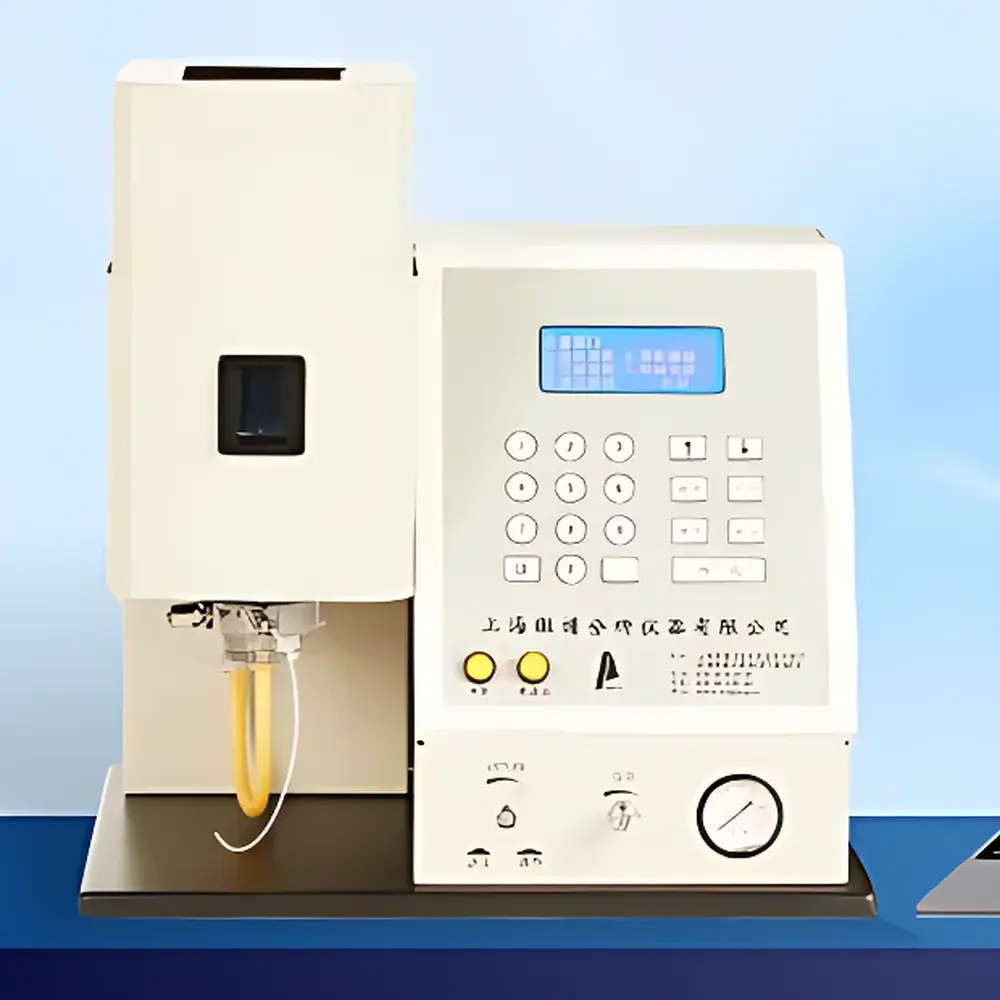
AOPU AP1500 Flame Photometer
| Brand | AOPU |
|---|---|
| Origin | Shanghai, China |
| Manufacturer Type | Direct Manufacturer |
| Model | AP1500 |
| Detection Range | K: 0–100 µg/mL |
| Na | 0–100 µg/mL |
| Li | 0–100 µg/mL |
| Ca | 0–1000 µg/mL |
| Ba | 0–3000 µg/mL |
| Detection Limit | K ≤ 0.004 mmol/L |
| Response Time | < 8 s |
| Repeatability | ≤ 3% |
| Sample Aspiration Rate | < 6 mL/min |
Overview
The AOPU AP1500 Flame Photometer is a benchtop atomic emission spectrometer engineered for quantitative determination of alkali and alkaline earth metals—specifically potassium (K), sodium (Na), lithium (Li), calcium (Ca), and barium (Ba)—in aqueous solutions. It operates on the principle of flame atomic emission spectroscopy (FAES): samples are nebulized into a stable premixed air–fuel flame (liquefied petroleum gas, propane, or butane), where metal ions are thermally excited and emit characteristic wavelengths upon relaxation. Emission intensity at element-specific spectral lines is measured using interference filter-based optical isolation and silicon photodiode detection. The instrument delivers direct concentration readout without requiring internal standardization, making it suitable for routine analysis in quality control laboratories where speed, robustness, and regulatory traceability are prioritized over ultra-trace sensitivity.
Key Features
- Five-channel optical architecture with dedicated interference filters for K, Na, Li, Ca, and Ba—enabling simultaneous measurement of up to three elements per run with independent calibration and real-time concentration display.
- Integrated flame safety system featuring automatic ion-sensing flame monitoring: loss of flame signal triggers immediate fuel cutoff and audible/visual alarm within 8 seconds; manual reset required via dedicated ignition switch.
- Digital touch-panel interface with numeric keypad for intuitive parameter entry, single-point calibration, and storage of multiple calibration curves (linear, segmented, and quadratic regression models).
- Optimized pneumatic nebulization system with built-in moisture separator and regulated aspiration rate (<6 mL/min) to ensure consistent aerosol generation and minimize matrix-induced flame instability.
- RS232 serial interface compliant with standard laboratory data acquisition protocols—supports direct connection to PCs or thermal printers for audit-ready reporting and GLP-compliant record retention.
- Self-contained design includes integrated air compressor; no external compressed air source required. Operates on standard 220 V AC ±10%, 50 Hz power supply with 250 W maximum draw.
Sample Compatibility & Compliance
The AP1500 accepts clarified, low-viscosity aqueous samples with total dissolved solids (TDS) < 0.5% w/v. Matrix effects from high salt content or organic solvents can be mitigated via dilution or matrix-matched calibration. It complies with foundational performance criteria outlined in ASTM D129–22 (Standard Test Method for Sulfur in Petroleum Products) for alkali metal quantification in fuels, and aligns with ISO 6977:2015 (Soil quality — Determination of exchangeable cations) for Ca²⁺ and K⁺ in soil extracts. While not FDA 21 CFR Part 11–certified out-of-the-box, its RS232 logging capability supports implementation of electronic signature workflows and audit trails when paired with validated third-party LIMS software. Instrument stability meets ISO 8573-1 Class 4 requirements for ambient lab environments (10–35 °C, RH ≤ 85%, vibration-free horizontal placement).
Software & Data Management
No proprietary software is bundled; however, the RS232 interface transmits ASCII-formatted data packets (e.g., “K=12.45;Na=8.72;Ca=156.3”) at user-defined intervals. Compatible with generic terminal emulators (e.g., Tera Term, PuTTY) and spreadsheet-based automation tools (e.g., Excel VBA, Python pySerial). Calibration curves—including linear, two-point segmented, and second-order polynomial fits—are stored in non-volatile memory and recalled per-element during analysis. All calibration metadata (date, operator ID, standard concentrations) is embedded in transmitted output strings to support GLP documentation requirements.
Applications
- Clinical & Nutritional Analysis: Quantification of Na⁺ and K⁺ in serum/plasma; Ca²⁺ in milk, infant formula, and fortified beverages; Li⁺ in therapeutic drug monitoring.
- Agricultural & Soil Science: Exchangeable K⁺ and Ca²⁺ in Mehlich-3 or ammonium acetate extracts; Na⁺ in irrigation water and saline soils per USDA ARS guidelines.
- Food & Beverage Quality Control: Na⁺ in processed foods (chips, sauces); K⁺ in fruit juices and sports drinks; Ca²⁺ in dairy products and plant-based alternatives.
- Industrial Raw Materials: Alkali content in silica sands and glass cullet; Ba²⁺ in catalyst supports and drilling mud additives; Na⁺ contamination in turbine oils and lubricants.
- Environmental Monitoring: Cation profiling in wastewater effluents, landfill leachates, and acid mine drainage samples per EPA Method 200.7 adaptations.
FAQ
What fuel gases are compatible with the AP1500?
Liquefied petroleum gas (LPG), propane, or butane—free of sulfur compounds and particulate contaminants—are approved. Natural gas is not supported due to differing stoichiometric combustion requirements.
Does the instrument require daily recalibration?
No. Single-point calibration with a mid-range standard is sufficient for routine use; verification with a second standard is recommended every 8–10 samples or at start-of-shift per ISO/IEC 17025 QA protocols.
Can the AP1500 measure magnesium or strontium?
No. Its optical configuration is fixed to the five specified elements (K, Na, Li, Ca, Ba) via interference filters; no wavelength scanning or grating-based dispersion is implemented.
What maintenance intervals are recommended?
Nebulizer capillary cleaning after every 50 samples; moisture separator draining before each session; annual verification of flame alignment and photodiode linearity using NIST-traceable standards.
Is the AP1500 suitable for GMP-regulated pharmaceutical testing?
It may be deployed in non-critical QC applications (e.g., excipient assay) when operated within a documented validation framework—including IQ/OQ/PQ, change control, and periodic performance qualification—but lacks out-of-the-box 21 CFR Part 11 compliance features such as electronic signatures or immutable audit logs.




