
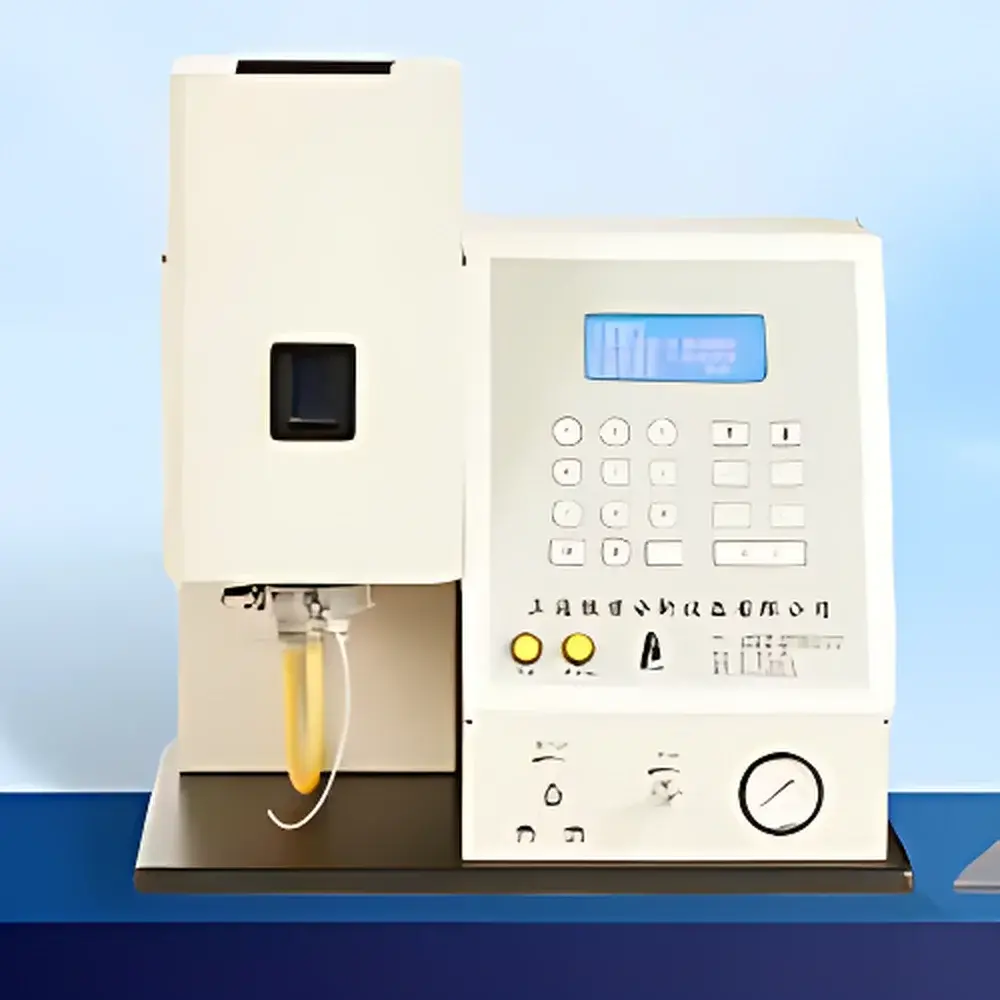
AOPU AP1500 GMP-Compliant Flame Photometer
| Brand | AOPU |
|---|---|
| Origin | Shanghai, China |
| Manufacturer | AOPU Instrument Co., Ltd. |
| Model | AP1500 GMP Edition |
| Detection Range | K: 0–100 µg/mL |
| Na | 0–100 µg/mL |
| Li | 0–100 µg/mL |
| Ca | 0–1000 µg/mL |
| Ba | 0–3000 µg/mL |
| Detection Limits | K ≤ 0.004 mmol/L |
| Response Time | < 8 s |
| Repeatability | ≤ 3% RSD |
| Sample Uptake Rate | < 6 mL/min |
Overview
The AOPU AP1500 GMP-Compliant Flame Photometer is a dedicated atomic emission spectrometer engineered for quantitative determination of alkali and alkaline earth metals—including potassium (K), sodium (Na), lithium (Li), calcium (Ca), and barium (Ba)—in aqueous solutions. Based on the principle of flame atomic emission spectroscopy (FAES), the instrument atomizes and excites sample ions in a controlled premixed air–fuel flame (liquefied petroleum gas, propane, or butane). Emitted characteristic radiation at element-specific wavelengths is isolated using interference filter-based optical discrimination and detected by silicon photodiodes. The AP1500 GMP Edition integrates hardware-level flame safety controls and software architecture aligned with pharmaceutical quality assurance requirements, making it suitable for routine analysis in QC laboratories operating under Good Manufacturing Practice (GMP) environments per Annex 11 and ICH Q7 guidelines.
Key Features
- Five-channel optical path with individually mounted interference filters for K, Na, Li, Ca, and Ba—enabling simultaneous measurement of up to three elements with direct concentration readout
- Digital touch-panel interface with numeric keypad for intuitive operation and real-time parameter adjustment
- Integrated flame management system featuring auto-ignition, ion-sensing flame monitoring, and fail-safe gas cutoff: automatic shutoff occurs within 8 seconds if flame extinction is detected, followed by audible alarm and manual reset capability
- Moisture separator integrated into the nebulizer gas path to minimize signal drift from water vapor interference
- RS232 serial interface supporting bidirectional communication with external PCs or thermal printers for data logging and report generation
- Three calibration modes—linear, segmented, and quadratic polynomial fitting—ensuring accurate quantification across wide dynamic ranges and non-linear response profiles
- Stability performance verified per pharmacopeial criteria: ≤3% relative variation over 15 s continuous sampling; ≤15% max variation across six 1-minute measurements
Sample Compatibility & Compliance
The AP1500 GMP Edition accepts clear, low-viscosity aqueous samples with total dissolved solids (TDS) < 0.1%. It is routinely employed for assay of electrolytes in pharmaceutical formulations (e.g., IV fluids, oral rehydration salts), raw material testing (excipients, active pharmaceutical ingredients), and environmental monitoring of process water. All hardware components—including burner head, nebulizer, and optical housing—are constructed from corrosion-resistant stainless steel and borosilicate glass. The instrument meets ISO/IEC 17025 general requirements for competence of testing and calibration laboratories and supports compliance with USP , EP 2.2.29, and Chinese Pharmacopoeia Volume IV (2020 Edition) flame photometric methods. Its design accommodates GLP/GMP audit readiness through traceable calibration records, user access control, and hardware-integrated safety interlocks.
Software & Data Management
The optional GMP-compliant software package provides full instrument control and regulatory-grade data integrity. It implements 21 CFR Part 11–aligned features including role-based user authentication (supporting ≥20 configurable accounts), hierarchical project management, password-protected method editing, adjustable decimal precision, and comprehensive audit trail functionality with time-stamped, immutable event logging (login/logout, calibration, measurement, parameter change, report export). Audit trails support filtered review by user, date range, or activity type. Data export is native to CSV and Excel-compatible formats; all raw intensity values, calibration coefficients, and final concentration results are stored with metadata (operator ID, timestamp, sample ID, instrument serial number). Software communicates bidirectionally via RS232, replicating all front-panel functions—including multi-element selection, standard curve generation, batch analysis, and statistical summary reporting.
Applications
- Quantitative release testing of K⁺/Na⁺ in intravenous saline and dextrose solutions per USP monographs
- Calcium and lithium content verification in tablet excipients and psychiatric drug intermediates
- Barium sulfate suspension purity assessment in radiopharmaceutical manufacturing
- Water quality monitoring in purified water (PW) and water-for-injection (WFI) distribution systems
- Stability-indicating assay of metal catalyst residues in API synthesis batches
- Educational use in university analytical chemistry labs for fundamental FAES methodology instruction
FAQ
What fuel gases are compatible with the AP1500 GMP Edition?
Liquefied petroleum gas (LPG), propane, or butane—provided they are free of sulfur compounds and particulate contaminants. A stable, clean-burning supply is required to maintain baseline stability and avoid burner clogging.
Is the instrument compliant with 21 CFR Part 11?
Yes—the optional GMP software includes electronic signatures, audit trail, and role-based access controls meeting FDA requirements for electronic records and signatures in regulated environments.
Can calibration curves be transferred between instruments?
Calibration parameters are stored internally and exportable as encrypted .cal files. Cross-instrument transfer requires validation per laboratory SOPs and may necessitate re-standardization due to detector and burner variability.
What maintenance intervals are recommended?
Daily: Nebulizer cleaning and moisture trap emptying. Weekly: Burner head inspection and air compressor oil check. Quarterly: Optical filter inspection and alignment verification. Annual: Full performance qualification (PQ) against certified reference standards.
Does the AP1500 support multi-point calibration for nonlinear analyte responses?
Yes—quadratic polynomial fitting mode allows up to five standard points per element, enabling accurate quantification across extended concentration ranges where Beer–Lambert linearity deviates.



