
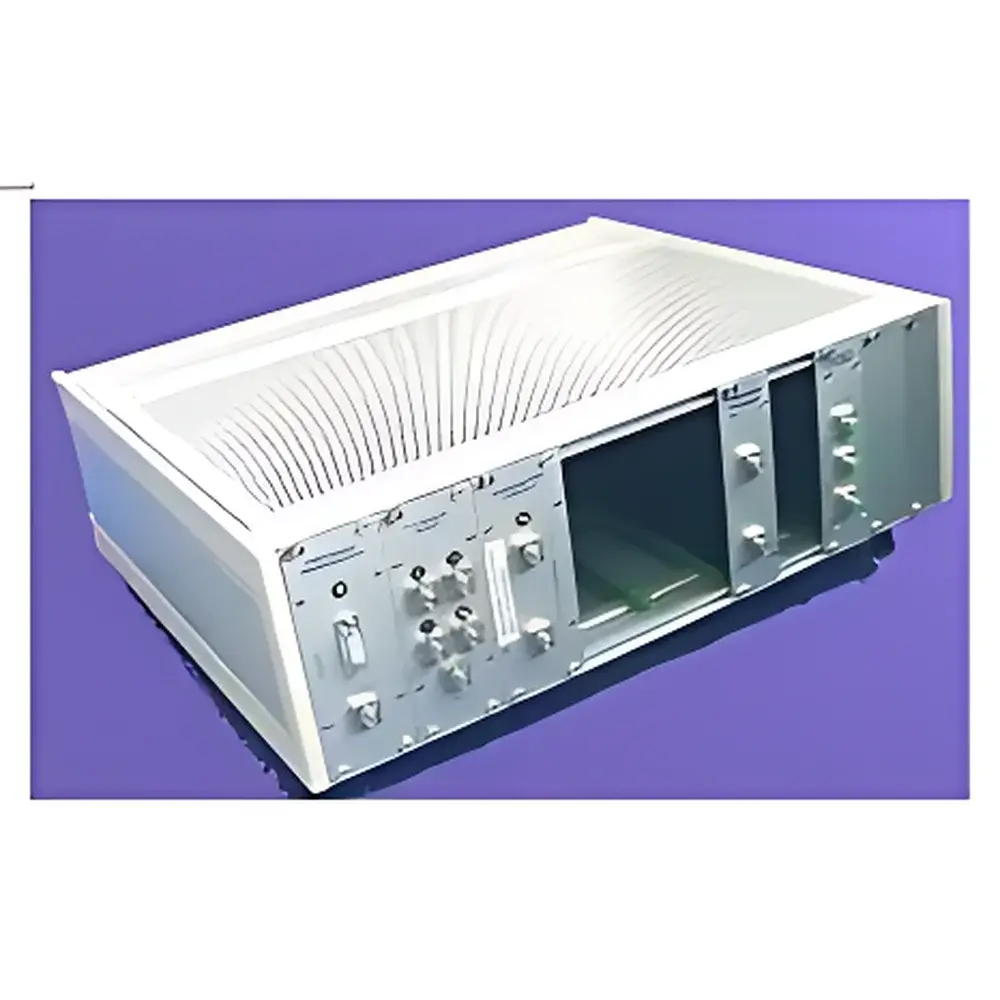
AOS Special Monitoring Units for Fiber Bragg Grating (FBG) Sensing Systems
| Brand | AOS/Advanced Optics Solutions |
|---|---|
| Origin | Germany |
| Manufacturer Type | Authorized Distributor |
| Origin Category | Imported |
| Model | Special Monitoring Units |
| Pricing | Upon Request |
Overview
The AOS Special Monitoring Units are modular, rack-mountable optical interrogation systems engineered for high-precision, real-time measurement of wavelength shifts in Fiber Bragg Grating (FBG) sensors. Based on tunable laser or broadband source + interferometric or spectrometric detection architectures—depending on configuration—these units operate on the fundamental principle that mechanical strain or temperature change induces a linear shift in the Bragg wavelength (ΔλB) of an FBG, governed by the photoelastic and thermo-optic effects. Designed for long-term structural health monitoring (SHM), the system delivers sub-picometer wavelength resolution and supports both single-point and dense FBG array interrogation. Its architecture complies with industry-standard optical time-domain reflectometry (OTDR) and wavelength-division multiplexing (WDM) principles, enabling scalable deployment across distributed sensor networks without signal crosstalk.
Key Features
- Modular 19-inch rack-mount design compliant with EIA-310-D mechanical standards, allowing seamless integration of additional functional units including FBG demultiplexers, circulators, couplers, polarization controllers, and channel expansion modules
- Support for both discrete single-FBG interrogation and cascaded FBG arrays (up to 50+ gratings per channel, depending on spectral spacing and bandwidth)
- Real-time dynamic sampling rates up to 2 kHz (configurable), optimized for vibration mode analysis and transient strain capture
- Thermal drift compensation via integrated reference FBG or internal temperature-stabilized cavity, ensuring measurement stability over extended deployments (>12 months unattended)
- Ruggedized chassis with IP20-rated enclosure, operating temperature range: −10 °C to +60 °C; designed for industrial environments including power generation facilities, wind turbine nacelles, and civil infrastructure control rooms
- Optical input/output interfaces conforming to IEC 61753-1 (Category C – Controlled Environment) and IEC 61300-2-4 (vibration endurance)
Sample Compatibility & Compliance
The system is compatible with standard telecom-grade silica fiber (SMF-28e+, G.652.D) and polyimide- or metal-coated FBGs optimized for harsh-environment embedding. It accepts FBGs written at common wavelengths (1510–1590 nm C-band; optional L-band extension), with reflectivity >70% and full-width-at-half-maximum (FWHM) ≤0.3 nm. All hardware and firmware comply with CE marking requirements under Directive 2014/30/EU (EMC) and 2014/35/EU (LVD). For regulated industries—including energy, aerospace, and heritage conservation—the system supports audit-ready operation when paired with optional GLP/GMP-compliant software add-ons (e.g., 21 CFR Part 11 electronic signature and audit trail modules).
Software & Data Management
AOS provides the proprietary FiberSense Studio software suite, delivered as a Windows-based client application with optional Linux CLI support. The software enables real-time spectrum visualization, automatic peak tracking, multi-parameter calibration (strain/temperature cross-sensitivity compensation), and time-series database logging (SQLite or SQL Server backends). Raw wavelength data is exported in IEEE 1596-compliant HDF5 format, facilitating interoperability with MATLAB, Python (via h5py), and LabVIEW. Data integrity is ensured through cyclic redundancy checksums (CRC-32) on all stored records; configuration files are digitally signed to prevent unauthorized modification. Remote access is supported via TLS 1.2-secured HTTP API, enabling integration into SCADA and cloud-based SHM platforms (e.g., AWS IoT Core, Azure IoT Hub).
Applications
- Long-term vibration monitoring of critical aerospace components—including aircraft wing spars, helicopter rotor blades, and gas turbine compressor disks—under operational loading conditions
- Distributed strain mapping across reinforced concrete bridges, offshore wind tower foundations, and nuclear containment structures to detect micro-cracking onset and progression
- Continuous thermal–mechanical monitoring of high-voltage transformer windings and hydroelectric generator stators, where conventional electrical sensors pose insulation or EMI risks
- Non-intrusive deformation tracking in historic masonry and timber-framed buildings, supporting UNESCO-aligned conservation protocols with millimeter-level displacement resolution over decades
- Multi-parameter sensing in composite material curing processes, simultaneously resolving residual strain, exothermic temperature gradients, and cure-state kinetics via embedded FBG arrays
FAQ
What is the maximum number of FBGs supported per interrogation channel?
Typically 20–50 gratings, depending on spectral guard band allocation and grating bandwidth; custom configurations support up to 100 with external WDM filters.
Can the system perform simultaneous strain and temperature discrimination?
Yes—using dual-parameter FBG configurations (e.g., chirped + uniform gratings, or FBG + LPG pairs) with appropriate calibration matrices implemented in FiberSense Studio.
Is field recalibration required after initial installation?
No—factory calibration is traceable to PTB (Physikalisch-Technische Bundesanstalt) standards; in-field verification uses built-in reference gratings with NIST-traceable drift characterization.
Does the unit support synchronization with external timing sources?
Yes—via IEEE 1588 Precision Time Protocol (PTP) v2.1 or GPS-disciplined 10 MHz clock input for phase-coherent multi-node deployments.
Are OEM integration options available for embedding into third-party monitoring platforms?
Yes—AOS provides documented C/C++ SDK, RESTful API, and EtherCAT slave interface options under NDA for system integrators.




