
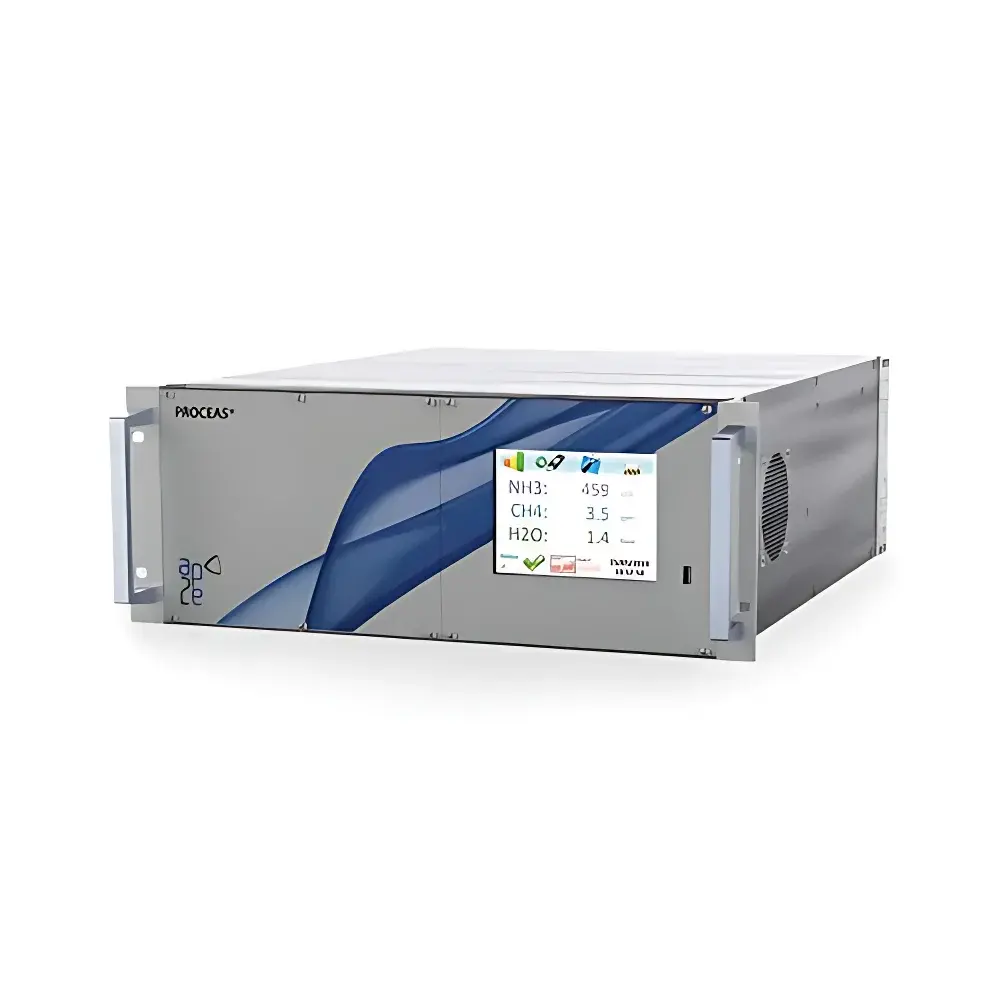
AP2E ProCeas® CO₂ CH₄ N₂O NH₃ H₂O Gas Analyzer
| Brand | AP2E |
|---|---|
| Origin | France |
| Model | ProCeas® |
| Measurement Principle | Optical-Feedback Cavity-Enhanced Absorption Spectroscopy (OF-CEAS) |
| Detection Gases | CO₂, CH₄, N₂O, NH₃, H₂O |
| Sampling Rate | 2 Hz |
| Measurement Cavity Volume | 25 mL |
| Temperature Stability | ±0.002 K (1 s), ±5×10⁻⁵ K (30 min) |
| Pressure Stability | ±0.016 mbar |
| Accuracy (5 min avg) | <1 ppb (N₂O, CH₄, NH₃), <80 ppb (CO₂), <60 ppm (H₂O) |
| Drift (24 h) | <5 ppb (N₂O), <3 ppb (CH₄), <0.5 ppm (CO₂) |
| Response Time | <4 s |
| Operating Temperature | −10 to +45 °C |
| Relative Humidity | <99% RH (non-condensing) |
| Flow Rate | ~200 mL/min |
| Output Interfaces | Ethernet, Modbus TCP/IP & RS, Analog, USB |
| Power | 110–230 VAC, 50–60 Hz, 150 VA |
| Dimensions | 19″ rack mount, 4U |
| Weight | 20 kg |
Overview
The AP2E ProCeas® CO₂ CH₄ N₂O NH₃ H₂O Gas Analyzer is a field-deployable, fully pre-calibrated trace gas analyzer engineered for in situ, real-time monitoring of biogeochemical fluxes across soil–atmosphere interfaces. It employs Optical-Feedback Cavity-Enhanced Absorption Spectroscopy (OF-CEAS), a patented high-fidelity laser absorption technique (WO03031949) that delivers exceptional selectivity, long-term stability, and sub-part-per-trillion detection sensitivity for simultaneous quantification of five key atmospheric constituents: carbon dioxide (CO₂), methane (CH₄), nitrous oxide (N₂O), ammonia (NH₃), and water vapor (H₂O). Unlike conventional non-dispersive infrared (NDIR) or tunable diode laser absorption spectroscopy (TDLAS) systems, OF-CEAS leverages ultra-high-finesse optical cavities—featuring three mirrors with reflectivity >99.999%—to extend the effective optical path length to tens of kilometers within a compact 25 mL measurement cell. This architecture enables precise pressure- and temperature-controlled measurements without reliance on external calibration gases, making it ideal for unattended, multi-year deployments in ecological, agricultural, and climate research settings.
Key Features
- Simultaneous, interference-free detection of CO₂, CH₄, N₂O, NH₃, and H₂O at 2 Hz sampling frequency
- Patented OF-CEAS technology ensuring intrinsic spectral specificity and immunity to cross-sensitivity between target analytes
- Integrated cavity temperature stabilization (±0.002 K over 1 s; ±5×10⁻⁵ K over 30 min) and pressure control (±0.016 mbar) for metrological-grade reproducibility
- Low-pressure sampling module (patent WO2010058107) preventing condensation-induced signal artifacts during high-humidity operation
- No consumables, no zero/span gas requirements—self-referencing calibration via internal wavelength locking and cavity resonance tracking
- Robust 19″ rack-mount enclosure (4U, 20 kg) rated for continuous operation across −10 to +45 °C ambient conditions and up to 99% RH (non-condensing)
- Comprehensive digital and analog I/O: Ethernet (Modbus TCP/IP), RS-485/232 (Modbus RTU), 0–10 V / 4–20 mA analog outputs, and USB for local diagnostics
Sample Compatibility & Compliance
The ProCeas® analyzer is designed for direct extraction sampling from soil gas wells, eddy covariance inlets, chamber headspaces, and atmospheric boundary layer profiles. Its low-flow design (~200 mL/min) minimizes pumping power demand while maintaining rapid gas exchange kinetics in the 25 mL measurement cavity—critical for resolving fast transient fluxes in dynamic ecosystems. The system complies with ISO 14064-3 guidance for greenhouse gas (GHG) quantification and supports data integrity requirements aligned with GLP and ISO/IEC 17025 laboratory accreditation frameworks. While not FDA 21 CFR Part 11-certified out-of-the-box, its deterministic measurement traceability, full audit trail logging (via optional software), and hardware-based timestamping enable validation for regulatory-grade environmental monitoring programs when deployed under documented SOPs.
Software & Data Management
Data acquisition and instrument control are managed via AP2E’s proprietary ProCeas Control Suite, a Windows-based application supporting real-time visualization, automated baseline correction, and configurable alarm thresholds. Raw spectral data, cavity parameters, and environmental metadata (T, P, flow) are logged in open-format CSV or HDF5 files for traceable post-processing. The analyzer natively supports integration into third-party SCADA and IoT platforms through standardized Modbus protocols. For long-term networked deployments, optional remote firmware updates and secure SSH access ensure operational continuity without physical site visits. All firmware versions undergo rigorous regression testing against NIST-traceable gas standards prior to release.
Applications
- Soil respiration and carbon flux partitioning in forest, grassland, and agricultural soils
- Nitrogen cycling studies—including nitrification, denitrification, and ammonia volatilization—under varying fertilizer regimes
- Integrated ecosystem monitoring: coupling with PRI-ECO’s PRI-8600 (multi-channel soil respiration & canopy photosynthesis) and PRI-8700 (dynamic soil chamber) systems
- Atmospheric boundary layer profiling using vertical gradient networks or drone-mounted configurations
- Validation of satellite-based GHG retrievals (e.g., OCO-2, TROPOMI, Sentinel-5P) through ground-truth time series
- Controlled-environment experiments: automated incubations (e.g., PRI-8800), soil warming, and moisture manipulation studies
FAQ
Does the ProCeas® require periodic calibration with certified standard gases?
No. The OF-CEAS architecture enables continuous self-referencing via cavity length stabilization and laser wavelength locking. Field recalibration is not required; annual verification against traceable reference gases is recommended for QA/QC compliance.
Can the analyzer operate continuously in high-humidity environments such as tropical soils or flooded rice paddies?
Yes. The patented low-pressure sampling module reduces dew point depression, effectively eliminating condensation risk even at 99% RH. Optional heated sample lines and Nafion dryers may be integrated for extreme conditions.
Is the system compatible with existing eddy covariance or soil flux chamber infrastructure?
Yes. Standard ¼″ Swagelok fittings, 0–10 V analog inputs for chamber actuation signals, and Modbus-compatible trigger synchronization allow seamless integration with PRI-ECO, Li-Cor, and Campbell Scientific measurement ecosystems.
What is the typical maintenance interval and service requirement?
The system is designed for >12 months of uninterrupted operation. Routine maintenance includes quarterly particulate filter replacement and annual inspection of optical alignment and pump performance—no cavity mirror cleaning or laser realignment is necessary under normal operating conditions.
Related Products







