
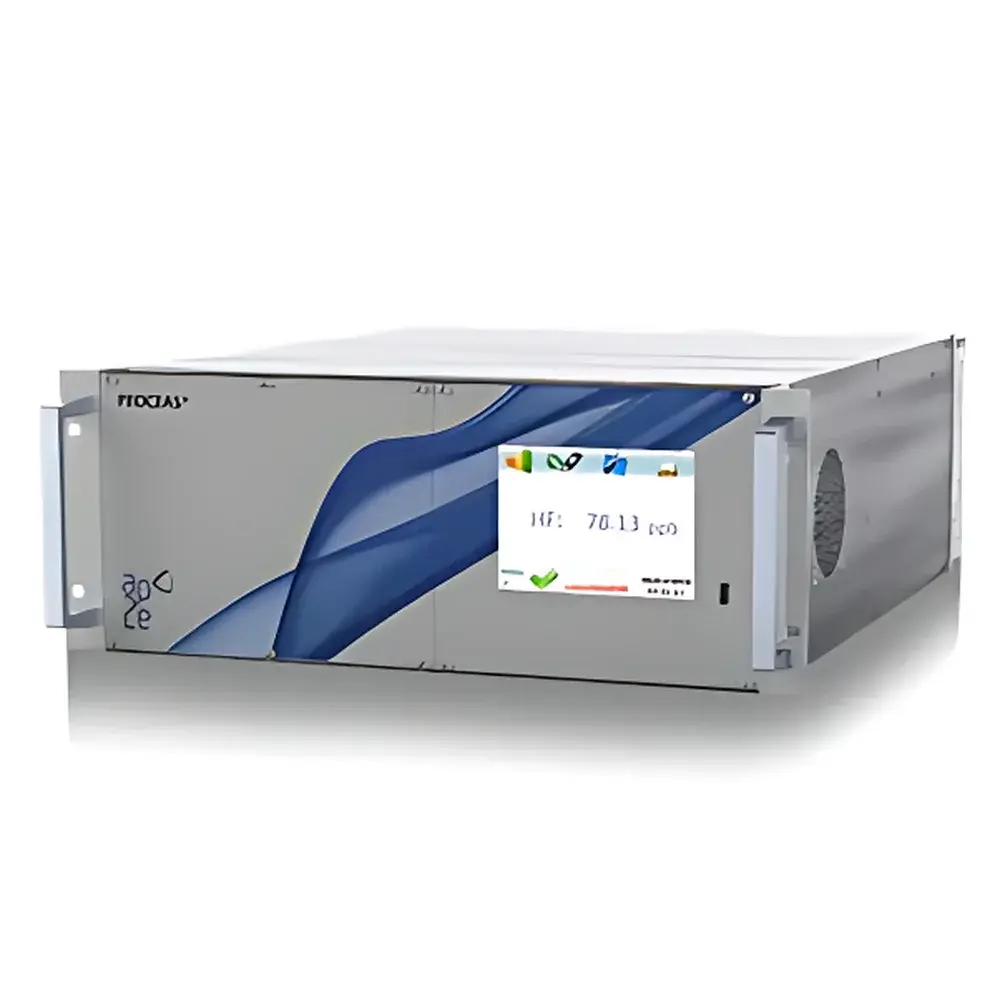
AP2E ProCeas® COS Analyzer
| Brand | AP2E |
|---|---|
| Origin | France |
| Model | ProCeas COS |
| Detection Principle | Optical-Feedback Cavity-Enhanced Absorption Spectroscopy (OF-CEAS) |
| Detection Limit (3σ, 60 s) | 2 ppb |
| Precision (1σ) | 0.6 ppb + 0.5% of reading |
| Zero Drift (72 h) | ±0.20 ppb |
| Measurement Interval | 1 s |
| Response Time (10–90%) | <60 s |
| Measurement Range | 0–10 ppm |
| Cavity Temperature Stability | ±0.002 K (1 s), ±5×10⁻⁵ K (30 min) |
| Cavity Pressure Control | ±0.016 mbar |
| Sample Temperature Range | −10 to +45 °C |
| Sample Humidity Limit | <99% RH (non-condensing) |
| Sample Flow Rate | >400 mL/min |
| Data Outputs | Ethernet, Modbus TCP/IP & RTU, Analog (4–20 mA / 0–10 V), USB |
| Power Supply | 110–230 VAC, 50–60 Hz |
| Power Consumption | 150 VA |
| Dimensions | 19″ rack-mount, 4U |
| Weight | 20 kg |
Overview
The AP2E ProCeas® COS Analyzer is a turnkey, high-precision, continuous online gas analyzer engineered for the quantitative measurement of carbonyl sulfide (OCS) in ambient air and controlled laboratory environments. It employs Optical-Feedback Cavity-Enhanced Absorption Spectroscopy (OF-CEAS), a patented laser absorption technique (WO03031949) that achieves sub-part-per-trillion sensitivity through optical resonance enhancement in a high-finesse cavity. Unlike conventional non-dispersive infrared (NDIR) or electrochemical sensors, OF-CEAS leverages three ultra-high-reflectivity mirrors (>99.999%) to extend the effective optical path length to tens of kilometers within a compact 25 mL measurement cell—enabling exceptional specificity, long-term stability, and immunity to spectral interferences from CO2, H2O, CH4, and other common atmospheric constituents. The instrument is factory pre-calibrated using NIST-traceable OCS standards and requires no external span gas or manual zeroing during routine operation. Its design addresses the critical need for robust, drift-free OCS quantification in ecosystem-scale carbon cycle research, where OCS serves as a quantitative tracer of gross primary production (GPP)—a parameter inaccessible via CO2 flux measurements alone due to concurrent respiratory CO2 release.
Key Features
- True direct-draw sampling: No chemical scrubbers, permeation dryers, or catalytic converters required—minimizes memory effects and preserves native sample integrity.
- Patented low-pressure sampling module (WO2010058107): Maintains sample pressure below dew point across full operational humidity range (≤99% RH, non-condensing), eliminating condensation-induced baseline artifacts and mirror contamination.
- Active thermal stabilization: Dual-stage cavity temperature control with stability of ±0.002 K over 1 second and ±5×10⁻⁵ K over 30 minutes—ensuring sub-ppb repeatability under variable ambient conditions.
- High-fidelity pressure regulation: Closed-loop cavity pressure control (±0.016 mbar) compensates for barometric fluctuations and flow-induced transients, preserving Beer-Lambert linearity.
- Low-adsorption fluidic architecture: Entire sample path—including inlet tubing, valves, and cavity surfaces—is constructed from electropolished stainless steel and fluoropolymer-coated components validated per ASTM D6866 and ISO 14855 for minimal surface reactivity with sulfur-containing species.
- Self-diagnostic firmware: Real-time monitoring of laser lock status, cavity alignment, mirror reflectivity decay, and signal-to-noise ratio—with automated alerts and log-triggered recalibration flags compliant with GLP audit requirements.
Sample Compatibility & Compliance
The ProCeas® COS Analyzer is designed for unattended, long-term deployment in field stations, eddy covariance towers, and climate-controlled growth chambers. It accepts raw ambient air across −10 to +45 °C and up to 99% relative humidity without desiccation or heating—enabled by its integrated low-pressure sampling strategy. All wetted materials comply with USP Class VI biocompatibility standards and are certified free of copper, brass, or nickel alloys that catalyze OCS decomposition. The system meets IEC 61326-1 (EMC for laboratory equipment) and IEC 61000-4 series immunity requirements. Data acquisition and storage support 21 CFR Part 11-compliant electronic signatures when paired with AP2E’s optional secure logging software—providing full audit trails, user access controls, and immutable record retention for regulatory submissions under EPA Method TO-15, ISO 14644-1 cleanroom monitoring protocols, and IPCC Tier 3 carbon accounting frameworks.
Software & Data Management
Instrument control, real-time visualization, and post-processing are managed via AP2E’s cross-platform ProCeas Control Suite (v5.2+), compatible with Windows, Linux, and macOS. The suite implements a hierarchical data model aligned with CF Metadata Conventions v1.8, enabling seamless ingestion into FluxNet, AmeriFlux, and ICOS data portals. Raw spectra, calibrated concentration time series, cavity diagnostics, and environmental metadata (T, P, RH, flow) are logged at 1 Hz with nanosecond timestamp precision via PTPv2 (IEEE 1588) synchronization. Export formats include NetCDF-4 (with embedded provenance attributes), CSV (ISO 8601 timestamps), and binary HDF5. Remote access is supported via TLS 1.3-encrypted Modbus TCP/IP or RESTful API endpoints—allowing integration into SCADA systems, LIMS platforms, and cloud-based analytics pipelines (e.g., AWS IoT Core, Azure Time Series Insights). Firmware updates preserve calibration history and maintain traceability to original factory certification certificates.
Applications
- Ecosystem-scale carbon flux partitioning: Quantifying gross primary productivity (GPP) across forest canopies, grasslands, and agricultural fields using OCS uptake as a photosynthetic proxy independent of ecosystem respiration.
- Plant physiology studies: Single-leaf gas exchange measurements under controlled light, CO2, and drought stress—leveraging 1 Hz temporal resolution to resolve rapid stomatal responses.
- Atmospheric chemistry modeling: Providing boundary condition constraints for global transport models (e.g., GEOS-Chem, CESM) through continuous OCS vertical profiling in tall-tower and aircraft campaigns.
- Soil-atmosphere exchange: Coupling with automated soil chambers to isolate biogenic OCS emissions from microbial sulfate reduction and abiotic mineral weathering processes.
- Calibration transfer validation: Serving as a primary reference standard for intercomparing quantum cascade laser (QCL) and mid-IR photoacoustic spectrometers in metrology laboratories.
FAQ
Does the ProCeas® COS Analyzer require periodic calibration with certified gas standards?
No. The instrument features an integrated wavelength reference cell and cavity-length stabilization loop that maintains absolute accuracy without external span gases. Annual verification against NIST-traceable OCS standards is recommended for ISO/IEC 17025 accreditation but not required for operational continuity.
Can it operate continuously in high-humidity tropical environments?
Yes. The patented low-pressure sampling system prevents condensation at all humidity levels ≤99% RH, even at 45 °C ambient temperature—validated across 18-month deployments in Amazonian and Southeast Asian flux towers.
Is the measurement affected by co-located CO2 analyzers emitting IR radiation?
No. OF-CEAS operates at 5.36 µm (1865 cm−1)—a spectral region isolated from CO2 Q-branch interference—and incorporates active laser frequency dithering and cavity mode-hop rejection algorithms to suppress broadband IR noise.
What maintenance is required over a 12-month field deployment?
Only quarterly inspection of inlet particulate filters and annual replacement of the internal desiccant cartridge (included in maintenance kit AP2E-MK-COS-1Y). No optical alignment, mirror cleaning, or laser recalibration is necessary.
How is data integrity ensured during power interruptions?
The unit includes a non-volatile memory buffer retaining ≥72 hours of 1 Hz data and full diagnostic logs. Upon power restoration, it resumes acquisition with synchronized timestamps and auto-reconciles gaps using internal atomic clock drift compensation.
Related Products







