
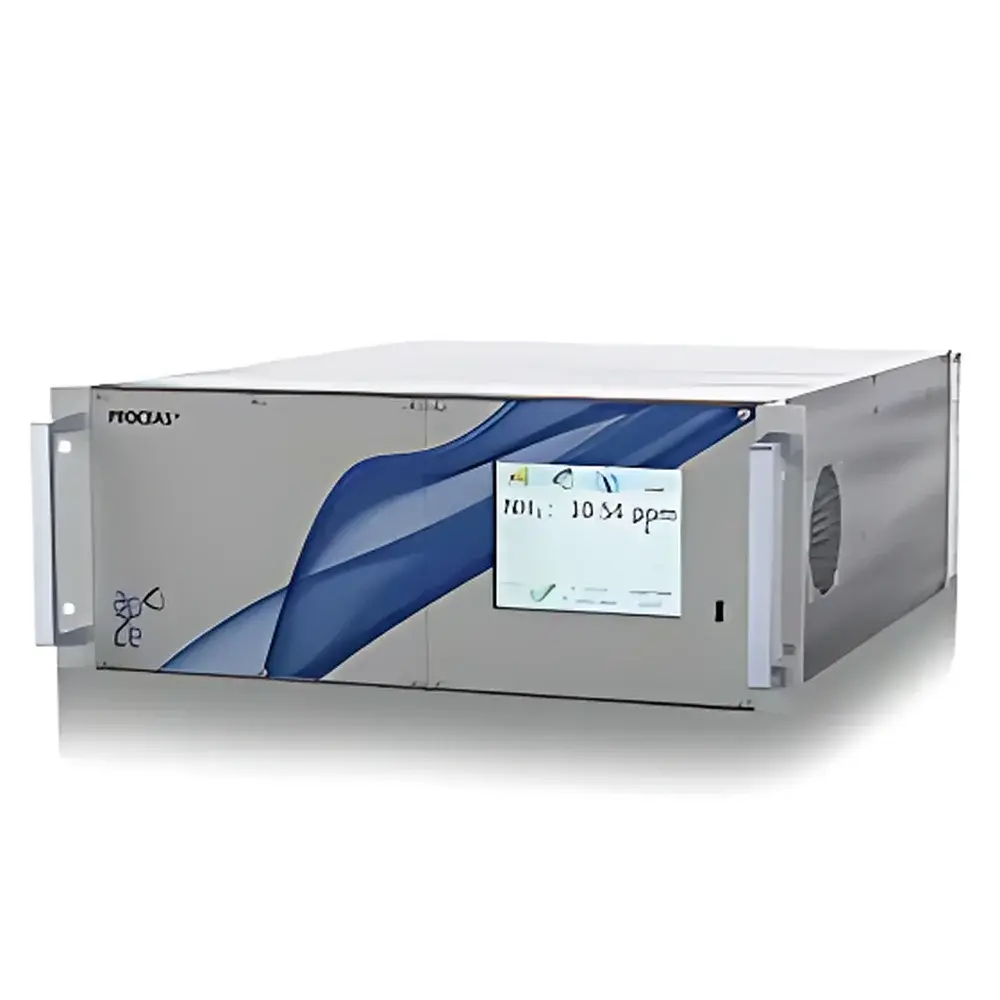
AP2E ProCeas® HCHO Formaldehyde Analyzer
| Brand | AP2E |
|---|---|
| Origin | France |
| Model | ProCeas HCHO |
| Detection Principle | Optical-Feedback Cavity-Enhanced Absorption Spectroscopy (OF-CEAS) |
| Detection Limit (3σ, 60 s) | <1 ppb |
| Accuracy (1σ) | 0.15 ppb + 0.1% of reading @ 300 s |
| Zero Drift (72 h) | ±0.20 ppb |
| Measurement Interval | 1 Hz |
| Measurement Range | 0–10 ppm |
| Temperature Control Stability | ±0.002 K @ 1 s |
| Pressure Control Stability | ±0.016 mbar |
| Sample Flow Rate | >400 mL/min |
| Operating Temperature | −10 to +45 °C |
| Relative Humidity | <99% RH, non-condensing |
| Data Interfaces | Ethernet, Modbus TCP/IP & RTU, Analog Outputs, USB |
| Power Supply | 110–230 VAC, 50–60 Hz |
| Power Consumption | 150 VA |
| Dimensions | 19″ rack-mount, 4U |
| Weight | 20 kg |
Overview
The AP2E ProCeas® HCHO Formaldehyde Analyzer is a high-precision, continuous online gas analyzer engineered for trace-level formaldehyde (HCHO) quantification in ambient air, cleanroom environments, semiconductor process gases, and industrial emission streams. It employs Optical-Feedback Cavity-Enhanced Absorption Spectroscopy (OF-CEAS), a patented spectroscopic technique (WO 03031949) that combines ultra-high-finesse optical cavities with active laser frequency stabilization. Unlike conventional absorption methods, OF-CEAS achieves effective optical path lengths exceeding 20 km within a compact 25 mL measurement cell—enabling sub-part-per-trillion sensitivity without cryogenic cooling or chemical derivatization. The system operates at precisely controlled temperature (±0.002 K over 1 s) and pressure (±0.016 mbar), minimizing thermal and barometric drift while ensuring metrological traceability. Its fully pre-calibrated architecture eliminates the need for external span gases or manual zero adjustments during routine operation.
Key Features
- Direct extractive sampling with no sample conditioning, scrubbing, or catalytic conversion required
- Patented low-pressure sampling module (WO2010058107) prevents condensation and surface adsorption artifacts in humid or variable-temperature streams
- Three-mirror optical cavity with mirror reflectivity >99.999%, enabling long photon residence time and exceptional signal-to-noise ratio
- Real-time self-diagnostic routines monitor cavity alignment, laser lock status, and pressure/temperature stability
- Drift-free performance validated over 72-hour intervals (±0.20 ppb zero drift), supporting unattended deployment in regulatory monitoring networks
- Rack-mount 4U form factor (19″) with integrated power supply, industrial-grade connectors, and EMI-hardened electronics
- Modular design allows field-replacement of critical subsystems—including optical head, vacuum pump, and analog I/O board—without recalibration
Sample Compatibility & Compliance
The ProCeas HCHO Analyzer accepts gaseous samples across a broad operational envelope: −10 to +45 °C inlet temperature, <99% RH (non-condensing), and flow rates ≥400 mL/min. Its chemically inert, low-adsorption stainless-steel and electropolished sampling path minimizes memory effects for formaldehyde—a highly reactive and surface-active molecule. The instrument meets ISO 16000-23 requirements for indoor air quality monitoring and supports compliance with EU Directive 2004/101/EC on VOC emissions. For pharmaceutical and semiconductor applications, its audit-ready data logging architecture aligns with FDA 21 CFR Part 11 (electronic records/signatures) and GLP/GMP validation protocols. All firmware and calibration parameters are digitally signed and version-controlled, enabling full traceability from factory certification to field operation.
Software & Data Management
The embedded Linux-based acquisition engine provides synchronized timestamping (NTP-supported), real-time spectral fitting using Voigt line-shape modeling, and automatic baseline correction via cavity mode tracking. Data output includes primary concentration values (ppb/ppm), raw absorbance spectra (16-bit), cavity transmission intensity, temperature/pressure logs, and diagnostic flags—all accessible via Ethernet (Modbus TCP/IP and RTU), isolated 4–20 mA analog outputs, or USB mass storage. Optional AP2E DataHub software enables remote configuration, multi-instrument fleet monitoring, automated report generation (PDF/CSV), and integration with SCADA or LIMS platforms. Audit trails record every user action, parameter change, and calibration event with immutable timestamps—essential for environmental reporting and regulatory submissions.
Applications
- Continuous emission monitoring (CEM) of formaldehyde from combustion sources, chemical synthesis units, and wood-processing facilities
- Intra-facility air quality surveillance in semiconductor cleanrooms (Class 1–100), where sub-ppb HCHO detection prevents photoresist contamination
- Validation of VOC abatement systems (e.g., thermal oxidizers, catalytic filters) through real-time inlet/outlet differential analysis
- Indoor air quality (IAQ) research in residential, educational, and healthcare buildings per ISO 16000-23 and WHO guidelines
- High-purity gas certification for electronics-grade nitrogen, argon, and specialty process gases (SEMI F21 compliant)
- Atmospheric chemistry studies requiring long-term stability and inter-laboratory comparability (e.g., ACTRIS, ICOS networks)
FAQ
Does the ProCeas HCHO require daily calibration gases?
No. The instrument performs autonomous zero and gain verification using internal reference cells and cavity resonance monitoring—eliminating dependence on external standard gases under normal operating conditions.
Can it measure other gases simultaneously?
Yes. Optional firmware modules enable concurrent quantification of CH4 (0–50 ppm) and H2O (0–5% RH) using the same optical path and detector array.
What maintenance is required over a 12-month period?
Scheduled maintenance includes replacement of the particulate filter (every 3 months), inspection of the inlet line integrity (biannually), and verification of mirror cleanliness (annually)—all documented in the onboard service log.
Is the system compatible with explosion-proof enclosures?
The base unit is rated for Class I, Division 2 environments; ATEX/IECEx-certified enclosure variants are available upon request for hazardous area deployment.
How is data integrity ensured during network outages?
Internal 16 GB flash memory buffers all primary and diagnostic data for up to 30 days. Upon network recovery, buffered records are transmitted with sequence-verified timestamps and cryptographic checksums.







