
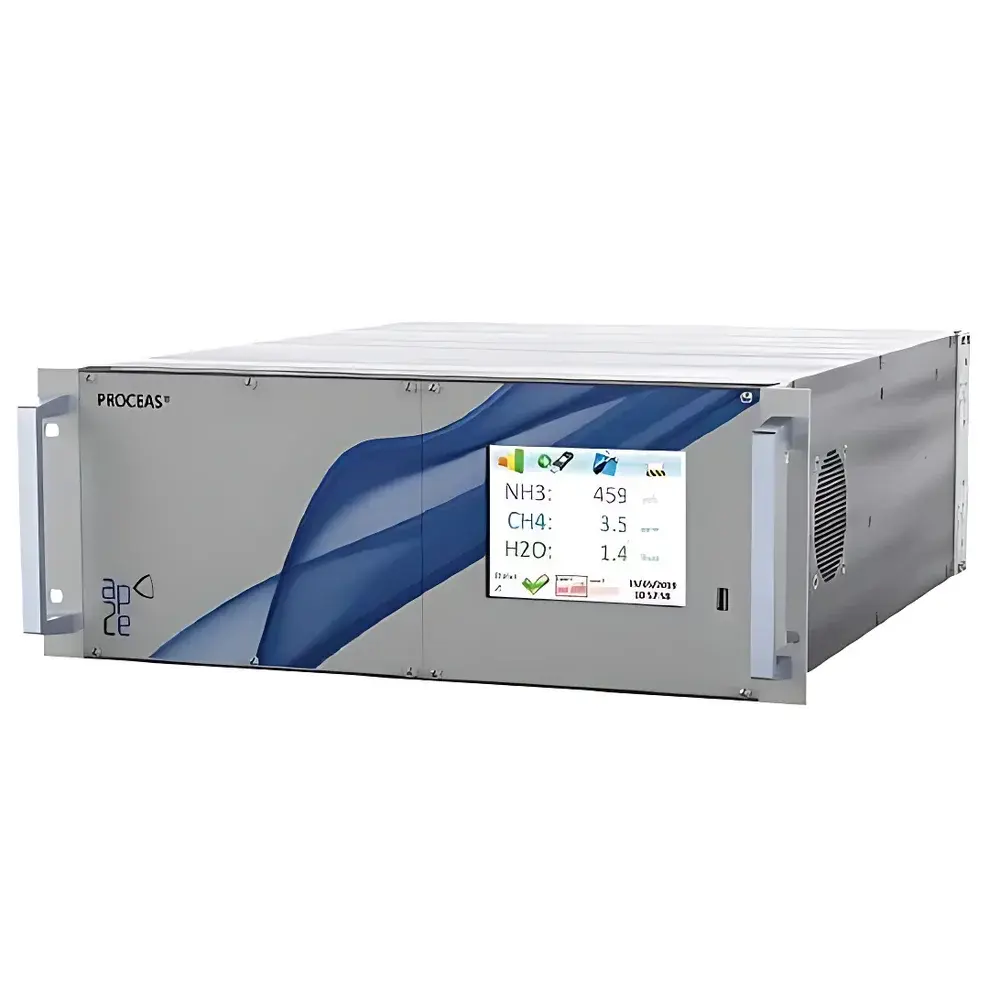
AP2E ProCeas® HCl Analyzer
| Brand | AP2E |
|---|---|
| Origin | France |
| Model | ProCeas HCl |
| Detection Principle | Optical-Feedback Cavity-Enhanced Absorption Spectroscopy (OF-CEAS) |
| HCl Detection Limit (3σ, 300 s) | 1 ppb |
| HCl Accuracy (1σ, 300 s) | 0.3 ppb + 0.1% of reading |
| HCl Measurement Range | 0–1000 ppb |
| H₂O Measurement Range | 0–5% |
| H₂O Detection Limit (3σ, 300 s) | 180 ppm |
| Zero Drift (72 h) | ±0.20 ppb |
| Response Time (10–90%) | <300 s |
| Measurement Interval | 2 s |
| Cavity Temperature Stability | ±0.002 K (1 s), ±5×10⁻⁵ K (30 min) |
| Cavity Pressure Stability | ±0.016 mbar |
| Sample Temp. Range | −10 to +45 °C |
| Max. Sample Humidity | <99% RH (non-condensing) |
| Sample Flow Rate | >400 mL/min |
| Data Interfaces | Ethernet, Modbus TCP/IP & RTU, Analog Outputs, USB |
| Power | 110–230 VAC, 50–60 Hz, 150 VA |
| Dimensions | 19″ rack-mount, 4U |
| Weight | 20 kg |
Overview
The AP2E ProCeas® HCl Analyzer is a high-precision, continuous-emission monitoring (CEM) instrument engineered for trace-level quantification of hydrogen chloride (HCl) in ambient air, cleanroom environments, and industrial process streams. It employs Optical-Feedback Cavity-Enhanced Absorption Spectroscopy (OF-CEAS), a patented spectroscopic technique (WO03031949) that combines ultra-high-finesse optical cavities with active laser frequency stabilization. Unlike conventional NDIR or CRDS-based analyzers, OF-CEAS achieves effective optical path lengths exceeding 20 km within a compact 25 mL measurement cell—enabling sub-part-per-trillion sensitivity without cryogenic cooling or vacuum pumping. The analyzer operates on direct extractive sampling with no chemical scrubbing, catalytic conversion, or permeation drying required, preserving native gas-phase speciation and eliminating memory effects associated with surface adsorption.
Key Features
- Patented OF-CEAS detection platform delivering 1 ppb HCl detection limit (3σ, 300 s integration) and <0.20 ppb zero drift over 72 hours
- Integrated low-pressure sampling module (patent WO2010058107) preventing condensation-induced measurement artifacts in humid or variable-temperature sample streams
- Triple-mirror optical cavity with mirror reflectivity >99.999%, enabling exceptional spectral resolution and long-term baseline stability
- Active thermal control of the measurement cavity: ±0.002 K short-term stability (1 s), ±5×10⁻⁵ K over 30 minutes—critical for minimizing temperature-dependent spectral broadening
- Pressure-regulated cavity (±0.016 mbar) ensures stoichiometric consistency between calibration and field measurements under fluctuating stack or duct conditions
- Self-calibrating architecture: no external span gases required; zero and gain corrections are performed automatically using internal reference channels and spectral fitting algorithms
- Low-adsorption flow path constructed from electropolished stainless steel and PFA-lined components, validated per ASTM D6348 and ISO 12039 protocols for halogenated compound analysis
Sample Compatibility & Compliance
The ProCeas HCl Analyzer is validated for operation across diverse sampling matrices including flue gas (post-SCR/FF), semiconductor fab exhaust, pharmaceutical synthesis off-gas, municipal waste incinerator emissions, and cement kiln bypass streams. It meets EN 15267-3 (QAL1 certification readiness), complies with EPA Method 26A performance criteria for HCl CEMS, and supports GLP/GMP data integrity requirements via embedded audit trails, user-access controls, and electronic signature capability. All firmware and calibration records are timestamped and exportable in CSV/JSON formats compatible with LIMS and EPA CDX submission workflows. The system satisfies IEC 61508 SIL2 functional safety requirements for critical emission monitoring applications.
Software & Data Management
The embedded Linux-based acquisition engine provides real-time spectral processing using least-squares multivariate fitting against high-resolution HITRAN-based HCl line databases. Data output includes primary HCl concentration (ppb), H₂O concentration (%), cavity pressure (mbar), cavity temperature (K), laser current (mA), and residual fit error metrics—all timestamped at 2 s intervals. Communication interfaces include Modbus TCP/IP (register-mapped), RS-485 Modbus RTU, 4–20 mA analog outputs (user-configurable range), and USB host for local diagnostics. Remote configuration, firmware updates, and spectral diagnostics are accessible via secure HTTPS web interface compliant with TLS 1.2 and password-protected role-based access (Admin, Operator, Viewer). Raw interferograms and processed spectra are stored onboard for ≥30 days and exportable for third-party validation.
Applications
- Continuous compliance monitoring of HCl emissions from waste-to-energy plants and hazardous waste incinerators per EU IED and US EPA 40 CFR Part 60 Subpart Ea
- In-line process control in semiconductor etch chamber exhaust management, where sub-ppb HCl detection enables real-time endpoint determination and abatement optimization
- Pharmaceutical API manufacturing: verification of HCl scavenger efficiency during deprotection steps and cleaning validation of reactor vessels
- Environmental monitoring networks measuring background HCl in coastal and urban atmospheres for acid deposition modeling
- Research applications in atmospheric chemistry requiring simultaneous HCl and H₂O co-quantification with trace-level precision and minimal cross-sensitivity
FAQ
Does the ProCeas HCl Analyzer require periodic calibration with certified gas standards?
No. The instrument performs automated zero and gain correction using its internal spectral reference channel and cavity-length tracking algorithm. External calibration is optional and only recommended annually for regulatory audit purposes.
Can it operate reliably in high-humidity sample streams?
Yes. The patented low-pressure sampling system maintains sample dew point below ambient temperature throughout the measurement train, preventing condensation even at 99% RH. No Nafion dryers or chiller units are required.
Is the analyzer compatible with existing CEMS infrastructure?
Yes. It supports Modbus TCP/IP and 4–20 mA analog outputs configured to match legacy DCS/PLC input specifications. Rack-mount form factor (19″, 4U) allows seamless integration into standard CEMS shelters.
What maintenance is required over a 12-month operational cycle?
Routine maintenance consists of quarterly particulate filter replacement and annual inspection of inlet tubing and O-rings. No optical alignment, laser replacement, or cavity cleaning is required under normal operating conditions.
How is data integrity ensured for regulatory reporting?
All measurements include embedded timestamps, operator IDs, calibration event logs, and cryptographic hash signatures. Audit trail files comply with FDA 21 CFR Part 11 requirements for electronic records and signatures.







