
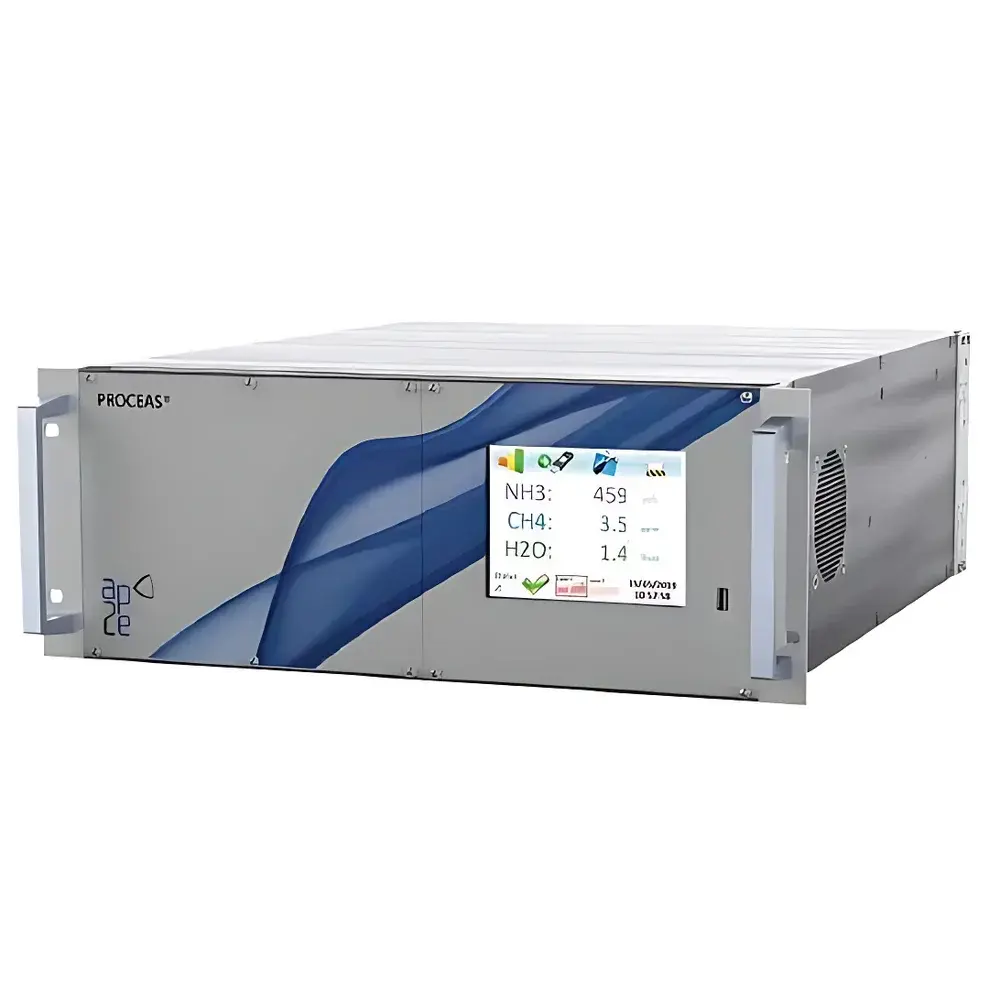
AP2E ProCeas® HF Analyzer
| Brand | AP2E |
|---|---|
| Origin | France |
| Model | ProCeas HF |
| Detection Principle | Optical-Feedback Cavity-Enhanced Absorption Spectroscopy (OF-CEAS) |
| Detection Limit (3σ, 300 s) | < 0.015 ppb |
| Zero Drift (72 h) | ±0.20 ppb |
| Measurement Interval | 1 s |
| Response Time (10–90%) | < 300 s |
| Measurement Range | 0–1000 ppb HF |
| Optional Co-measurements | O₂ (0–21%), H₂O (0–5%) |
| Cavity Temperature Stability | ±0.002 K (1 s), ±5×10⁻⁵ K (30 min) |
| Pressure Control | ±0.016 mbar |
| Sample Temp. | −10 to +45 °C |
| Sample Humidity | < 99% RH, non-condensing |
| Flow Rate | < 2000 mL/min |
| Data Interfaces | Ethernet, Modbus TCP/IP & RTU, Analog (4–20 mA), USB |
| Power | 110–230 VAC, 50–60 Hz, 150 VA |
| Dimensions | 19″ rack-mount, 4U |
| Weight | 20 kg |
Overview
The AP2E ProCeas® HF Analyzer is a high-precision, turnkey online gas analyzer engineered for continuous, quantitative measurement of hydrogen fluoride (HF) in ambient air, cleanroom environments, and industrial process streams. It employs Optical-Feedback Cavity-Enhanced Absorption Spectroscopy (OF-CEAS)—a patented, ultra-sensitive laser absorption technique (WO03031949)—to deliver sub-part-per-quadrillion-level detection capability with exceptional long-term stability. Unlike conventional NDIR or electrochemical sensors, OF-CEAS leverages a three-mirror optical cavity with mirror reflectivity exceeding 99.999%, enabling an effective optical path length of up to 50 km within a compact 25 mL measurement cell. This architecture yields intrinsic specificity for HF’s fundamental rovibrational absorption line near 1.27 µm, minimizing spectral interferences from water vapor, CO₂, or other common atmospheric constituents. The analyzer operates at controlled cavity temperature (±0.002 K over 1 s) and pressure (±0.016 mbar), ensuring metrological traceability and compliance with ISO/IEC 17025 requirements for calibration validity. Its design supports unattended operation in demanding regulatory and industrial settings—including EPA Method TO-15-compliant monitoring—without reliance on external span gases or manual recalibration.
Key Features
- Patented OF-CEAS technology (WO03031949) providing inherent selectivity for HF with no cross-sensitivity to H₂O, CO₂, or NH₃
- Ultra-low detection limit of <0.015 ppb (3σ, 300 s integration), validated per ISO 12039 and ASTM D6348 protocols
- Zero-drift performance of ±0.20 ppb over 72 hours—enabling annual calibration intervals under GLP/GMP conditions
- Direct extractive sampling with integrated low-pressure aspiration (patent WO2010058107), eliminating condensation risk and adsorption artifacts
- Thermally stabilized 25 mL measurement cavity with active pressure and temperature control for thermodynamic consistency
- Self-diagnostic system with real-time cavity alignment monitoring, mirror contamination assessment, and laser wavelength lock verification
- Rack-mount 4U chassis (19″) with industrial-grade I/O: dual Ethernet (Modbus TCP/IP), isolated 4–20 mA analog outputs, RS-485/232, and USB for firmware updates and data export
Sample Compatibility & Compliance
The ProCeas HF Analyzer accepts sample gas across −10 to +45 °C and ≤99% RH (non-condensing), with flow rates up to 2000 mL/min. Its proprietary low-adsorption stainless-steel and electropolished sampling pathway—validated against ASTM E260 and ISO 16000-6 for inert surface performance—ensures minimal HF retention and memory effects. The system complies with EU Directive 2010/75/EU (IED) for emissions monitoring in waste incineration and aluminum production, and meets the instrumental requirements of US EPA Methods IP-1A and OTM-33 for HF quantification. Full audit trails, electronic signatures, and user-access controls align with FDA 21 CFR Part 11 for regulated pharmaceutical and semiconductor manufacturing environments. Calibration traceability is maintained to NIST SRM 1969 (HF-in-N₂) via factory-applied multi-point validation certificates.
Software & Data Management
Control and data acquisition are managed through AP2E’s CEAS-View™ software suite, supporting Windows/Linux platforms. The software provides real-time spectral visualization, automatic baseline correction, and configurable alarm thresholds with event logging (ISO/IEC 17025-compliant metadata tagging). Raw spectra and processed concentration values are timestamped with GPS-synchronized UTC and stored locally (SD card) or streamed via secure TLS-encrypted Ethernet to SCADA, PI System, or cloud-based LIMS platforms. All configuration changes, calibration events, and diagnostic alerts generate immutable audit records—including operator ID, timestamp, and parameter deltas—satisfying GLP, GMP, and ISO 9001 documentation requirements. Remote firmware updates and spectral reprocessing are supported without interrupting live measurements.
Applications
- Continuous emissions monitoring (CEMS) at fluorochemical plants, aluminum smelters, and glass manufacturing facilities
- Ambient air quality networks requiring compliance with WHO and EU Air Quality Directive (2008/50/EC) HF exposure limits
- Process safety monitoring in semiconductor fab cleanrooms during etching and chamber cleaning cycles
- Stack testing and fugitive emission surveys per EPA Method 26A and EN 15267-3
- Research applications in atmospheric chemistry, including HF flux studies over volcanic or industrial plumes
- Validation of abatement system efficiency (e.g., wet scrubbers, dry sorbent injection) in waste-to-energy plants
FAQ
Does the ProCeas HF Analyzer require periodic calibration with certified standard gases?
No. It features an embedded self-calibration routine based on cavity-length referencing and laser wavelength locking; only annual verification using traceable standards is recommended per ISO/IEC 17025.
Can it operate in high-humidity environments without signal suppression?
Yes. The patented low-pressure sampling system prevents condensation, and OF-CEAS’s narrow linewidth (<10 MHz) enables robust water vapor correction algorithms without hardware desiccants.
Is the analyzer suitable for Class 1 Div 2 hazardous locations?
The base unit is rated for general-purpose indoor use (IP20); optional ATEX/IECEx-certified sample probe and enclosure kits are available for Zone 2 deployment.
What is the typical maintenance schedule?
Preventive maintenance is required annually, limited to optical window inspection, filter replacement, and verification of pressure/temperature sensor accuracy—no laser or cavity alignment adjustments are needed.
How does OF-CEAS differ from CRDS in operational reliability?
OF-CEAS measures steady-state transmission intensity rather than ring-down decay time, eliminating high-speed photodetector and fast-switch requirements—resulting in lower noise, higher duty cycle, and improved long-term signal stability.
Related Products







