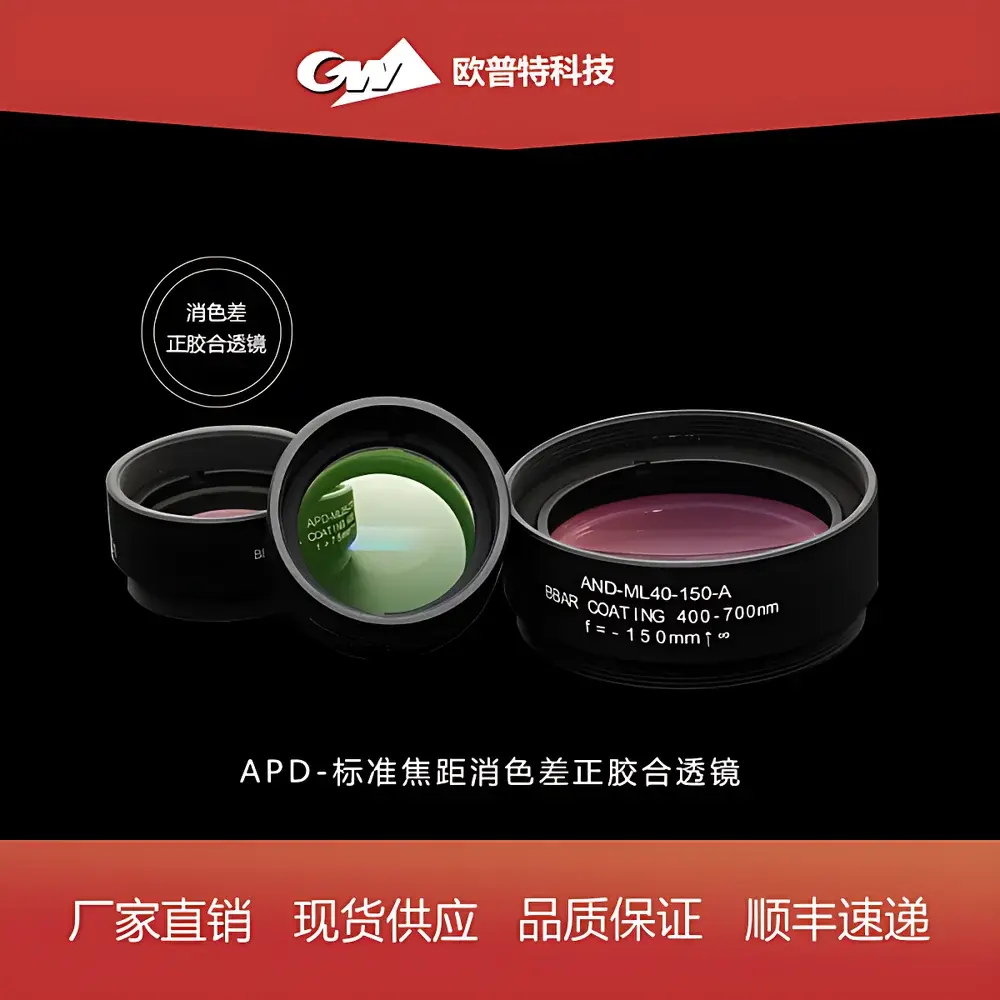
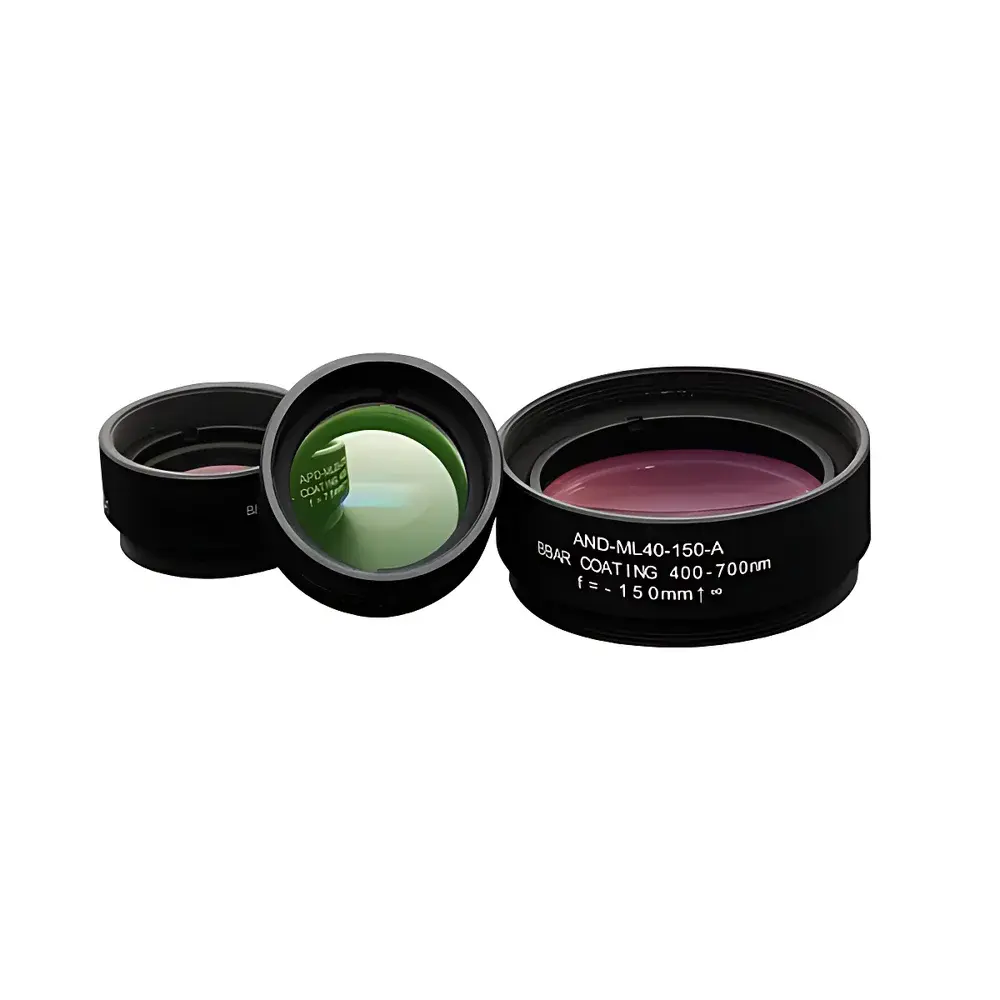
APD-ML Series Mounted Achromatic Doublet Lenses
| Origin | Beijing, China |
|---|---|
| Manufacturer Type | Authorized Distributor |
| Product Origin | Domestic (China) |
| Model | APD-ML50 / APD-ML40 |
| Component Category | Optical Elements |
| Mounting | Threaded Lens Housing (M52×0.75 or M48×0.75) |
| Available Focal Lengths | 63–4000 mm |
| Clear Aperture | 38 mm (40 mm mount) or 48 mm (50 mm mount) |
| Coating | Broadband Antireflection (VIS, 400–700 nm) |
| Material | BK7 / SF2 or Equivalent Crown-Flint Pair |
Overview
The APD-ML Series consists of precision-mounted achromatic doublet lenses engineered for high-fidelity optical systems requiring minimized chromatic and spherical aberration across the visible spectrum (400–700 nm). Each lens is constructed from a cemented pair of optical glasses—typically BK7 crown and SF2 flint—with optimized dispersion properties to achieve first-order correction of axial chromatic aberration. This design significantly reduces focal shift between blue (486.1 nm), green (587.6 nm), and red (656.3 nm) wavelengths, delivering tighter spot sizes and improved image fidelity compared to singlet lenses of equivalent focal length. The lenses are pre-aligned and permanently mounted in robust aluminum housings with standardized metric threading (M48×0.75 or M52×0.75), ensuring mechanical stability, repeatable positioning, and compatibility with industry-standard optomechanical components such as lens tubes, translation stages, and kinematic mounts.
Key Features
- Precision achromatic correction: Dual-wavelength (F-line & C-line) focus alignment ensures <1% longitudinal chromatic error over the VIS band.
- Pre-mounted configuration: Eliminates manual centering and cementing risks; reduces assembly time and alignment uncertainty in OEM and R&D systems.
- High surface quality: λ/4 wavefront accuracy at 632.8 nm, scratch-dig 40–20 per MIL-PRF-13830B.
- Broadband antireflection coating: Average reflectance <0.5% per surface across 400–700 nm; low polarization sensitivity.
- Thermally stable housing: Anodized aluminum mount with coefficient of thermal expansion matched to optical assembly requirements.
- Traceable metrology: Each lens batch undergoes interferometric verification of focal length (±0.2%), back focal distance (±0.15 mm), and centration error (<3 arcmin).
Sample Compatibility & Compliance
The APD-ML Series is compatible with standard optomechanical platforms including Thorlabs, Newport, and Edmund Optics mounting systems. All lenses meet ISO 10110-3 surface quality specifications and conform to RoHS Directive 2011/65/EU for hazardous substance restrictions. While not certified to ISO 9001 at the component level, manufacturing and testing follow documented procedures aligned with ISO 9001:2015 principles. The AR coating process complies with ISO 13665 for optical thin-film durability (adhesion, abrasion, humidity resistance). For regulated applications—including clinical imaging instrumentation or GLP-compliant spectroscopic setups—lens documentation includes lot traceability, coating spectral data, and calibrated focal length reports upon request.
Software & Data Management
No embedded firmware or proprietary software is associated with these passive optical components. However, comprehensive technical documentation—including Zemax-compatible .ZAR files (available on request), measured modulation transfer function (MTF) curves, point spread function (PSF) datasets, and coating spectral transmittance plots—is provided in standardized formats (CSV, PDF, STEP). Calibration certificates include NIST-traceable reference measurements where applicable. All data packages adhere to FAIR principles (Findable, Accessible, Interoperable, Reusable) and may be integrated into enterprise PLM or LIMS environments via API-accessible metadata schemas.
Applications
- Laser beam collimation and focusing in DPSS, diode, and fiber-coupled systems (e.g., 532 nm, 635 nm, 780 nm sources).
- Imaging optics for machine vision, fluorescence microscopy, and multispectral inspection systems requiring diffraction-limited performance.
- Spectrometer collimators and camera objectives in UV-VIS-NIR benchtop and portable analyzers.
- Optical train components in educational labs, interferometers, and Fourier transform spectrometers.
- Custom OEM integration in analytical instruments subject to IEC 61000-6-3 EMC and IEC 61326-1 measurement equipment standards.
FAQ
Are these lenses suitable for laser applications above 500 mW average power?
Yes—when operated within specified power density limits (≤500 W/cm² for CW visible lasers), provided proper beam homogenization and thermal management are implemented. Damage threshold testing per ISO 21254-1 is available upon request.
Do you provide custom focal lengths or non-standard coatings?
Yes—custom AR coatings (e.g., NIR-enhanced, UV-VIS, or dual-band) and focal lengths outside the standard catalog can be quoted with lead times of 8–12 weeks.
Is back focal distance guaranteed for system-level ray tracing?
Yes—each lens is individually measured using a commercial autocollimator-based focal station; BFD tolerance is ±0.15 mm and reported on the certificate of conformance.
Can these lenses be used in vacuum or high-humidity environments?
The aluminum housing and cemented design are rated for operation in 5–95% RH non-condensing environments. Vacuum use requires optional outgassing certification (per ASTM E595) and is available on special order.
What is the maximum permissible centration error for alignment-critical setups?
All APD-ML lenses are tested to ≤3 arcmin residual centration error (per ISO 10110-8); tighter tolerances (≤1 arcmin) are available under Premium Grade designation.