
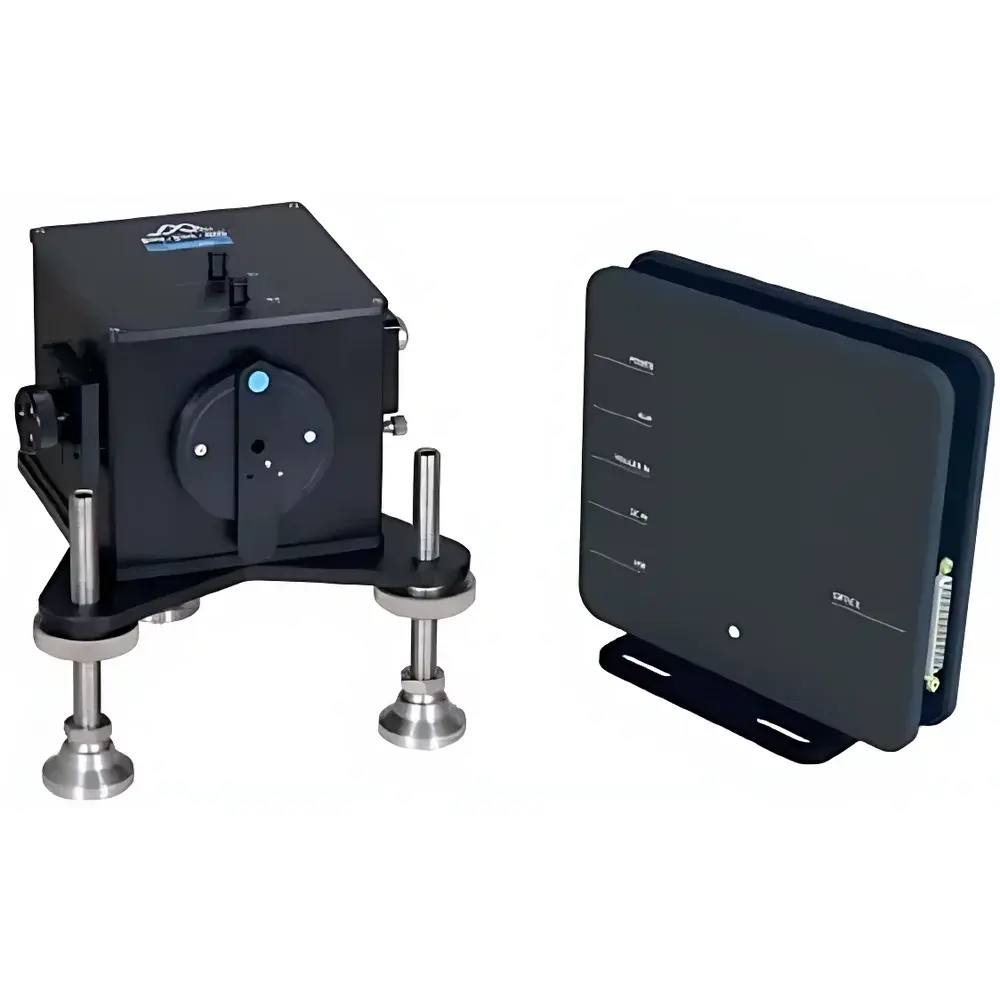

APE Mini USB Autocorrelator
| Brand | APE |
|---|---|
| Origin | Germany |
| Model | Mini USB |
| Measurement Principle | Second-Harmonic Generation (SHG) based Intensity Autocorrelation |
| Optical Architecture | Collinear or Non-Collinear Configuration |
| Wavelength Ranges | VIS I (420–550 nm), VIS II (540–750 nm), NIR (700–1100 nm), IR (1000–1600 nm) |
| Pulse Width Range | <20 fs (optional) to 3.5 ps |
| Scan Range | 150 fs – 15 ps |
| Minimum Measurable Pulse Width | 50 fs (down to <20 fs with optional short-pulse kit) |
| Scan Repetition Rate | ≥10 Hz |
| Input Polarization | Horizontal (polarization rotator optional) |
| Minimum Laser Repetition Rate | 300 Hz |
| Detector Options | Photomultiplier Tube (PMT, sensitivity: 10⁻⁴ W²) or Photodiode (PD, sensitivity: 1 W²) |
| Trigger Input | TTL, up to 10 kHz |
| Interface | USB 2.0 and RS-232 |
| Power Supply | 95–240 V AC, 50–60 Hz, 8 W |
| Display | Monochrome LCD (240 × 128 pixels) |
| Controller | miniLink (replaces legacy control unit), integrated real-time SHG signal acquisition and autocorrelation trace processing |
| Software | Windows-based APE Control Suite with real-time trace visualization, FWHM pulse width calculation, background subtraction, and export (CSV, PNG, ASCII) |
| Compliance | CE-marked |
Overview
The APE Mini USB Autocorrelator is a compact, high-fidelity intensity autocorrelator engineered for precise measurement of ultrashort laser pulses in research and industrial laser development laboratories. Based on second-harmonic generation (SHG) in nonlinear optical crystals, the instrument implements either collinear or non-collinear interferometric configurations to reconstruct the temporal intensity profile of femtosecond and picosecond pulses. Its core design adheres to fundamental principles of optical autocorrelation: splitting the input pulse into two time-delayed replicas, overlapping them in a nonlinear crystal, and detecting the SHG intensity as a function of optical path delay. This yields the intensity autocorrelation function, from which full-width-at-half-maximum (FWHM) pulse duration is derived—assuming standard pulse shapes (e.g., sech² or Gaussian) and deconvolution factors. The Mini USB operates across four spectral bands—VIS I (420–550 nm), VIS II (540–750 nm), NIR (700–1100 nm), and IR (1000–1600 nm)—enabling characterization of Ti:sapphire, Yb-fiber, Cr:forsterite, and OPO-based sources without hardware reconfiguration.
Key Features
- Plug-and-play operation via USB 2.0 interface—no external power supply or dedicated controller rack required
- Dual-mode optical architecture supporting both collinear and non-collinear SHG geometries for optimal signal-to-noise ratio across pulse durations and beam qualities
- miniLink digital controller: FPGA-based real-time delay scanning, synchronous data acquisition, and onboard autocorrelation computation at ≥10 Hz refresh rate
- High-resolution temporal sampling enabled by precision piezoelectric translation stage with sub-femtosecond step resolution and closed-loop position feedback
- Integrated monochrome LCD display (240 × 128 px) for standalone monitoring of scan progress, pulse width readout, and system status
- Configurable detector options: high-sensitivity PMT (10⁻⁴ W²) for low-energy oscillators or robust photodiode (1 W²) for amplifier outputs
- Optional polarization rotator for compatibility with vertically polarized input beams—critical for alignment with crystal phase-matching axes
Sample Compatibility & Compliance
The Mini USB is designed for free-space, TEM₀₀ Gaussian or near-Gaussian ultrashort pulses with horizontal linear polarization (vertical polarization supported via optional rotator). It accommodates repetition rates from 300 Hz upward, making it suitable for regenerative amplifiers, cavity-dumped oscillators, and fiber-based systems. Input energy per pulse should be adjusted via calibrated neutral-density filters to remain within detector saturation limits—particularly important for high-peak-power IR pulses (e.g., 1064 nm or 1550 nm), where optional IR viewing cards (e.g., model 84499-56) aid safe alignment. The system complies with EU CE directives for electromagnetic compatibility (EMC) and low-voltage equipment. Its software architecture supports timestamped measurement logs, user authentication, and parameter locking—features aligned with GLP and ISO/IEC 17025 documentation requirements. While not FDA 21 CFR Part 11 certified out-of-the-box, audit-trail functionality can be extended via third-party validation packages.
Software & Data Management
Control and analysis are performed using the APE Control Suite—a native Windows application distributing real-time autocorrelation traces, computed FWHM values, and normalized intensity profiles. The software implements automatic baseline correction, adjustable smoothing kernels, and selectable deconvolution assumptions (sech², Gaussian, Lorentzian). All acquired datasets are saved in machine-readable formats (CSV, ASCII) alongside metadata including date/time stamp, laser wavelength, selected range, detector type, and user ID. Exported traces retain full resolution (≥2048 data points per scan) for post-processing in MATLAB, Python (NumPy/SciPy), or OriginLab. Remote operation via TCP/IP is supported through optional API extensions, enabling integration into automated test benches governed by LabVIEW or Python-based control frameworks.
Applications
- Characterization of mode-locked oscillators (Ti:sapphire, Yb:KGW, Er:fiber) during cavity optimization
- Monitoring pulse compression dynamics in chirped-pulse amplification (CPA) systems before and after grating/pulse shaper adjustment
- Validation of dispersion compensation in hollow-core fiber compressors and multipass cells
- Quality assurance of commercial ultrafast lasers in OEM production lines
- Educational demonstrations of time-domain interferometry and nonlinear optical signal generation
- Time-resolved spectroscopy setup calibration—ensuring pump-probe temporal overlap fidelity
FAQ
What is the minimum measurable pulse duration with standard configuration?
The base Mini USB achieves reliable measurements down to 50 fs FWHM. Pulses shorter than 20 fs require the optional Short-Pulse Kit, which includes optimized crystal thickness and dispersion-compensated optics.
Can the Mini USB measure vertically polarized input beams?
Yes—when equipped with the optional polarization rotator, enabling alignment with the nonlinear crystal’s phase-matching axis regardless of incident polarization orientation.
Is attenuation necessary for high-energy laser sources?
Yes. Input fluence must be reduced to avoid crystal damage or detector saturation. A calibrated ND filter set (OD 1–4) is recommended for amplifier outputs (>1 µJ/pulse) or high-repetition-rate Yb-fiber systems.
Does the system support real-time monitoring during laser tuning?
Yes—the ≥10 Hz scan rate and USB streaming enable live trace updates synchronized with cavity mirror adjustments or compressor grating rotations.
How is compliance with laboratory quality standards addressed?
Measurement logs include operator ID, timestamp, instrument serial number, and configuration parameters—satisfying traceability requirements under ISO/IEC 17025. Optional electronic signature modules enable 21 CFR Part 11 readiness.





