
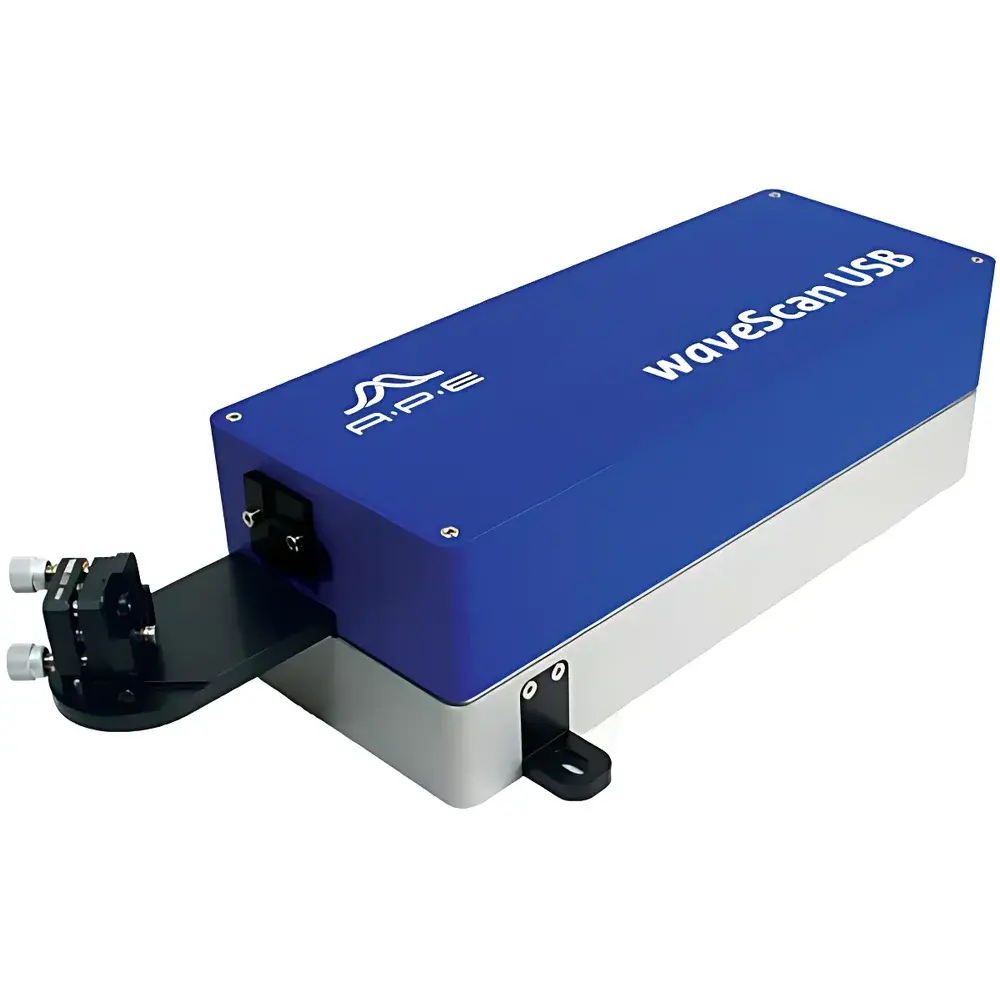

APE Wavescan USB Laser Wavelength Meter
| Brand | APE |
|---|---|
| Origin | Germany |
| Model | Wavescan USB |
| Wavelength Range | 200–2600 nm (configurable by optical module) |
| Resolution | <0.2 nm (standard), <0.1 nm (Blue HR module), <0.5 nm (Extended IR module) |
| Accuracy | ±0.2 nm (±0.1 nm with Blue HR module) |
| Scan Rate | ~6 Hz |
| Input Options | Free-space and optional fiber coupling (SMA, FC/PC, FC/APC) |
| Supported Laser Types | CW and pulsed lasers with repetition rate >1 kHz (accumulation mode) or CW/≥4 MHz (real-time mode) |
| Interface | USB 2.0 |
| Software | Windows-compatible control and analysis suite |
Overview
The APE Wavescan USB Laser Wavelength Meter is a compact, high-precision interferometric wavelength measurement system engineered for laboratory and industrial laser characterization environments. Unlike dispersive spectrometers, the Wavescan USB employs a scanning Michelson interferometer architecture—optimized for absolute wavelength determination via Fourier-transform principles—delivering superior accuracy, repeatability, and dynamic range compared to grating-based monochromators. Designed specifically for continuous-wave (CW) and repetitively pulsed lasers (repetition rates ≥1 kHz in accumulation mode; ≥4 MHz in real-time mode), it eliminates reliance on calibration references during routine operation. Its modular optical path accommodates multiple spectral configurations—from deep ultraviolet (200–1050 nm) to mid-infrared (1000–2600 nm)—enabling traceable, NIST-compatible measurements across diverse laser technologies including Ti:sapphire, Yb-fiber, OPOs, quantum cascade lasers, and diode-pumped solid-state sources.
Key Features
- Modular spectral coverage: Eight interchangeable optical modules support tailored wavelength ranges—including UV2 (200–1050 nm), UV (250–1100 nm), Blue HR (350–800 nm), Blue (350–1100 nm), VIS/IR (500–1600 nm), IR (800–1600 nm), VIS (500–1100 nm), and Extended IR (1000–2600 nm)
- High-resolution detection: Standard resolution <0.2 nm; enhanced to <0.1 nm with Blue HR module for demanding visible-spectrum applications
- Traceable accuracy: Absolute wavelength accuracy of ±0.2 nm (±0.1 nm with Blue HR), validated against stabilized HeNe and iodine-stabilized lasers per ISO 13694 and ISO/TR 11146 standards
- Dual-input flexibility: Native free-space beam input with optional fiber-coupled interfaces (SMA 905, FC/PC, FC/APC) for integration into OEM laser systems or fiber-optic test benches
- Real-time acquisition: Scanning rate of approximately 6 Hz enables dynamic monitoring of wavelength drift, mode hops, and thermal tuning behavior
- USB 2.0 interface with low-latency communication: Fully compatible with Windows 10/11; no external power supply required
Sample Compatibility & Compliance
The Wavescan USB is optimized exclusively for collimated, spatially coherent laser sources. It supports input beam diameters from 0.5 mm to 5 mm (adjustable aperture), power levels from 10 µW to 5 mW (dependent on module and wavelength), and polarization-insensitive operation. The instrument complies with IEC 61000-6-3 (EMC emission) and IEC 61010-1 (safety requirements for electrical equipment). Measurement traceability aligns with ISO/IEC 17025 guidelines when operated within calibrated environmental conditions (23 ± 2 °C, <60% RH). While not certified for FDA 21 CFR Part 11 out-of-the-box, audit-ready data export (CSV, XML) and software logging features support GLP/GMP workflows when paired with validated lab information management systems (LIMS).
Software & Data Management
The included Wavescan Control Software provides intuitive, scriptable control via a native Windows GUI. Functions include automated wavelength sweep, peak identification, multi-line analysis, real-time drift tracking, and overlay of historical measurement series. Raw interferogram data and processed spectra are exportable in ASCII, CSV, and HDF5 formats. API support (DLL and .NET wrappers) enables integration with LabVIEW, MATLAB, Python (via PyWin32), and custom C++ applications. All measurement sessions include embedded metadata: timestamp, module ID, input configuration, environmental sensor readings (optional external temperature/humidity probe), and user-defined annotation fields—ensuring full auditability for quality documentation.
Applications
- Characterization of tunable lasers (e.g., external cavity diodes, dye lasers, OPOs) during development and production testing
- Monitoring long-term wavelength stability in ultrafast amplifier chains (e.g., CPA/Ti:Sa systems operating at 1 kHz–10 MHz)
- Verification of wavelength calibration in spectroscopic light sources used for absorption or fluorescence metrology
- Validation of wavelength-locking performance in frequency-stabilized lasers for atomic physics and quantum optics experiments
- Supporting ISO 13694-compliant laser safety assessments where precise λ-determination impacts MPE calculations
- In-process verification in photonics manufacturing lines integrating fiber lasers, VCSELs, or DFB diodes
FAQ
Can the Wavescan USB measure broadband or ASE sources?
No. It is designed exclusively for narrow-linewidth laser sources (Δλ < 0.1 nm typical). Broadband or multimode emission will produce ambiguous interferograms and invalid wavelength results.
Is external calibration required before use?
The instrument performs internal zero-path-difference calibration at startup. Optional annual factory recalibration is recommended for metrology-critical applications to maintain ±0.1 nm traceability.
What laser pulse energies are supported in accumulation mode?
Minimum detectable pulse energy is ~10 pJ at 800 nm (with IR module); optimal performance requires ≥100 pJ for stable accumulation at >1 kHz repetition rates.
Does the software support remote operation over network?
Native USB-only connectivity is provided; network access requires host PC bridging via standard Windows Remote Desktop or third-party VNC solutions.
Are firmware updates available?
Yes—APE releases periodic firmware revisions addressing spectral line fitting algorithms, noise suppression, and compatibility with newer Windows OS versions. Updates are distributed via secure customer portal download.






