
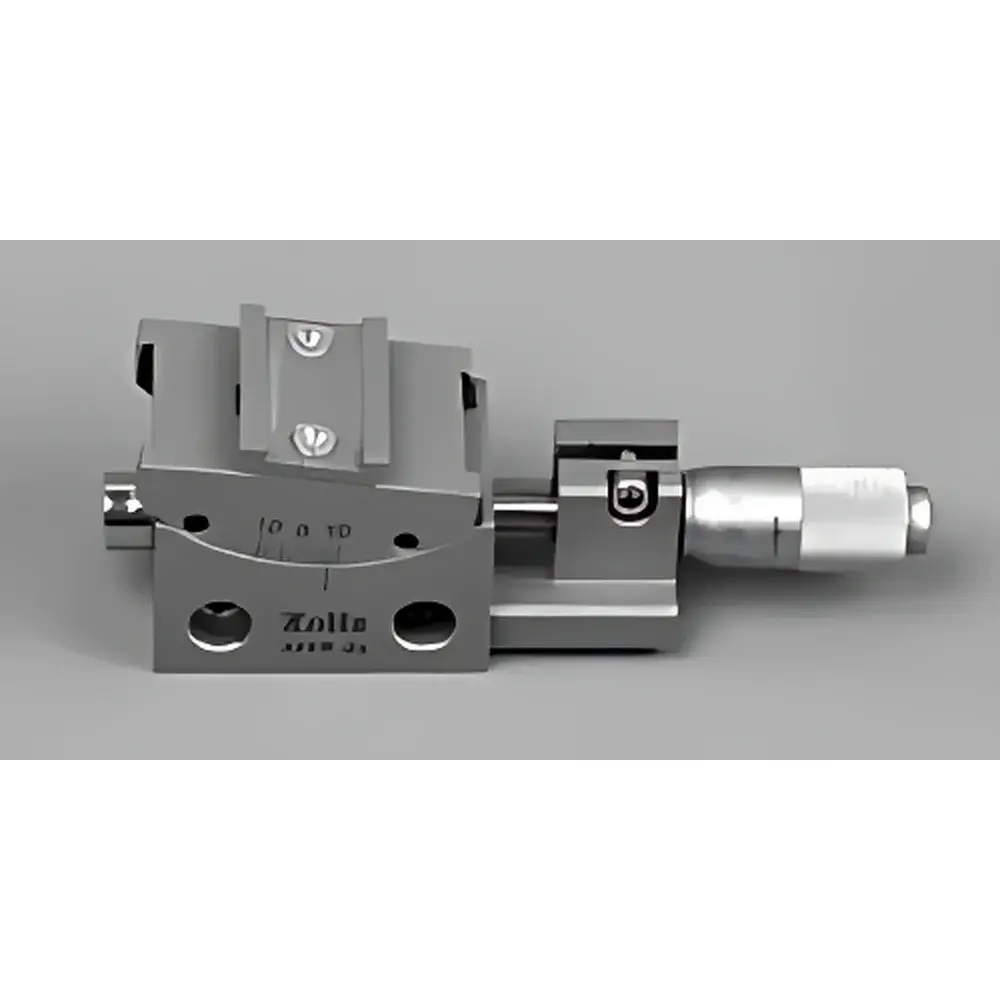
APFP-θx Precision Tilt Mount for Optical Fiber Alignment
| Brand | ZOLIX |
|---|---|
| Origin | Beijing, China |
| Manufacturer Type | Direct Manufacturer |
| Product Origin | Domestic (China) |
| Model | APFP-θx |
| Pricing | Upon Request |
| Tilt Range (θx) | ±7° |
| Angular Resolution | 6 arcseconds |
| Construction Material | Stainless Steel with High Thermal Stability |
| Guidance Mechanism | Crossed Roller Bearings |
| Mounting Interface | Standardized Dovetail Base |
Overview
The APFP-θx Precision Tilt Mount is a high-stability optical positioning stage engineered specifically for fine angular alignment of optical fibers, collimators, fiber couplers, and other quasi-cylindrical or planar optical components in demanding laboratory and industrial photonics applications. Designed according to fundamental principles of mechanical metrology and thermal drift mitigation, the mount employs a rigid crossed roller bearing guidance system—eliminating backlash, hysteresis, and elastic deformation under load. Its core function is to deliver precise, repeatable, and drift-free rotation about the X-axis (θx), enabling accurate beam steering, coupling optimization, and polarization alignment in free-space or fiber-pigtailed optical setups. The device operates within a defined angular range of ±7°, with a calibrated resolution of 6 arcseconds (0.00167°), making it suitable for applications requiring sub-milliradian angular control—such as interferometric alignment, wavelength locking in external cavity lasers, and mode-matching in quantum optics experiments.
Key Features
- Thermally stable stainless steel construction minimizes dimensional drift over extended operation periods and across ambient temperature fluctuations (±0.5 °C/h typical lab variation).
- Crossed roller bearing mechanism ensures pure rotational motion without parasitic translation, maintaining optical axis integrity during adjustment.
- Dovetail base interface (standard 12 mm or 20 mm profile, compatible with common optical breadboard rails) enables rapid integration into multi-axis kinematic platforms.
- Direct-coupling capability with APFP-XYZ translation stages allows seamless assembly into 4-DOF (X-Y-Z-θx) compound alignment systems without stacking errors or cumulative tolerance buildup.
- Micrometer-driven actuation with engraved angular scale and vernier readout supports both coarse positioning and fine-tuning workflows under visual or camera-assisted alignment.
- No lubrication required in standard operation; vacuum-compatible variants available upon request (material certification and outgassing data provided per ASTM E595).
Sample Compatibility & Compliance
The APFP-θx accommodates optical components with standardized mounting footprints, including Ø12.7 mm, Ø25.4 mm, and rectangular fiber launchers up to 30 mm × 30 mm. It supports passive and active alignment protocols used in ISO 10110–7 (optical component surface form tolerances) and Telcordia GR-1209-CORE (fiber optic device reliability testing). While not certified to IEC 61300–3–35 (fiber optic connector repeatability), its mechanical repeatability (< ±3 arcseconds over 100 cycles, per internal qualification test report ZOLIX-APFP-θx-RT-2023) meets typical requirements for R&D-grade photonic assembly. The unit complies with RoHS 2011/65/EU and REACH SVHC regulations for material content.
Software & Data Management
As a manually operated mechanical stage, the APFP-θx does not include embedded electronics or digital interfaces. However, it is fully compatible with third-party motion control ecosystems—including Thorlabs Kinesis®, Newport APT™, and LabVIEW-based DAQ systems—when integrated with optional motorized actuators (e.g., ZOLIX MFA-12 stepper motor adapter kit, sold separately). Position logs generated via external encoders can be timestamped and archived in accordance with GLP-compliant electronic lab notebook (ELN) workflows. Audit trails for alignment records may be maintained using 21 CFR Part 11–compliant software when paired with validated hardware abstraction layers.
Applications
- Active alignment of single-mode fiber pigtails to laser diodes, photonic integrated circuits (PICs), and micro-optical assemblies.
- Angle-tuning of fiber Bragg gratings (FBGs) and long-period gratings (LPGs) during spectral characterization.
- Beam walk correction in Michelson and Mach–Zehnder interferometers requiring dynamic θx compensation.
- Calibration reference stage for angle-sensitive detectors, such as quadrant photodiodes and position-sensing detectors (PSDs).
- Integration into automated wafer-level testing stations for silicon photonics packaging lines.
FAQ
Is the APFP-θx compatible with vacuum environments?
Yes—standard units are vacuum-ready to 1×10⁻⁵ Torr when assembled with dry-lubricated bearings and non-outgassing fasteners. Full vacuum qualification reports available upon technical inquiry.
Can multiple APFP-θx mounts be stacked for multi-axis tilt control?
Stacking is not recommended due to cumulative wobble and reduced stiffness. Instead, use orthogonal mounting on a common baseplate or integrate with APFP-θy for decoupled dual-axis tilt functionality.
What is the maximum payload capacity at full ±7° tilt?
Rated static load capacity is 1.2 kg with center-of-mass ≤15 mm from pivot axis. Payload derating applies beyond 5° tilt; detailed load/moment diagrams provided in the mechanical interface manual.
Does ZOLIX provide calibration certificates traceable to NIM?
Yes—NIM-traceable angular calibration (ISO/IEC 17025 accredited) is available as an optional service, including uncertainty budgeting per GUM (JCGM 100:2008).






