
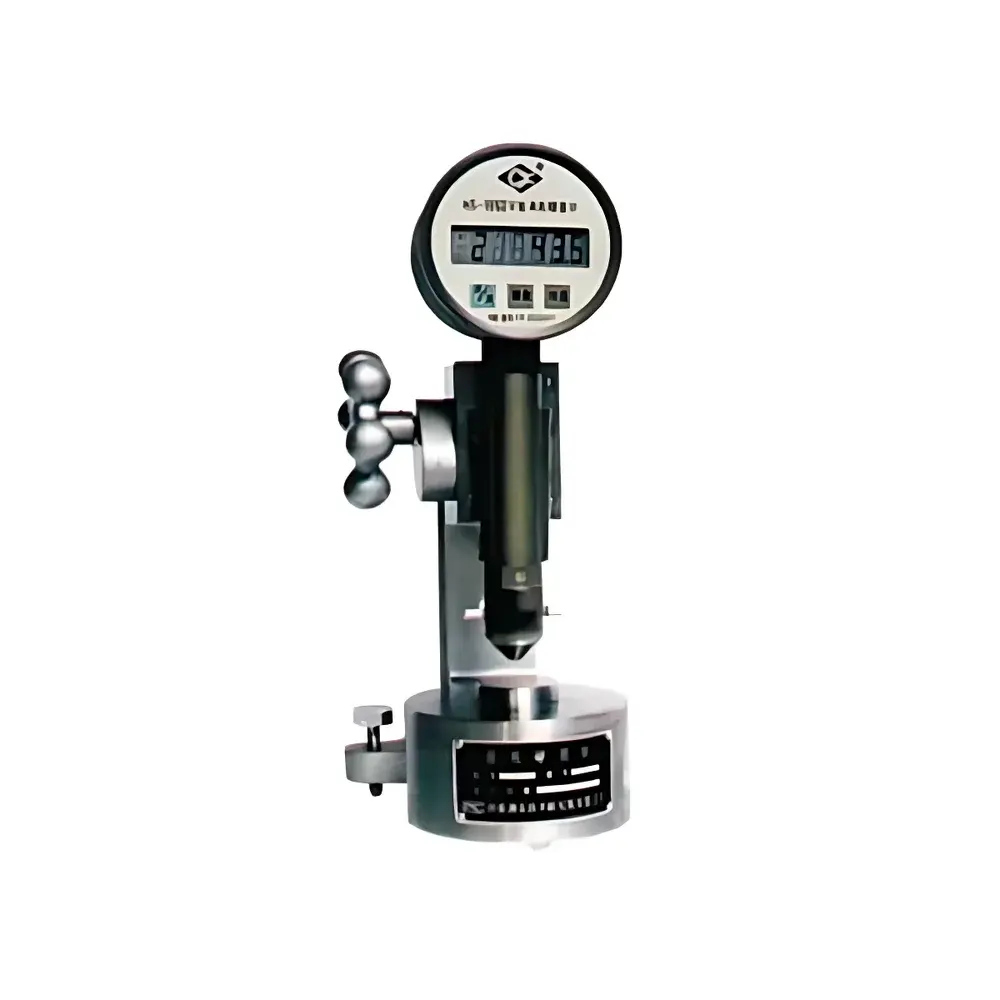
API HS-19GDV Shore Hardness Tester
| Brand | API |
|---|---|
| Origin | Sichuan, China |
| Manufacturer Type | Authorized Distributor |
| Country of Origin | China |
| Model | HS-19GDV |
| Instrument Type | Shore Durometer (Type A & D) |
| Hardness Range | 14–115 Shore A / 20–85 Shore D (typical dual-scale calibration per ASTM D2240) |
| Display | LCD digital readout with statistical functions (mean, delete, hold) |
| Data Output | RS-232 interface for optional printer or PC connectivity |
| Hardness Conversion | Built-in algorithms for approximate conversion to Brinell (HB), Rockwell (HRB/HRC), and Vickers (HV) scales per ISO 14676 and ASTM E140 |
Overview
The API HS-19GDV Shore Hardness Tester is an electromechanical durometer engineered for rapid, repeatable indentation hardness assessment of polymeric, elastomeric, and soft metallic materials. It operates on the fundamental principle defined in ASTM D2240 and ISO 868: a standardized spring-loaded indenter (Type A for softer elastomers; Type D for harder thermoplastics and rigid rubbers) is pressed vertically into the test surface under controlled force and dwell time; the depth of penetration is converted to a dimensionless Shore scale value via calibrated mechanical displacement sensing and microprocessor-based signal conditioning. Unlike purely analog instruments, the HS-19GDV integrates a high-stability load train, temperature-compensated transducer, and embedded firmware to minimize operator-induced variability—making it suitable for quality control laboratories, incoming material inspection, and R&D environments where traceable, mid-range hardness data (14–115 Shore A) are required under ambient conditions (23 ± 5 °C, 50 ± 5% RH).
Key Features
- Electromechanical dual-scale design compliant with ASTM D2240 Type A and Type D configurations—enabling seamless transition between low-hardness elastomers (e.g., silicone gels, soft PVC) and semi-rigid thermoplastics (e.g., ABS, polycarbonate)
- Backlit LCD display with real-time numeric readout, automatic zeroing, and on-device statistical processing—including arithmetic mean calculation across up to 9 sequential readings, individual value deletion, and data hold function
- Integrated RS-232 serial port supporting direct connection to thermal printers or legacy laboratory PCs for ASCII-formatted data export (no proprietary software required)
- Built-in hardness conversion tables aligned with ISO 14676 Annex B and ASTM E140 empirical correlations—providing estimated equivalents to Brinell (HB), Rockwell B/C (HRB/HRC), and Vickers (HV) values for cross-method reference (note: conversions are approximations and not substitutes for direct measurement)
- Rugged aluminum alloy housing with ergonomic hand grip and precision-ground anvil surface—designed for benchtop stability and resistance to mechanical shock during routine industrial use
Sample Compatibility & Compliance
The HS-19GDV is validated for flat, smooth, and homogeneous specimens ≥6 mm thick with minimum lateral dimensions of 25 mm × 25 mm. It is unsuitable for curved, porous, or highly viscoelastic surfaces exhibiting significant creep within the standard 1-second dwell time. Calibration verification follows ISO 48-2 procedures using NIST-traceable Shore hardness reference blocks (certified by CNAS-accredited labs). The instrument meets CE marking requirements for electromagnetic compatibility (EN 61326-1) and general safety (EN 61010-1). While not FDA 21 CFR Part 11–compliant out-of-the-box (lacking audit trail and electronic signature functionality), its raw data output supports manual GLP documentation workflows in regulated manufacturing settings.
Software & Data Management
No proprietary software is bundled with the HS-19GDV. All data handling occurs locally via the onboard microcontroller. Measurement records remain volatile unless transmitted externally via RS-232. Users may integrate output into custom LIMS or Excel-based tracking systems using standard terminal emulation (e.g., PuTTY, Tera Term) at 9600 bps, 8N1 configuration. The device stores no historical logs, user profiles, or timestamps—consistent with its role as a dedicated, deterministic measurement tool rather than a networked analytical platform.
Applications
- Quality assurance of rubber compounds in automotive sealing systems (door boots, gaskets) per SAE J2236
- In-process verification of TPE and TPV extrusion profiles in medical tubing production
- Material screening during formulation development of silicone encapsulants and polyurethane adhesives
- Receiving inspection of polymer bushings, conveyor belts, and vibration-damping mounts in heavy machinery OEM supply chains
- Academic teaching labs demonstrating polymer viscoelasticity principles and hardness–modulus relationships
FAQ
Is the HS-19GDV calibrated before shipment?
Yes—each unit undergoes factory calibration against certified Shore reference blocks and includes a calibration certificate traceable to national metrology institutes.
Can it measure curved surfaces?
No. ASTM D2240 requires flat, parallel surfaces. Curved geometries introduce measurement bias exceeding ±5 Shore units and invalidate compliance reporting.
Does it support USB or Bluetooth connectivity?
No. Only RS-232 serial interface is provided; USB-to-serial adapters may be used with appropriate drivers.
What is the recommended recalibration interval?
Annually under normal use, or after any mechanical impact, exposure to temperatures >50 °C, or when verification with reference blocks deviates by >2 Shore units.
Are conversion values to Rockwell or Vickers officially certified?
No. Conversions are algorithmic estimates based on published correlation matrices; they carry no metrological traceability and must not be used for contractual or regulatory acceptance testing.



