
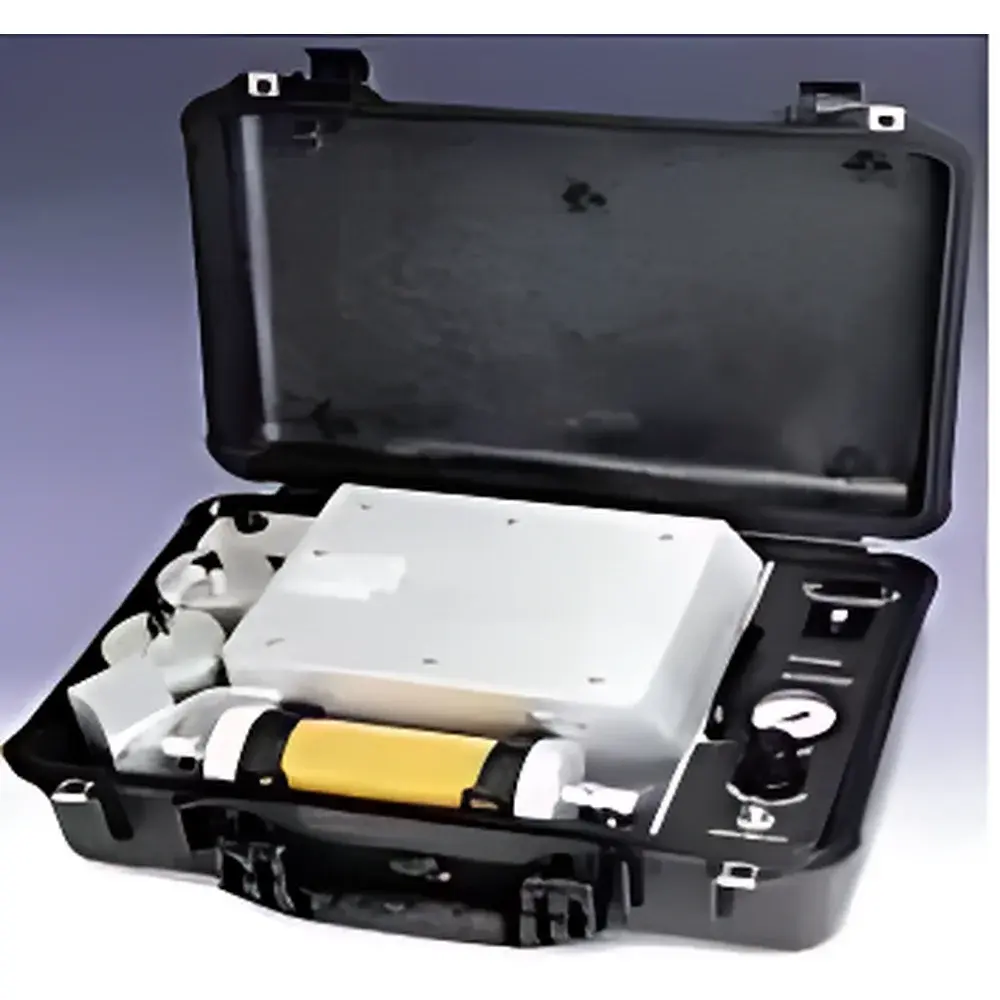
API T751 Portable Zero Air Generator System
| Brand | API |
|---|---|
| Origin | USA |
| Model | T751 |
| Output Flow Rate | 5 SLPM @ 30 psig |
| Maximum Output Pressure | 30 psig |
| Dew Point | < –20 °C (until desiccant saturation) |
| SO₂, NO, NO₂, O₃, H₂S Removal | < 0.5 ppb |
| CO Removal (with optional CO scrubber) | < 0.025 ppm |
| Compressor Type | Single-cylinder, oil-free piston pump |
| Power Input | 110–240 VAC, 50–60 Hz, 130 W |
| Operating Temperature | 5–40 °C |
| Dimensions (L×W×H) | 178 × 470 × 356 mm |
| Weight | 10.9 kg |
| Desiccant | Silica gel with dew point LED indicator |
| Warm-up Time | 30 minutes |
Overview
The API T751 Portable Zero Air Generator System is an engineered solution for on-site generation of ultra-pure, contaminant-free air—specifically designed to meet the stringent requirements of environmental monitoring, calibration laboratories, and field-deployed gas analyzers. It operates on a multi-stage purification principle: ambient air is drawn in via an internal oil-free piston compressor, passed through a high-efficiency particulate filter, dried using regenerable silica gel desiccant (achieving a consistent dew point of < –20 °C), and then subjected to chemically selective scrubbing to remove reactive trace gases—including sulfur dioxide (SO₂), nitrogen oxides (NO/NO₂), ozone (O₃), and hydrogen sulfide (H₂S)—to sub-ppb levels. An optional catalytic CO scrubber module further extends capability to reduce carbon monoxide to < 0.025 ppm. This system adheres to the fundamental definition of “zero air” as specified in EPA Method TO-14A, ASTM D6196, and ISO 8573-1 Class 1 for gaseous contaminants, making it suitable for zero-gas verification, span calibration, permeation tube purging, and background compensation in continuous emission monitoring systems (CEMS) and ambient air quality networks.
Key Features
- Compact, field-ready design housed in a rugged high-density polyethylene carry case (10.9 kg total mass), optimized for transport and rapid deployment in mobile labs or remote monitoring stations.
- Integrated dew point sensor with LED status indicator—provides real-time visual feedback to signal desiccant saturation and timely replacement.
- Modular, tool-free component architecture enables quick access to filters, scrubbers, and desiccant cartridges for routine maintenance without specialized technicians.
- Oil-free single-cylinder piston compressor ensures long service life, low vibration, and zero hydrocarbon contamination—critical for VOC-sensitive applications.
- Standard scrubber media deliver verified removal efficiency for SO₂, NO, NO₂, O₃, and H₂S to < 0.5 ppb; optional CO scrubber meets EPA-recommended limits for zero-air certification protocols.
- Stable 5 SLPM output at 30 psig with pressure-regulated delivery—compatible with dynamic dilution calibrators, gas chromatograph carrier lines, and photometric ozone generators.
Sample Compatibility & Compliance
The T751 is validated for use with regulatory-grade analytical instrumentation requiring certified zero air, including UV photometric NOx analyzers (EPA PS-1/PS-2), chemiluminescence detectors, FTIR gas cells, and laser-based cavity ring-down spectrometers. Its output purity satisfies traceability requirements under ISO/IEC 17025 for calibration gas standards and supports GLP-compliant audit trails when paired with time-stamped log files from external data acquisition systems. While the unit itself does not include built-in 21 CFR Part 11 compliance features (e.g., electronic signatures or audit logging), its stable, documented performance enables integration into FDA- or EMA-regulated environmental validation workflows when operated within controlled procedural frameworks.
Software & Data Management
The T751 is a standalone hardware system with no embedded firmware, touchscreen interface, or proprietary software. All operational parameters—including flow stability, pressure consistency, and warm-up progression—are monitored via analog indicators (LEDs) and mechanical gauges. For traceable recordkeeping, users are advised to log startup time, desiccant replacement dates, scrubber service intervals, and periodic verification measurements (e.g., using a calibrated ppb-level SO₂ analyzer) in laboratory notebooks or LIMS-compatible spreadsheets. The 30-minute thermal stabilization period ensures reproducible baseline conditions prior to critical calibration events—a practice aligned with ASTM D6196 Annex A2 recommendations for zero-air generator qualification.
Applications
- Zero-air supply for calibration of ambient air quality monitors (e.g., federal equivalent method [FEM] analyzers per 40 CFR Part 53).
- Purging gas for permeation tube ovens and dynamic dilution calibrators (e.g., Dynacalibrator series).
- Carrier and purge gas in GC-FID, GC-ECD, and PTR-MS systems where hydrocarbon-free air is mandatory.
- Background reference gas in optical absorption instruments (DOAS, CRDS) requiring low-scatter, low-absorption matrices.
- Mobile emissions testing—supporting roadside NOx/VOC measurement campaigns and stack testing pre-calibration sequences.
- Indoor air quality (IAQ) chamber blanking and HVAC system commissioning verification.
FAQ
What is the required warm-up time before achieving certified zero-air output?
The T751 requires a minimum 30-minute stabilization period after power-on to ensure thermal equilibrium of scrubber beds and desiccant saturation control—this is essential for meeting sub-ppb contaminant specifications.
Can the T751 be used continuously for extended periods?
Yes—designed for unattended operation up to 8 hours per day; however, daily inspection of dew point LED and monthly scrubber integrity checks are recommended per API Technical Bulletin TB-751-02.
Is the CO scrubber included by default?
No—the CO scrubber is an optional accessory; standard configuration covers SO₂, NO, NO₂, O₃, and H₂S only.
How often must the silica gel desiccant be replaced?
Replacement frequency depends on ambient humidity and usage duration; the integrated dew point LED provides unambiguous indication—typically every 2–4 weeks under continuous 5 SLPM operation at 50% RH.
Does the T751 require external cooling or ventilation?
No—its passive thermal management and low-power compressor (130 W) allow safe operation in enclosed spaces; however, intake air must be free of oil mist and excessive particulates to preserve filter life.
Related Products







