
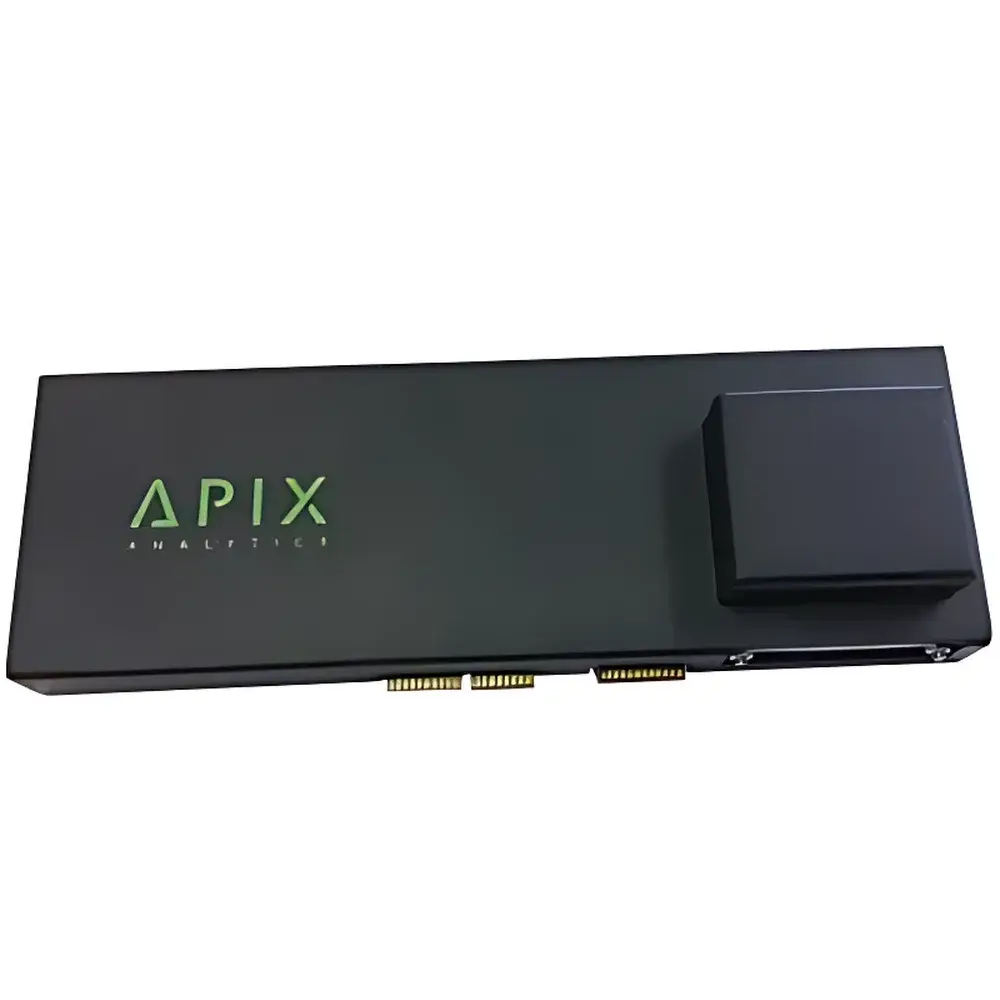
APIX Analytics APIX-PPAM Plug-and-Play Analytical Module
| Brand | APIX Analytics |
|---|---|
| Origin | France |
| Model | APIX-PPAM |
| Type | Portable Multicomponent Gas Analyzer Module |
| Principle | Silicon-Microfabricated Gas Chromatography with Integrated NEMS/μTCD Detection |
| Response Time | ≤10 ms (injection) |
| Repeatability | <0.1% RSD for sample injection |
| Sample Compatibility | Natural gas, ambient air, permanent gases, hydrocarbons (C1–C10), VOCs, sulfur compounds, halogenated organics, oxygenates |
| Carrier Gases | He, H₂, N₂, Ar, synthetic dry air |
| Carrier Flow Rate | ~1 mL/min |
| Injection Volume | <15 µL |
| Column Temperature Range | 50–160 °C (stability <0.1 °C) |
| Detector Operating Range | Ambient to 120 °C |
| Detection Range | sub-ppb (with preconcentration) to % v/v |
| Module Dimensions | 27 × 10 × 3 cm |
| Weight | 900 g |
Overview
The APIX Analytics APIX-PPAM Plug-and-Play Analytical Module is a silicon-microfabricated, field-deployable gas chromatography (GC) core engine designed for real-time, multi-component gas analysis in demanding environmental, industrial, and safety-critical applications. Unlike conventional benchtop GC systems, the PPAM integrates the entire analytical chain—sample introduction, micro-injection, capillary column separation, and detection—onto a monolithic silicon platform using MEMS/NEMS fabrication techniques. Its operational principle relies on temperature-programmed capillary gas chromatography coupled with dual-mode silicon-based detection: nanoelectromechanical systems (NEMS) resonant mass sensors and micro-thermal conductivity detectors (μTCD). This hybrid detection architecture delivers high selectivity for structurally similar compounds (e.g., BTEX isomers, C₃–C₅ alkanes/alkenes) while maintaining robustness across variable matrix compositions—including humid ambient air, high-pressure natural gas streams, and low-concentration VOC emissions.
Key Features
- Silicon-integrated architecture: Combines micro-injector, separation column, and dual NEMS/μTCD detector in a single 27 × 10 × 3 cm module weighing only 900 g.
- Ultra-fast, programmable micro-injection: Injection duration adjustable from 10 ms (minimum) to 100 ms (typical); injection repeatability <0.1% RSD.
- Low carrier gas consumption: Operates at ~1 mL/min with standard gases (He, H₂, N₂, Ar, synthetic dry air), minimizing logistical burden in remote or mobile deployments.
- Modular column compatibility: Interchangeable capillary columns (e.g., PDMS-5, RTX-1, ALOX-5, MS5A, DB-WAX) enable targeted analysis of permanent gases, light/heavy hydrocarbons, sulfur species (H₂S, THT), halocarbons, oxygenates, and aromatic VOCs.
- High sensitivity without preconcentration: Sub-ppm detection for C₆+ hydrocarbons; sub-ppb capability when paired with optional VOC preconcentrators.
- Thermally stabilized separation: Column oven maintains ±0.1 °C stability over 50–160 °C range, ensuring retention time reproducibility essential for quantitative compliance monitoring.
Sample Compatibility & Compliance
The PPAM module supports direct analysis of unfiltered, non-corrosive gas matrices including natural gas (BTU determination per ASTM D3588, ISO 6976), ambient air (EPA TO-15/TO-17 compliant workflows), biogas, refinery off-gas, and industrial stack emissions. It accommodates sample pressures >1.5 bar and tolerates trace moisture and particulates typical of field-sampled streams. When integrated into certified systems—such as the ATEX-rated MAX-One™ or the multi-module ChromPix 4d platform—the PPAM enables continuous emissions monitoring (CEM) aligned with EU IED (2010/75/EU), US EPA Method 320, and ISO 13864 for occupational exposure assessment. All firmware and data handling modules comply with ALCOA+ principles and support audit-ready electronic records under FDA 21 CFR Part 11 when deployed in GLP/GMP environments.
Software & Data Management
Each PPAM module interfaces via digital RS-485 or Ethernet to host platforms running APIX’s proprietary ChromOS™ firmware. The software provides real-time chromatogram visualization, automated peak integration using retention time locking (RTL), calibration curve management (linear/nonlinear), and configurable alarm thresholds per compound. Raw sensor data (NEMS resonance frequency shifts + μTCD voltage outputs) are logged at 100 Hz resolution with embedded time stamps and environmental metadata (column temp, carrier flow, ambient pressure). Export formats include CSV, XML, and vendor-neutral netCDF for third-party LIMS integration. Firmware updates and method deployment occur remotely via secure TLS-encrypted channels, supporting ISO/IEC 27001-aligned cybersecurity practices.
Applications
- Natural gas quality control: Continuous BTU, Wobbe index, and hydrocarbon dew point monitoring per AGA Report No. 8.
- Atmospheric research: High-temporal-resolution VOC speciation (BTEX, terpenes, carbonyls) in urban, rural, and boundary-layer studies.
- Industrial hygiene: Real-time workplace exposure assessment for H₂S, chlorine, formaldehyde, and chlorinated solvents.
- Leak detection & LDAR programs: Quantitative mapping of fugitive emissions from valves, flanges, and compressors.
- Biogas upgrading: CH₄/CO₂ ratio optimization and siloxane/sulfur compound tracking prior to membrane or PSA treatment.
- R&D laboratories: Rapid method development for novel gas mixtures using interchangeable column modules and adaptive injection protocols.
FAQ
What gas standards are required for calibration?
Certified reference gas mixtures traceable to NIST or PTB, with concentrations spanning the intended measurement range (e.g., 1 ppm–10% v/v). Calibration intervals follow ISO 17025 guidelines—typically every 3–6 months depending on usage intensity.
Can the PPAM operate unattended for extended periods?
Yes—when integrated into ChromPix 4d or MAX-One™ systems with uninterruptible power supply (UPS) and remote telemetry, the PPAM supports >30-day autonomous operation with automatic zero/span checks and diagnostic self-tests.
Is column maintenance user-performed?
Column replacement is tool-free and completed in <2 minutes via standardized bayonet interface; no gas-tight ferrules or torque wrenches required. Columns are rated for ≥500 injections before performance validation.
Does the module support regulatory reporting formats?
Yes—ChromOS™ exports data in EPA 40 CFR Part 60 Appendix B-compliant XML schemas and generates PDF reports with digital signatures meeting EN 10204 3.1 certification requirements.
How is temperature compensation handled during field deployment?
An onboard Pt1000 sensor monitors ambient thermal gradients; column oven control algorithms dynamically adjust heating profiles to maintain programmed isothermal or ramped temperature programs within ±0.05 °C deviation.







