
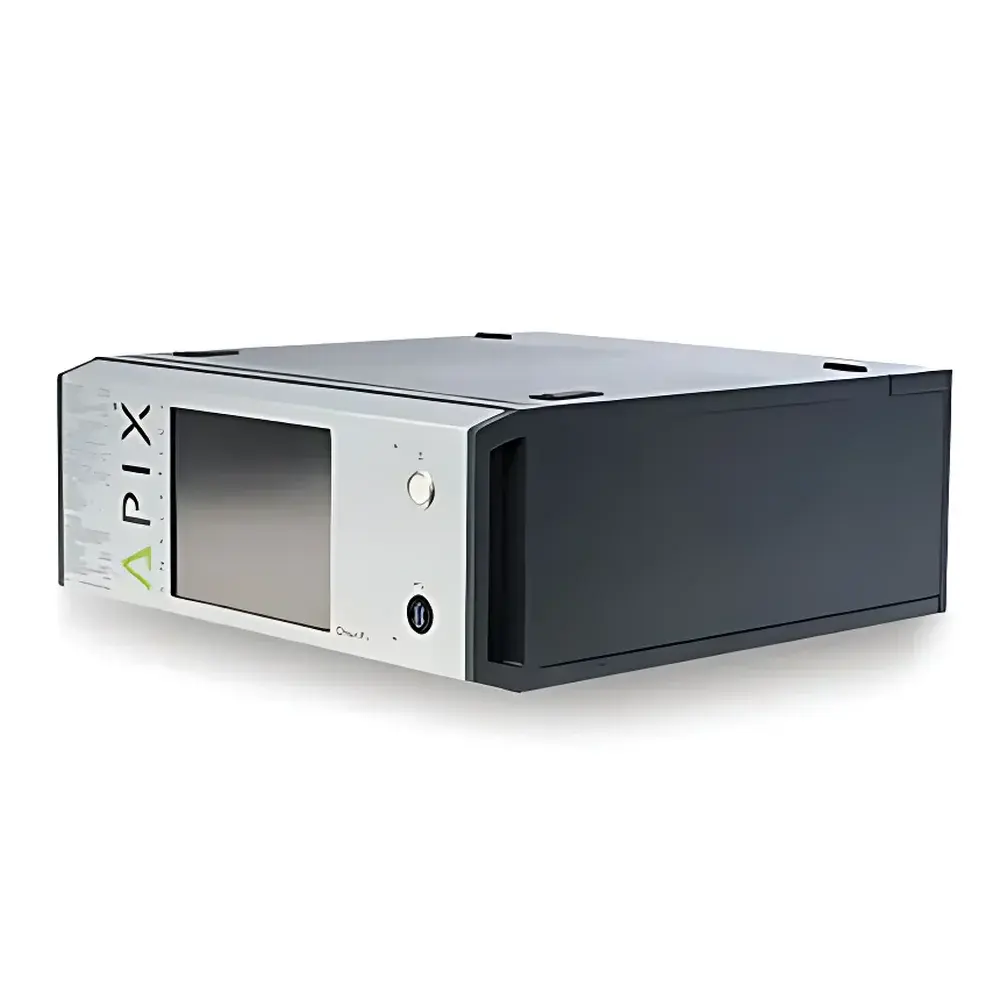
APIX ChromPix 2® Portable Multicomponent Gas Analyzer
| Brand | APIX Analytics |
|---|---|
| Origin | France |
| Model | ChromPix 2 |
| Type | Portable GC-based Analyzer |
| Principle | Microfabricated Gas Chromatography with Silicon-based μ-TCD and NEMS Detection |
| Response Time | <0.01 s (detector response) |
| Sample Types | Natural gas, biogas, industrial stack emissions, VOCs (including BTEX), permanent gases (N₂, O₂, CO₂), sulfur compounds (H₂S, THT, mercaptans), and specialty gases |
| Column Capacity | Up to 4 parallel capillary columns |
| Carrier Gases | He, H₂, N₂, Ar, synthetic dry air |
| Operating Temperature | −10–40 °C |
| Power | 100–240 V AC, 50–60 Hz, 150 W (config-dependent) |
| Dimensions | 450 × 460 × 220 mm |
| Weight | 10 kg |
| Column Temp Range | 50–160 °C (stability <0.1 °C) |
| Detection Range | sub-ppm to % v/v |
| LOD (VOCs w/ preconcentration) | <1 ppb |
| LOD (H₂S) | 7 ± 0.7 ppm (with sample conditioning) |
| LOD (THT) | 2 ± 0.2 ppm (with sample conditioning) |
| LOD (C₁–C₆ hydrocarbons) | <5 ppm |
| LOD (C₆–C₁₂) | <1 ppm |
| LOD (N₂/O₂/CO₂) | <10 ppm |
| LOD (BTEX) | <1 ppm |
| Analysis Time | ≤1 min (separation), ≤2 min (incl. backflush) |
Overview
The APIX ChromPix 2® is a portable, modular microgas chromatograph engineered for high-fidelity multicomponent gas analysis in field-deployable and laboratory environments. Unlike conventional benchtop GC systems, the ChromPix 2 leverages APIX Analytics’ proprietary silicon-microfabrication platform—integrating monolithic μ-TCD (micro-Thermal Conductivity Detector) and NEMS (Nano-Electro-Mechanical Systems) sensing elements directly onto the chip-scale separation architecture. Its core analytical principle relies on temperature-programmed capillary gas chromatography coupled with real-time thermal conductivity differential detection, enabling quantitative resolution of complex gas matrices without reliance on consumable detectors or radioactive sources. Designed for regulatory-grade monitoring and process control, the system delivers repeatable retention time alignment (<0.05% RSD) and calibrated peak area reproducibility across extended operation cycles—critical for compliance with ISO 8573-5 (compressed air purity), ASTM D1945 (natural gas analysis), and EN 15403 (biogas quality).
Key Features
- True Modular GC Architecture: Supports up to four independent analytical channels—each with dedicated capillary column, carrier gas line, and detector—enabling simultaneous multi-method analysis (e.g., C₁–C₆ hydrocarbons + permanent gases + sulfur species + BTEX) without cross-contamination or reconfiguration downtime.
- Zero-External-Piping Design: All fluidic pathways—including injection valves, column ovens, and detector manifolds—are embedded within a sealed, thermally stabilized aluminum chassis. Eliminates external tubing, reducing leak points, dead volumes, and calibration drift associated with traditional GC systems.
- Sub-minute Separation Capability: Optimized column geometry and rapid oven thermal ramping (up to 30 °C/min) achieve full-resolution chromatograms for natural gas or biogas in ≤60 seconds; backflush completes cycle in ≤120 seconds—ideal for high-throughput environmental screening and continuous emission monitoring (CEM) interfaces.
- ppb-Class Sensitivity with Preconcentration: When paired with optional PPAM (Programmable Preconcentration & Adsorption Module), the μ-TCD achieves sub-ppb detection limits for aromatic VOCs and halogenated compounds—validated per EPA Method TO-17 and ISO 16017-1 protocols.
- Field-Ruggedized Engineering: Operates reliably from −10 to +40 °C ambient; shock- and vibration-tested to IEC 60068-2 standards; meets IP54 ingress protection for outdoor deployment near flare stacks, landfills, or biogas upgrading units.
Sample Compatibility & Compliance
The ChromPix 2 accommodates gaseous samples across diverse pressure and compositional profiles: natural gas (up to 10 bar upstream regulated), raw biogas (with H₂S scrubbing), flue gas (diluted or undiluted), ambient air (for fugitive VOC mapping), and ultra-high-purity process gases (e.g., semiconductor-grade N₂). It complies with key international standards for gas analysis instrumentation, including ISO/IEC 17025:2017 (testing laboratory competence), ASTM D1945/D1946 (hydrocarbon speciation), and EN 16723-1 (biomethane quality certification). Data integrity is maintained through audit-trail-enabled firmware supporting FDA 21 CFR Part 11-compliant electronic records when integrated with validated LIMS or SCADA platforms.
Software & Data Management
Control and data acquisition are managed via ChromPix ControlSuite™—a Windows-based application offering method editor, real-time chromatogram overlay, automated calibration curve generation (linear, quadratic, or polynomial), and batch report export (PDF, CSV, XML). All raw chromatographic data (including detector voltage traces, temperature logs, and valve timing events) are stored in vendor-neutral HDF5 format. The system supports OPC UA connectivity for seamless integration into industrial automation ecosystems (e.g., Siemens PCS7, Emerson DeltaV) and provides RESTful API endpoints for custom dashboard development. Firmware updates preserve historical calibration coefficients and retain user-defined method libraries across version upgrades.
Applications
- Continuous methane and CO₂ monitoring at landfill gas extraction wells per EU Landfill Directive (1999/31/EC)
- Real-time compositional verification of upgraded biomethane prior to grid injection (EN 16723-1 compliance)
- Leak detection and quantification of VOCs (e.g., benzene, toluene) in petrochemical fenceline monitoring programs
- Trace sulfur compound profiling (H₂S, mercaptans, THT) in natural gas odorant dosing validation
- Permanent gas ratio analysis (O₂/N₂/Ar) in modified atmosphere packaging (MAP) quality assurance
- On-site verification of syngas composition (H₂/CO/CH₄/CO₂) in small-scale gasification plants
FAQ
Does the ChromPix 2 require carrier gas cylinders on-site?
Yes—standard configurations accept regulated He, H₂, N₂, Ar, or synthetic dry air via standard CGA-580 or DIN 477 fittings. Optional integrated gas generators (H₂ or zero-air) are available for fully autonomous operation.
Can it be used for unattended long-term monitoring?
Yes—when installed with external power backup, environmental enclosure, and remote telemetry (4G/LTE or Ethernet), the system supports unattended operation for >30 days with scheduled auto-calibration using internal span gas reservoirs.
Is method transfer possible from legacy GC systems?
Retention time indexing and spectral library matching allow approximate method porting; however, due to microcolumn geometry and thermal mass differences, full revalidation per ISO/IEC 17025 is recommended for accredited use.
What maintenance intervals are required?
Detector baseline stability is verified weekly via zero-gas check; column bake-out is performed monthly; full system performance qualification (SPQ) is recommended every 6 months or after 500 injections—documented in accordance with GLP traceability requirements.
Related Products







