
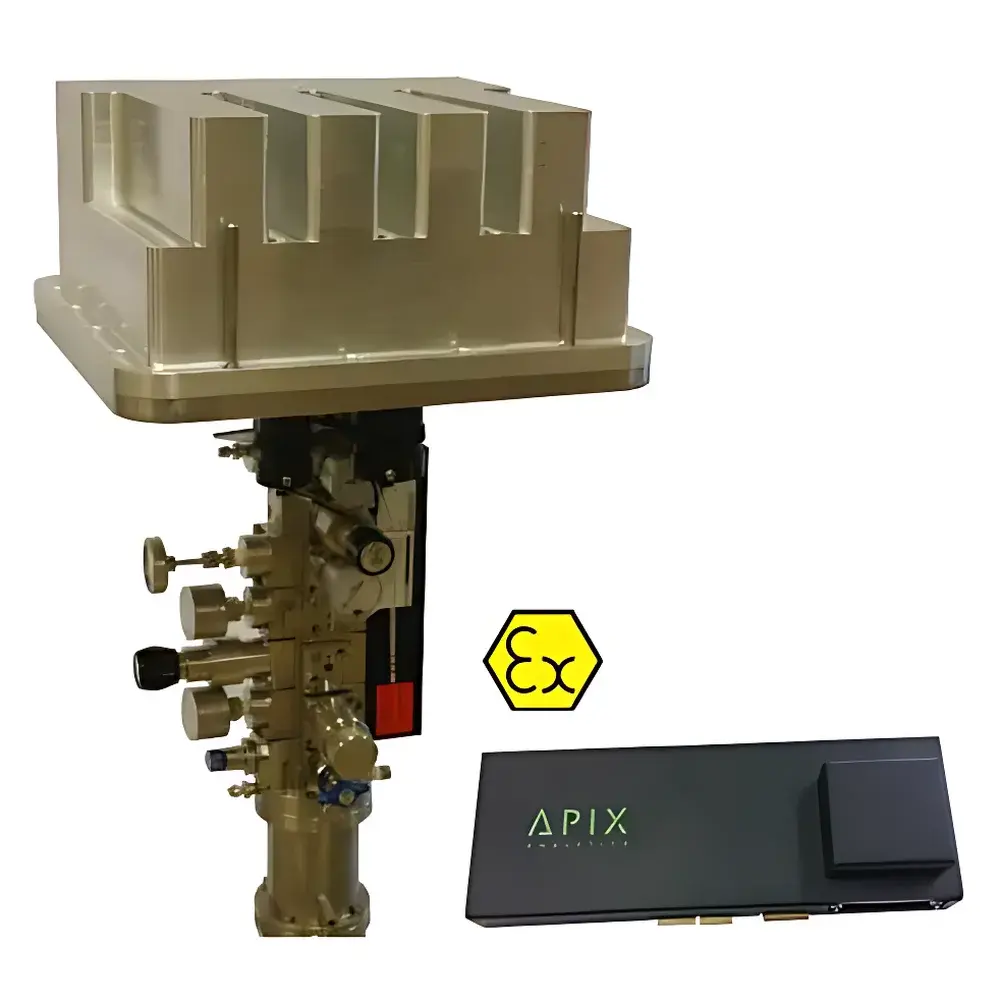
APIX MAX-One™ Portable Multicomponent Gas Analyzer
| Brand | APIX Analytics |
|---|---|
| Origin | France |
| Model | APIX MAX-One™ |
| Type | Portable |
| Response Time | 0.01 s |
| Detection Principle | MEMS-based Micro-Gas Chromatography with μTCD |
| Compliance | ATEX II 2G Ex IIB+H2 T6, CSA Div 1 Class I, Group B, C, D, AEx d IIB+H2 T6, NeSSI-compatible |
| Dimensions | 360 × 350 × 170 mm |
| Weight | 25 kg |
| Power Input | 100–240 V AC, 50–60 Hz |
| Max Power Consumption | 750 W |
| Operating Temperature | −10 to +40 °C |
| GC Column Temp Range | 50–160 °C (stability < 0.1 °C) |
| Carrier Gases | He, H₂, N₂, Ar, synthetic dry air |
| Sample Injection Pressure | 1–15 bar |
| Injection Volume | < 15 µL |
| Detector | Micro-Thermal Conductivity Detector (μTCD), ambient-120 °C |
| Detection Range | sub-ppm to % v/v |
| LOD (typical) | Permanent gases (N₂, CO₂, O₂) < 10 ppm |
Overview
The APIX MAX-One™ Portable Multicomponent Gas Analyzer is a field-deployable, micro-gas chromatography (μGC) system engineered for real-time, multi-analyte quantification in demanding industrial and environmental settings. Unlike conventional benchtop GC analyzers, the MAX-One™ leverages proprietary Plug-and-Play Analytical Modules (PPAMs)—silicon-based monolithic microsystems integrating sampling, precise micro-injection, high-resolution capillary column separation, and miniaturized thermal conductivity detection. Each PPAM implements a dedicated analytical method optimized for specific gas families (e.g., permanent gases, light hydrocarbons, sulfur compounds, or aromatic VOCs). Up to four PPAMs can be simultaneously housed within a single chassis, enabling concurrent, time-synchronized analysis of >12 target components without cross-method interference. The instrument operates on the fundamental principle of differential thermal conductivity—measuring minute changes in heat dissipation across micro-fabricated resistive elements as carrier gas elutes analytes through temperature-controlled capillary columns. Its ultra-fast response (<10 ms) stems from MEMS-actuated injection valves, low-thermal-mass column ovens, and high-bandwidth μTCD signal processing—making it uniquely suited for transient process monitoring, combustion optimization, and biogas upgrading control.
Key Features
- Modular architecture with up to four hot-swappable PPAM modules—each pre-calibrated and application-specific
- MEMS-enabled micro-injection system delivering reproducible sample volumes <15 µL at pressures up to 15 bar
- Temperature-stabilized capillary columns (50–160 °C, stability <0.1 °C) for high-resolution separation of complex gas matrices
- Micro-thermal conductivity detector (μTCD) with ambient-to-120 °C operational range and sub-ppm detection capability
- ATEX II 2G Ex IIB+H2 T6 and CSA Class I Div 1 certification—certified for continuous operation in Zone 1 hazardous areas
- NeSSI-compliant interface enabling seamless integration with Astute™ sampling systems for true online, in-line, or at-line deployment
- Low footprint (360 × 350 × 170 mm) and lightweight design (25 kg) supporting mobile laboratory, trailer-mounted, or fixed-installation configurations
- Wide carrier gas compatibility—including He, H₂, N₂, Ar, and synthetic dry air—allowing method flexibility and safety optimization
Sample Compatibility & Compliance
The MAX-One™ is validated for quantitative analysis of combustion-related gases (O₂, CO, CO₂, CH₄, H₂, NO, SO₂), natural gas stream components (C₁–C₅ alkanes, N₂, CO₂), biogas and biomethane (CH₄, CO₂, H₂S, NH₃, siloxanes), and volatile organic compounds (benzene, toluene, ethylbenzene, xylenes—BTEX). All PPAM modules undergo factory calibration against NIST-traceable standard gas mixtures, with documented uncertainty budgets per ISO/IEC 17025 requirements. The system complies with EN 60079-0, EN 60079-1, and CSA C22.2 No. 1, ensuring full conformity with international explosion protection directives. For regulated environments, the instrument supports audit-ready data logging with electronic signatures and configurable retention policies aligned with FDA 21 CFR Part 11 and EU Annex 11 expectations.
Software & Data Management
PixLPRO™—the embedded process control software—is built on a deterministic real-time Linux kernel and provides intuitive method setup, automated calibration sequence execution, peak integration with baseline correction, and multivariate drift compensation. Raw chromatograms, processed results, and system diagnostics are timestamped and stored locally (SSD) with optional encrypted export to OPC UA servers or cloud-based SCADA platforms. PixLPRO™ includes configurable alarm thresholds, trend visualization tools, and batch reporting templates compliant with ISO 8573-1 (compressed air purity) and ISO 14644-1 (cleanroom air classification) where applicable. Remote firmware updates and diagnostic telemetry are supported via TLS-secured Ethernet or LTE interfaces—without requiring onsite engineering intervention.
Applications
- Continuous monitoring of flue gas composition for boiler efficiency optimization and regulatory compliance (EU IED, US EPA 40 CFR Part 60)
- In-line quality assurance of pipeline natural gas (ISO 6974, ASTM D1945) and upgraded biomethane (EN 16723-1)
- Real-time detection of trace H₂S and mercaptans in biogas desulfurization units
- Leak detection and fugitive emission quantification (EPA Method 21, ISO 16000-36) using portable survey mode
- Process analytics in chemical synthesis, hydrogen production, and syngas conditioning loops
- Environmental monitoring of landfill gas, wastewater treatment off-gas, and agricultural digesters
FAQ
What gases can the MAX-One™ analyze simultaneously?
It depends on PPAM configuration: a 4-module system can concurrently quantify permanent gases (O₂, N₂, CO₂, CH₄), light hydrocarbons (C₂H₆, C₃H₈), sulfur species (H₂S, COS), and aromatics (BTEX)—up to 16 components per analysis cycle.
Is the system suitable for unattended, long-term operation?
Yes—designed for 24/7 operation with automatic zero/span checks, column bake-out routines, and predictive maintenance alerts triggered by pressure decay or detector drift trends.
Can the MAX-One™ integrate with existing DCS or MES platforms?
Yes—via native Modbus TCP, OPC UA, or MQTT protocols; PixLPRO™ supports custom tag mapping and secure certificate-based authentication.
Does it require carrier gas cylinders on-site?
Yes—though its low consumption (30 days of continuous operation from a standard 10-L cylinder; optional integrated gas generators are available for H₂ and N₂.
How is calibration maintained under field conditions?
Each PPAM includes internal reference channels and supports automated multi-point calibration using certified standard blends; calibration validity is verified before each analysis cycle per ISO/IEC 17025 clause 7.7.
Related Products







