
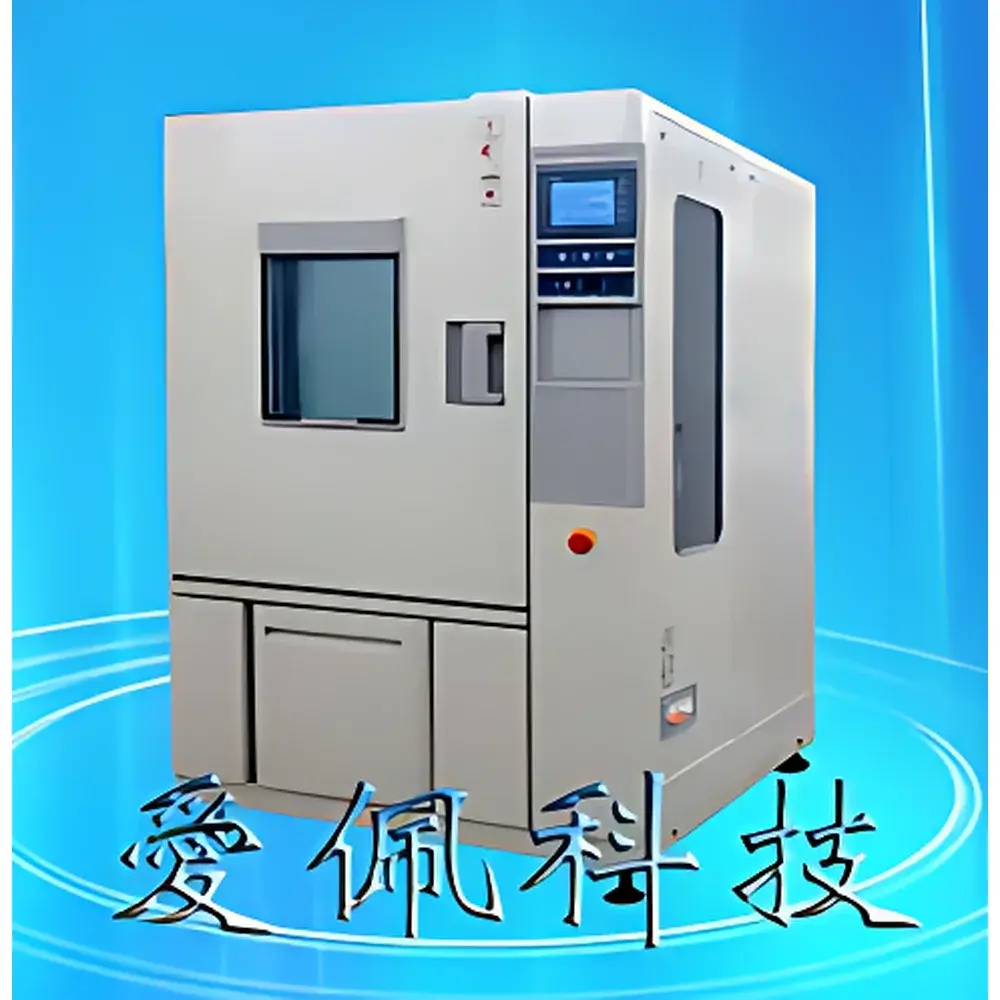
APKJ AP-GD-1000L High-Low Temperature Cycling Test Chamber (Manufacturer Direct)
| Brand | APKJ |
|---|---|
| Origin | Guangdong, China |
| Manufacturer Type | Direct Manufacturer |
| Country of Origin | China |
| Model | AP-GD-1000L |
| Pricing | Upon Request |
Overview
The APKJ AP-GD-1000L High-Low Temperature Cycling Test Chamber is an engineered environmental simulation system designed to replicate extreme thermal conditions for reliability validation and performance evaluation of industrial components and finished products. Operating on a dual-stage refrigeration principle with cascade compressor architecture, it delivers precise, stable, and repeatable temperature profiles across a wide operational range — from –70 °C to +150 °C (typical configuration; exact limits depend on chamber load and ambient conditions). The chamber employs forced-air convection via multi-blade centrifugal fans to ensure uniform thermal distribution (±1.0 °C at 1 m from chamber walls per IEC 60068-3-5), minimizing thermal gradients that could compromise test validity. Its structural design integrates high-efficiency polyurethane insulation (100–150 mm thickness), stainless steel inner chamber, and double-glazed observation window with anti-fog heating — all contributing to low thermal leakage and energy-efficient operation.
Key Features
- Intuitive membrane-key control panel with real-time display of setpoint, actual temperature, elapsed time, and cycle stage
- Lan-enabled controller supporting remote programming, data logging, and machine supervision via standard Ethernet (TCP/IP); USB port for firmware updates and offline data export
- Cascade refrigeration system featuring imported hermetic compressors (Tecumseh France or equivalent OEM grade), optimized for deep-cold capability and long-term stability
- Environmentally compliant refrigerant pairing: Low-stage R23 or R508B; high-stage R404A or R507 — fully aligned with U.S. EPA SNAP program and EU F-Gas Regulation (usable beyond 2030 under current phase-down schedules)
- Comprehensive safety architecture including over-temperature cut-off, compressor high-pressure protection, phase failure detection, door interlock, and real-time fault diagnostics with on-screen troubleshooting guidance
- Modular construction supports six standardized internal volumes (including 1000 L working space) and ten pre-configured test profiles compliant with major international environmental stress standards
Sample Compatibility & Compliance
The AP-GD-1000L accommodates diverse sample geometries — from PCB assemblies and automotive ECUs to polymer specimens and sealed consumer electronics enclosures — without requiring custom fixtures. Internal dimensions (W×H×D): 1000 mm × 1000 mm × 1000 mm; max. payload: 80 kg (static, uniformly distributed). It is validated to meet the thermal performance and instrumentation accuracy requirements of GB/T 10589–1989 (Low-Temperature Test Chamber Specifications), GB/T 10592–1989 (Climatic Test Chamber General Requirements), GB/T 2423.1–2008 (Test Aa/Ab: Cold), GB/T 2423.4–2012 (Test Db: Cycle), and MIL-STD-810G Method 502.2 (Low Temperature) and Method 507.2 (Temperature Shock). Optional calibration certificates traceable to NIM (China National Institute of Metrology) are available upon request.
Software & Data Management
The embedded controller runs APKJ’s proprietary TES-Link firmware, supporting up to 99 programmable cycles with 999 segments per cycle, ramp rate control (0.1–10 °C/min), and hold steps with timer-based triggers. All test data — including temperature vs. time stamps, alarm logs, and system status events — are timestamped and stored internally (≥30 days at 1-second resolution) and exportable in CSV format. For regulated environments, optional 21 CFR Part 11-compliant software modules provide electronic signatures, audit trails, and role-based user access control — facilitating GLP/GMP-aligned validation protocols in pharmaceutical, medical device, and aerospace QA labs.
Applications
This chamber serves as a core tool in product development and quality assurance workflows across multiple sectors: thermal cycling endurance testing of lithium-ion battery modules; cold-start verification of automotive sensors and infotainment systems; accelerated aging studies of elastomers and adhesives per ASTM D395; qualification of military-grade connectors under MIL-PRF-28876; and pre-shipment stress screening (ESS) of consumer electronics per JEDEC JESD22-A104. Its reproducible thermal transitions support root-cause analysis of solder joint fatigue, seal integrity failure, and coefficient-of-thermal-expansion (CTE) mismatch phenomena.
FAQ
What is the standard temperature range for the AP-GD-1000L?
Standard configuration covers –70 °C to +150 °C; extended ranges (e.g., –80 °C) require customized refrigeration tuning and are subject to additional lead time.
Does the chamber support automated data export to LIMS or MES platforms?
Yes — via Modbus TCP or OPC UA protocol integration (optional hardware interface module required).
Is third-party calibration and IQ/OQ documentation available?
Yes — APKJ provides factory calibration reports (NIST-traceable reference sensors) and customizable validation packages compliant with ISO/IEC 17025 and GAMP5 guidelines.
What maintenance intervals are recommended for the refrigeration system?
Compressor oil analysis every 2,000 operating hours; full refrigerant circuit inspection annually; filter-drier replacement every 18 months under continuous operation.
Can the chamber be integrated into a centralized lab monitoring network?
Yes — LAN connectivity enables SNMP-based monitoring, SNMP trap alerts, and integration with building management systems (BMS) or enterprise SCADA platforms.



