
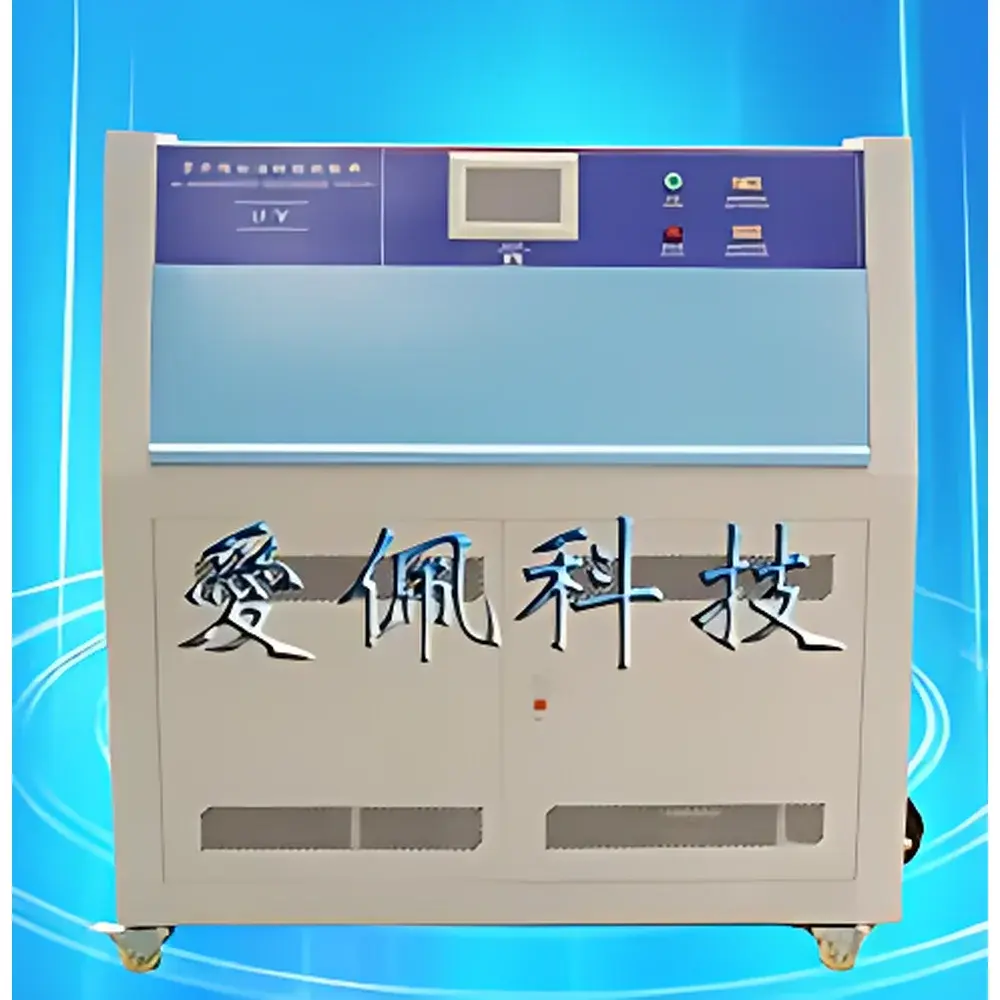
Apkji AP-UV-03 Fluorescent UV Aging Test Chamber
| Brand | Apkji |
|---|---|
| Origin | Guangdong, China |
| Manufacturer Type | OEM/ODM Manufacturer |
| Country of Origin | China |
| Model | AP-UV-03 |
| Price | Upon Request |
| Temperature Range | RT to +70°C |
| Humidity Range | ≥90% RH |
| Temperature Uniformity | ±1°C |
| Temperature Fluctuation | ±0.5°C |
| Lamp Center-to-Center Spacing | 70 mm |
| Sample-to-Lamp Distance | 50 mm ±3 mm |
| Irradiance Control Range | 0.5–1.0 W/m² (adjustable) |
| UV Spectrum | UVA (315–400 nm), UVB (280–315 nm) |
| Lamp Type | 1200 mm × 40 W fluorescent UV tubes (UVA-340 / UVB-313 optional), 8 units |
| Rated Lamp Life | ≥1600 h |
| Controller | TEMI880 color touchscreen or RKC intelligent controller |
| Temperature Control Method | PID auto-tuning with SSR output |
| Standard Specimen Size | 75 mm × 290 mm |
| Water Pan Depth | 25 mm (auto-maintained) |
| Effective UV Exposure Area | 900 mm × 210 mm |
| Black Panel Temperature Range | +50°C to +70°C |
| Exposure Cycle Options | UV irradiation, condensation, and water spray (independently programmable) |
| Test Duration | 0–999 h (programmable) |
| Sample Holder Capacity | 24 positions |
| Spray Function | Fully automated |
Overview
The Apkji AP-UV-03 Fluorescent UV Aging Test Chamber is an engineered environmental simulation system designed for accelerated weathering evaluation of polymeric materials, coatings, adhesives, textiles, and automotive components under controlled ultraviolet (UV) radiation, condensation, and water spray exposure. It operates on the principle of fluorescent UV lamp-based irradiation—primarily using UVA-340 (simulating solar UV below 365 nm) or UVB-313 (providing more aggressive short-wave UV for rapid degradation studies)—combined with cyclic condensation (to simulate dew formation) and optional water spray (to replicate rain erosion). This tri-modal exposure protocol enables reproducible acceleration of photochemical degradation mechanisms—including chain scission, oxidation, pigment fading, surface microcracking, and loss of mechanical integrity—within days or weeks, correlating strongly with multi-month outdoor exposure in subtropical and temperate climates.
Key Features
- Eight high-stability 40 W fluorescent UV lamps (1200 mm length), configurable as UVA-340 or UVB-313 spectral types, mounted in a top-mounted horizontal array for uniform irradiance distribution
- Precise irradiance control (0.5–1.0 W/m² at 340 nm) via integrated radiometric feedback and lamp power modulation
- Black panel temperature sensor monitoring (range: +50°C to +70°C) ensures accurate surface heating simulation during UV exposure
- Automated condensation cycle with temperature-controlled water pan (depth: 25 mm, maintained dynamically) to generate realistic dew-phase moisture ingress
- Programmable water spray function with adjustable duration, frequency, and pause intervals—compliant with ASTM G154 Cycle 4 and ISO 4892-3 Annex B
- High-resolution color touchscreen controller (TEMI880 or RKC) supporting multi-step exposure profiles, real-time data logging, and password-protected parameter locking
- PID auto-tuning temperature control with SSR output delivers stable chamber air temperature (RT to +70°C) and tight uniformity (±1°C) and stability (±0.5°C)
- Dedicated sample rack accommodating 24 standard specimens (75 mm × 290 mm); custom fixtures available per ISO 11341 and ASTM D4329 mounting requirements
- Effective UV irradiation zone measuring 900 mm × 210 mm, optimized for spatial irradiance homogeneity per IEC 61215-2 MQT10
Sample Compatibility & Compliance
The AP-UV-03 accommodates flat, rigid, or semi-flexible specimens up to 3 mm thickness—including plastic sheets, painted metal panels, elastomeric seals, fiber-reinforced composites, and printed electronics substrates. Its design aligns with international standards for laboratory weathering, including ASTM D4329 (standard practice for fluorescent UV-condensation exposures), ISO 4892-3 (plastics—methods of exposure to laboratory light sources—fluorescent UV lamps), and GB/T 14522 (Chinese national standard for mechanical properties testing of non-metallic materials under UV exposure). All control algorithms and data records comply with GLP documentation requirements; audit trail functionality supports 21 CFR Part 11 readiness when paired with validated software configuration.
Software & Data Management
The TEMI880 controller provides embedded data storage for up to 100 test programs and 10,000 timestamped measurement points (temperature, irradiance, black panel temp, cycle phase). Exportable CSV logs include irradiance integral (J/m²), cumulative condensation time, and thermal history—all traceable to internal RTC and calibrated sensors. Optional Ethernet or RS485 interface enables integration into centralized lab management systems (LIMS) or MES platforms. Firmware updates are delivered via USB and include version-locked calibration coefficients to maintain metrological integrity across maintenance cycles.
Applications
- Formulation screening of UV stabilizers, HALS additives, and pigment systems in automotive clearcoats and architectural sealants
- Comparative lifetime prediction of polymer blends (e.g., PP/EPDM, PC/ABS) under tropical humidity–UV stress coupling
- Qualification testing of photovoltaic module encapsulants (EVA, POE) per IEC 61215-2 MQT10 and UL 1703 Annex H
- Regulatory submission support for FDA 510(k) or CE marking of medical device packaging (ISO 11607-2)
- Root cause analysis of field failures related to chalking, gloss loss, or interfacial delamination in outdoor signage and façade systems
- Internal QC release testing for batch-to-batch consistency of UV-curable inks and adhesives
FAQ
What UV spectral options are supported, and how do they differ in application?
The AP-UV-03 accepts both UVA-340 and UVB-313 lamp types. UVA-340 closely matches terrestrial solar UV down to 340 nm and is preferred for realistic long-term durability assessment. UVB-313 emits significant energy below 320 nm, inducing faster degradation—ideal for quality control screening or failure mode acceleration.
Is the irradiance calibrated and traceable to NIST standards?
Yes. Each unit ships with a factory calibration certificate referencing a NIST-traceable UV radiometer (340 nm bandwidth). Users may perform field verification using optional handheld calibrators compliant with ISO/IEC 17025.
Can the chamber operate continuous UV-only cycles without condensation or spray?
Yes. All three exposure modes—UV irradiation, condensation, and water spray—are independently programmable and can be enabled or disabled per test step.
What maintenance intervals are recommended for lamp replacement and sensor verification?
Lamps should be replaced after 1600 h of operation or upon observed irradiance drift >10% from setpoint. Black panel and chamber air sensors require annual verification against reference thermometers per ISO/IEC 17025 procedures.
Does the system support remote monitoring and alarm notification?
Via optional Ethernet module and Apkji’s LabLink™ gateway, users can access real-time status, receive SMS/email alerts on deviation events (e.g., temperature out-of-spec, lamp failure), and download logs remotely—fully auditable for ISO 9001 surveillance.



