
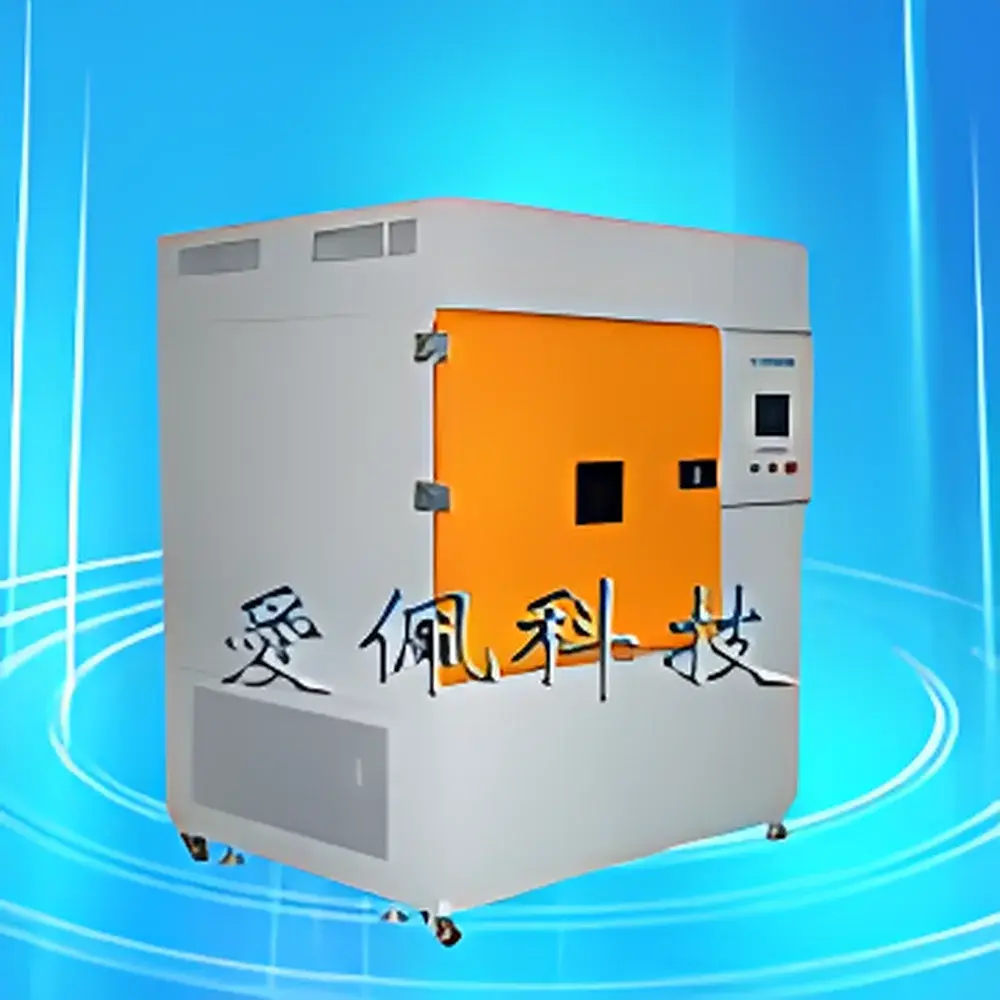
Apkji AP-XD-100 Xenon Arc Weathering Test Chamber
| Brand | Apkji |
|---|---|
| Origin | Guangdong, China |
| Manufacturer Type | OEM Manufacturer |
| Country of Origin | China |
| Model | AP-XD-100 |
| Power Supply | 380 V AC / 50 Hz |
| Xenon Lamp Power | 6 kW (air-cooled, ±5–20% tolerance) |
| Heating Power | 2 kW |
| Humidification Power | 2 kW |
| Igniter Voltage/Current | 220 V AC / 27 ± 3 A |
| Ignition Time | < 2 s |
| Re-ignition Interval | > 10 min |
| Black Panel Temperature | 63 ± 3 °C |
| Temperature Range | +10 °C to 80 °C (above ambient) |
| Temperature Uniformity | ±2 °C |
| Temperature Fluctuation | ±0.5 °C |
| Humidity Range | 80–98 %RH |
| Humidity Uniformity & Fluctuation | ±3 %RH |
| Sample Rack Rotation Speed | 1–5 rpm (360° continuous rotation) |
| Specimen Dimensions | 75 × 150 mm (standard) |
| Lamp-to-Specimen Distance | 350–782 mm (adjustable) |
| Rainfall Duration | 0–9999 min (continuously adjustable) |
| Light Cycle Timer | 0–99 h 99 min (with programmable on/off intervals) |
| Internal Chamber Dimensions (W×D×H) | 900 × 900 × 850 mm |
| Compliance | GB/T 16422.2, GB 10485–1989 |
Overview
The Apkji AP-XD-100 Xenon Arc Weathering Test Chamber is an engineered environmental simulation system designed for accelerated weathering evaluation of polymeric, coating, textile, automotive, and aerospace materials under controlled exposure to solar radiation, thermal cycling, and moisture stress. It employs a 6 kW air-cooled xenon arc lamp—the internationally accepted spectral source for replicating terrestrial sunlight—filtered through borosilicate outer and quartz inner sleeves to approximate the UV–visible–near-IR irradiance distribution of global daylight (CIE No. 85, ISO 4892-2). The chamber integrates precise black panel temperature control (63 ± 3 °C), programmable humidity conditioning (80–98 %RH), and synchronized water spray cycles to emulate dew formation, rainfall, and thermal shock—key degradation drivers in real-world outdoor service life. Unlike UV fluorescent or metal halide systems, xenon arc technology delivers full-spectrum fidelity critical for evaluating photostability, chalking, gloss loss, color shift, and mechanical embrittlement across diverse material classes.
Key Features
- High-fidelity xenon arc illumination with spectral filtering compliant with ISO 4892-2 and ASTM G155 Class A/B irradiance profiles
- Independent dual-control architecture: microprocessor-based PID regulation for temperature (±0.5 °C fluctuation) and humidity (±3 %RH uniformity)
- Programmable light/dark cycles with adjustable irradiance intensity, duration, and interruption patterns
- Automated rain simulation system featuring adjustable spray frequency (e.g., 60 min on / 12 min off), pressure-regulated nozzles, and distilled-water-only operation
- Motor-driven 360° rotating specimen rack (1–5 rpm), accommodating ≥10 standard 75 × 150 mm test panels at variable radial distances (350–782 mm) from lamp axis
- Integrated safety interlocks: lamp ignition disabled without active cooling water flow; automatic lamp shutoff upon coolant failure or overtemperature event
- Dual-stage protection circuitry for igniter (220 V AC, 27 ± 3 A) with <2 s startup and mandatory >10 min cooldown between reignitions
- Stainless-steel interior chamber (900 × 900 × 850 mm W×D×H) with corrosion-resistant insulation and condensate management system
Sample Compatibility & Compliance
The AP-XD-100 supports standardized flat-panel specimens per ISO 4892-2, ASTM D4329, and GB/T 16422.2 protocols—including painted metal substrates, plastic injection-molded parts, elastomeric seals, architectural coatings, and fiber-reinforced composites. Its black panel temperature sensor enables direct correlation to surface heating effects observed in field exposure. The chamber meets national standards GB 10485–1989 (road vehicle lighting and signaling device testing) and GB/T 16422.2 (plastics—methods of exposure to laboratory light sources), and its operational parameters are traceable to NIST-traceable calibration practices. While not inherently 21 CFR Part 11 compliant, audit-ready data logging (via optional RS485/Modbus interface) supports GLP/GMP-aligned validation when integrated with qualified LIMS or ELN platforms.
Software & Data Management
The AP-XD-100 utilizes a dedicated industrial-grade controller with embedded non-volatile memory for storing up to 100 user-defined test programs—including multi-step sequences combining irradiance ramping, thermal soak, humidity hold, and cyclic spray phases. Real-time monitoring displays black panel temperature, chamber RH, lamp voltage/current, and elapsed cycle time. Optional USB or Ethernet connectivity enables export of timestamped CSV logs for post-test statistical analysis (e.g., ΔE* color change, gloss retention %, tensile strength decay). All parameter settings and runtime events are recorded with date/time stamps to support internal quality audits and regulatory documentation requirements.
Applications
- Accelerated aging of automotive interior trim, exterior paint systems, and headlamp lenses per SAE J2412 and ISO 11341
- UV resistance validation of architectural sealants, roofing membranes, and PVC window profiles
- Colorfastness assessment of textiles and printing inks under simulated subtropical climatic conditions
- Photostability screening of pharmaceutical packaging materials (e.g., HDPE bottles, blister foil laminates)
- Correlation studies between lab-based xenon exposure and natural outdoor exposure in Florida (QUV vs. Xenon), Arizona, or South Africa
- R&D formulation optimization—quantifying impact of UV absorbers, HALS stabilizers, or pigment selection on service life prediction
FAQ
What type of water must be used in the spray system?
Only distilled or deionized water is permitted to prevent mineral deposits on optics, nozzles, and specimens. Tap or softened water will cause scaling and inconsistent spray patterns.
How often should the xenon lamp be replaced?
Lamp output degrades gradually; replacement is recommended after 1,500–2,000 hours of operation or when irradiance falls below 80% of initial calibrated value—verified using a NIST-traceable radiometer.
Can the specimen rack speed be adjusted during a test?
Yes—rotation speed (1–5 rpm) is fully programmable and may be changed mid-cycle via the controller interface without interrupting temperature or humidity profiles.
Is the chamber suitable for testing three-dimensional components?
While optimized for flat panels, custom jigs can accommodate small 3D parts (<150 mm max dimension); however, shadowing and non-uniform irradiance must be evaluated per ISO 4892-2 Annex B guidance.
Does the system include calibration certificates?
Factory calibration certificates for black panel sensor and chamber temperature/humidity sensors are provided. Field recalibration services and third-party certification (e.g., TÜV, SGS) are available upon request.



