
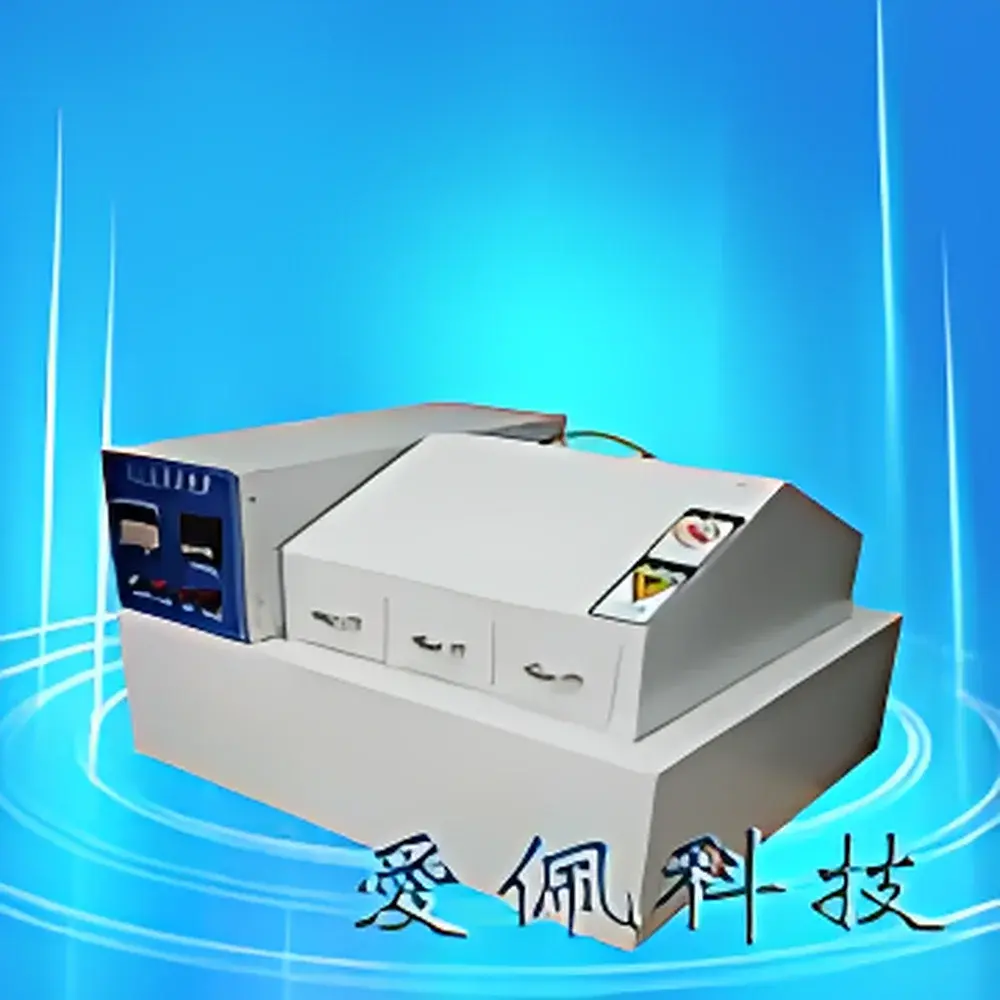
Apkji AP-ZQ-2 Steam Aging Test Chamber
| Brand | Apkji |
|---|---|
| Origin | Guangdong, China |
| Manufacturer Type | Direct Manufacturer |
| Country of Origin | China |
| Model | AP-ZQ-2 |
| Heating Time | R.T. to 98°C in 60 min |
| Temperature Controller | Microcomputer PID + PWM + SSR, LED Display |
| Temperature Sensor | PT-100 Platinum Resistance Thermometer |
| Temperature Resolution | 0.1°C |
| Temperature Uniformity | ±0.3°C |
| Inner Chamber Material | SUS#316 Stainless Steel, Full Argon Welding |
| Outer Chamber Material | SUS#316 Stainless Steel |
| Insulation Material | Fire-Retardant Polyurethane Foam |
| Heating Element | High-Temperature Insulated Heater |
| Safety Protections | Earth Leakage Circuit Breaker, Low-Water Cut-Off (Teflon-Coated), Over-Temperature Alarm, Error Indicator |
| Power Supply | 1φ3w AC220V, 50/60Hz |
| Current Rating | 6.5A |
| Net Weight | 60 kg |
| External Dimensions (W×D×H) | 808×560×440 mm |
| Test Baskets | 3 Sets |
| Optional Features | RO Pure Water Auto-Fill System, Scheduled Power-On Timer |
Overview
The Apkji AP-ZQ-2 Steam Aging Test Chamber is an engineered environmental stress test system designed for accelerated aging evaluation of electronic components under controlled saturated steam conditions. It operates on the principle of high-humidity thermal stress exposure—specifically, maintaining a stable saturated steam atmosphere at elevated temperatures (up to 98°C) to simulate long-term moisture ingress and oxidation effects over compressed timeframes. This method is widely adopted in reliability qualification protocols for passive and active semiconductor devices, where intermetallic diffusion, solder joint degradation, and terminal oxidation are primary failure mechanisms. Unlike conventional humidity chambers, the AP-ZQ-2 generates and sustains true saturated steam (100% RH at temperature) without condensation pooling, enabling reproducible, ISO/IEC 17025-aligned test environments compliant with JEDEC JESD22-A102 (Moisture Resistance) and MIL-STD-202 Method 108 (Steam Aging). Its fully welded SUS#316 stainless steel construction ensures chemical inertness against corrosive condensates and long-term resistance to chloride-induced pitting—a critical requirement for testing lead-free terminations and fine-pitch packages.
Key Features
- Precision microcomputer-based PID+PWM+SSR temperature control system with 0.1°C resolution and ±0.3°C stability across the working range (ambient to 98°C)
- PT-100 platinum resistance thermometer embedded in the steam chamber wall for direct, drift-compensated temperature feedback
- Full-argon TIG-welded inner chamber fabricated from medical-grade SUS#316 stainless steel—electropolished finish optional per customer specification
- Integrated dry-run protection: Teflon-coated water-level sensor prevents heater burnout during low-water conditions
- Dual-stage safety architecture including earth leakage circuit breaker, over-temperature cut-off, and real-time error code display
- Modular test basket configuration (3 standard stainless steel baskets) supporting simultaneous multi-sample aging with uniform steam distribution
- Optional RO pure water auto-fill system eliminates manual refilling and reduces mineral deposit accumulation in steam generators
Sample Compatibility & Compliance
The AP-ZQ-2 accommodates ICs (QFP, BGA, SOP), discrete semiconductors (diodes, transistors), passive components (chip resistors/capacitors), and PCB-mounted connectors with exposed metal terminations. It supports standardized sample mounting via non-reactive stainless steel fixtures or custom jigs. The chamber meets structural and operational requirements referenced in IPC-J-STD-020 (Moisture Sensitivity Level Testing), JEDEC J-STD-033 (Handling, Packing, Shipping), and ASTM F1879 (Standard Guide for Evaluating Moisture Resistance of Electronic Components). All electrical components comply with IEC 61000-6-2 (EMC immunity) and IEC 61000-6-4 (EMC emissions). Full traceability of calibration records, maintenance logs, and firmware revision history is maintained per GLP/GMP documentation standards.
Software & Data Management
While the base model features a stand-alone LED controller, optional RS-485/Modbus RTU interface enables integration into centralized lab management systems (LIMS) or MES platforms. Real-time temperature logging at user-defined intervals (1–60 sec) is supported via external data acquisition modules. All test parameters—including setpoint, ramp rate, dwell duration, and elapsed cycle time—are programmable and stored in non-volatile memory. Audit trail functionality (optional upgrade) satisfies FDA 21 CFR Part 11 requirements for electronic records and signatures, including operator ID tagging, timestamped parameter changes, and immutable event logs.
Applications
- Pre-solderability aging of component leads and terminations prior to wave or reflow soldering validation
- Qualification of moisture barrier integrity in molded IC packages (e.g., epoxy molding compound delamination assessment)
- Accelerated life testing of conformal coatings under cyclic steam exposure
- Corrosion susceptibility screening of tin, silver, and copper metallizations in high-temperature saturated vapor
- Process validation for lead-free assembly lines requiring strict MSL (Moisture Sensitivity Level) compliance
FAQ
What is the maximum operating temperature and steam saturation level achievable?
The chamber reaches and maintains 98°C at 100% relative humidity (saturated steam condition) with no free-standing condensate.
Is the unit suitable for continuous operation in a Class 1000 cleanroom environment?
Yes—the all-SUS#316 construction, zero-oil steam generation, and sealed electrical compartments meet ISO 14644-1 Class 6 particulate limits when installed with appropriate air filtration.
Does the system support automated test sequencing (e.g., ramp-hold-cool cycles)?
Standard configuration supports single-step steam aging; multi-segment profiles require optional PC-based controller upgrade with programmable logic sequence capability.
How often does the steam generator require descaling or maintenance?
With RO pure water feed (recommended), descaling intervals exceed 1,200 hours of cumulative operation; visual inspection every 200 hours is advised.
Can third-party calibration certificates be issued per ISO/IEC 17025?
Yes—Apkji provides NIST-traceable calibration reports for temperature sensors and chamber uniformity mapping upon request, with accredited laboratory endorsement available.



