
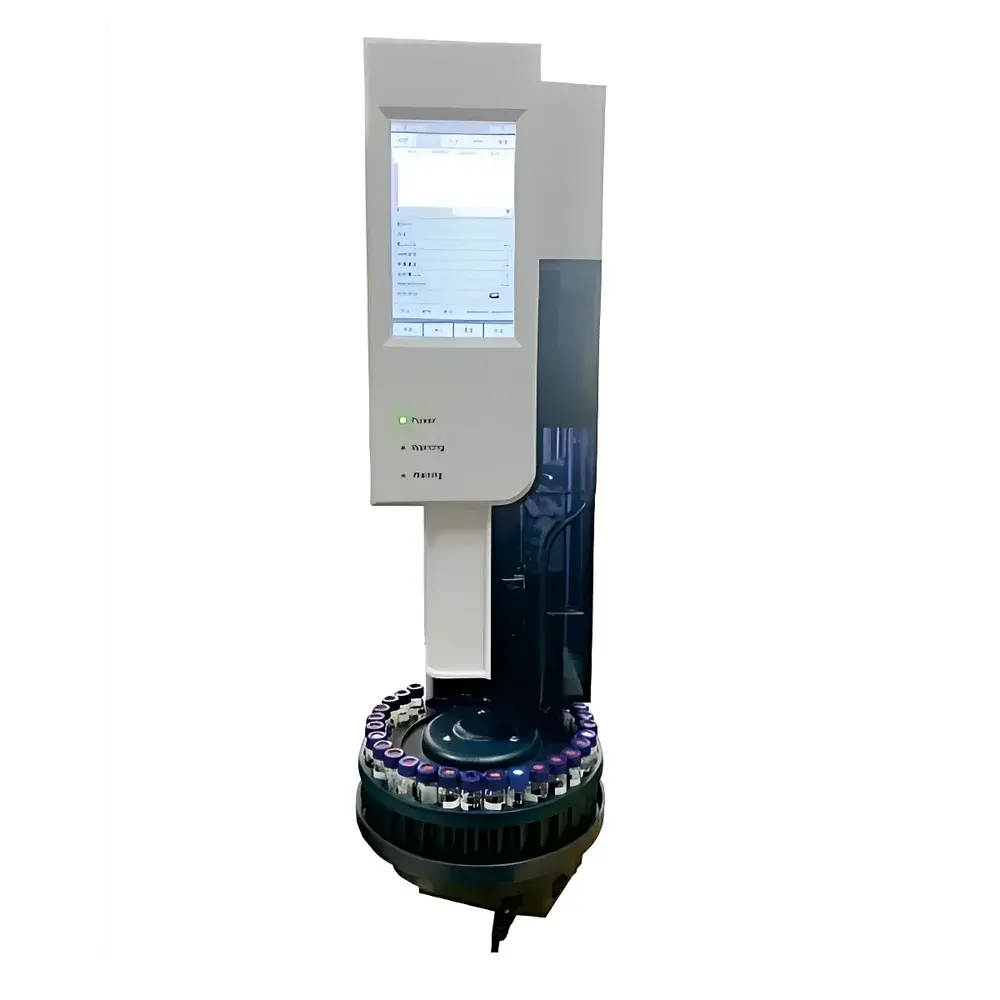
APL APL-AS-24 Multifunctional Gas Chromatography Autosampler
| Brand | APL |
|---|---|
| Origin | Sichuan, China |
| Manufacturer Type | Direct Manufacturer |
| Regional Classification | Domestic (China) |
| Model | APL-AS-24 |
| Instrument Type | Gas Chromatography Autosampler |
| Maximum Sample Capacity | 24 positions (expandable to 160) |
| Minimum Injection Volume | 0.1 µL |
| Maximum Injection Volume | 250 µL |
| Replicate Injections per Vial | up to 99 |
| Syringe Options | 1, 5, 10, 25, 50, 100, 250, 500 µL |
| Solvent Bottle Positions | 2 (expandable to 11) |
| Waste Bottle Positions | 1 (expandable to 5) |
| Method Storage | up to 20 methods |
| Needle Wash Cycles | up to 99 |
| Pump Draw Cycles | up to 99 |
| Viscosity Delay | 0–60 s |
| Dwell Time Pre-/Post-Insertion | 0–120 s |
| Injection Timing Reproducibility (Dual-Tower Mode) | < 1 ms |
| Communication Interfaces | Modbus RTU, USB 2.0 |
| Operating Temperature | −20 °C to 50 °C |
| Storage Temperature | −40 °C to 70 °C |
| Operating Humidity | 10–90% RH |
| Storage Humidity | 5–90% RH |
Overview
The APL APL-AS-24 Multifunctional Gas Chromatography Autosampler is an engineered solution for high-precision, unattended sample introduction in routine and research-grade gas chromatography (GC) workflows. Designed around a robust dual-tower architecture and CAN bus-based modular control system, it delivers deterministic timing, low dead-volume injection mechanics, and seamless integration with third-party GC systems—including Agilent, Thermo Fisher, Shimadzu, and PerkinElmer platforms—via hardware-synchronized trigger signals or software-controlled reverse communication. Its core operational principle relies on stepper motor-driven syringe actuation with real-time encoder feedback, ensuring positional repeatability at the sub-microliter level and eliminating cumulative positional drift over extended run sequences. The system supports both conventional split/splitless inlet modes and advanced techniques such as programmed temperature vaporizing (PTV) injection, making it suitable for volatile organic compound (VOC) analysis, residual solvent testing, petrochemical profiling, and environmental screening applications where regulatory compliance and method traceability are essential.
Key Features
- 5-inch capacitive touch HMI with guided, context-aware input workflow—reducing operator error during method setup.
- High-fidelity absolute-position encoding of the sample tray and needle drive mechanism—eliminating step-loss errors across multi-day unattended operation.
- Buffered needle pushrod design minimizing system dead volume and carryover risk between injections.
- Dual-tower configuration enabling synchronized dual-injection capability with timing reproducibility < 1 ms—critical for internal standard co-injection or parallel column analysis.
- Modular CAN 2.0B dual-wire communication backbone supporting hot-swappable functional units (e.g., barcode scanner, Peltier-cooled sample compartment, auxiliary solvent rack).
- Configurable injection kinetics: independent adjustment of needle insertion speed, aspiration rate, dispense rate, dwell time pre/post-insertion, and viscosity delay (0–60 s).
- Comprehensive safety validation: real-time parameter integrity checking (e.g., volume overflow, invalid position index, out-of-range dwell time) prior to sequence execution.
- Native support for Modbus RTU over RS-485 and USB 2.0 CDC class interface—enabling direct integration with LIMS, ELN, or custom SCADA environments without proprietary drivers.
Sample Compatibility & Compliance
The APL-AS-24 accommodates standard 11 mm × 32 mm GC vials (24-position base tray), with field-upgradable expansion to 160 positions using optional rotary or linear high-capacity trays. It supports dual-solvent selection (2 primary + 9 auxiliary positions) and multi-stage needle wash protocols (up to 99 cycles per injection) using configurable solvent sequences. Integrated barcode scanning (optional accessory) enables sample-level traceability aligned with ISO/IEC 17025 and FDA 21 CFR Part 11 requirements when paired with audit-trail-enabled PC software. Temperature-controlled sample storage (−10 °C to 60 °C, ±0.5 °C stability) is available as an add-on module, meeting USP <621> and EP 2.2.47 recommendations for thermally labile analytes. All firmware logic and sequence execution logs are timestamped and non-erasable, facilitating GLP/GMP-compliant data review.
Software & Data Management
The included Windows-based APL-GCControl software provides full bidirectional instrument control—allowing remote method upload, real-time status monitoring, live sequence editing, and post-run log export in CSV/CSV-UTF8 format. Sequence files include embedded metadata (user ID, timestamp, instrument serial, method checksum), and all parameter changes are recorded in a tamper-evident audit trail compliant with ALCOA+ principles. The software exposes a documented COM API and REST-like HTTP endpoint for integration into enterprise laboratory informatics systems. Raw event logs (motor steps, encoder counts, I/O state transitions) are stored separately for forensic troubleshooting and root-cause analysis during method validation or regulatory inspection.
Applications
- Routine QC testing of pharmaceutical excipients and APIs per USP <467> residual solvents monograph.
- Environmental analysis of EPA Method 8260C volatiles in soil and water extracts.
- Flavor & fragrance profiling in food matrices using cold-on-column or PTV injection.
- Petrochemical hydrocarbon group-type analysis (HT-GC) requiring precise, high-throughput sample introduction.
- Method development labs requiring flexible syringe selection (1–500 µL), variable dwell times, and programmable multi-solvent washing.
FAQ
Does the APL-AS-24 support ASTM D3606 or ISO 6974-2 compliant benzene/toluene/xylene (BTX) analysis?
Yes—its sub-millisecond injection timing reproducibility, programmable PTV ramp profiles, and compatibility with cryo-focused splitless inlets meet the retention time stability and quantitation precision requirements of both standards.
Can the autosampler be validated under GMP conditions?
Yes—when used with the optional audit-trail-enabled software package and calibrated syringes traceable to NIST standards, it satisfies IQ/OQ/PQ documentation requirements for regulated environments.
Is external triggering via TTL or contact closure supported?
Yes—the rear-panel I/O module provides optically isolated TTL inputs for GC start/stop synchronization and dry-contact outputs for external device coordination (e.g., oven door interlock, detector enable).
What is the maximum allowable syringe volume error after 10,000 injections?
Based on accelerated wear testing per ISO 8655-3, volumetric deviation remains within ±0.3% of nominal value for 10 µL and larger syringes; 1 µL syringes exhibit ±1.2% deviation under identical conditions.
How is carryover mitigated during high-concentration sample analysis?
Through three-tiered mitigation: (1) programmable multi-solvent needle wash with adjustable draw/dispense cycles, (2) heated needle seat (up to 150 °C) to prevent condensation, and (3) vacuum-assisted purge between injections using integrated vent valve control.




