
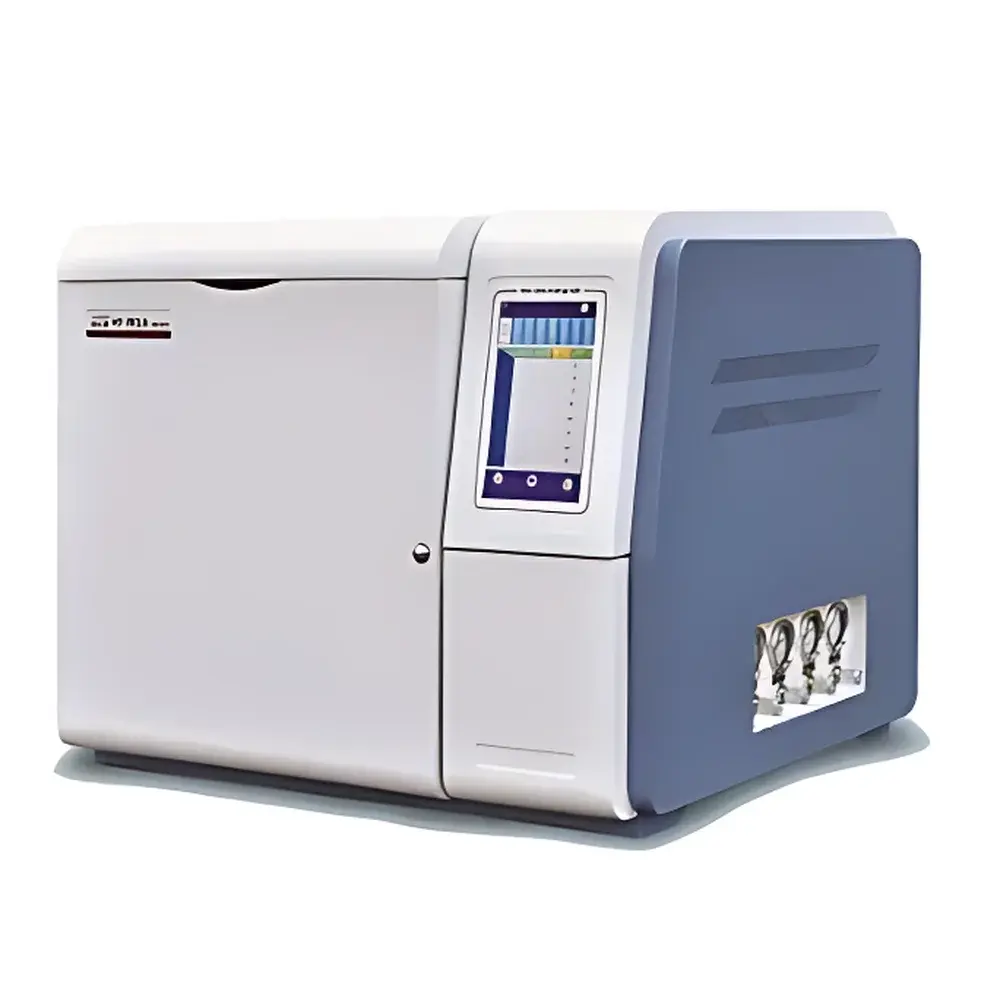
APL APL-GC-901A Laboratory Gas Chromatograph
| Brand | APL |
|---|---|
| Origin | Sichuan, China |
| Manufacturer Type | Direct Manufacturer |
| Instrument Type | Laboratory Gas Chromatograph |
| Model | APL-GC-901A |
| Temperature Control Range | Ambient +4°C to 450°C |
| Maximum Ramp Rate | 80°C/min |
| Cooling Time | <7 min (250°C to 50°C) |
| Carrier Gas Flow Range | 0–500 mL/min |
| Carrier Gas Pressure Range | 0–0.6 MPa |
| Injector Maximum Temperature | 350°C |
| Injector Pressure Setting Range | 0–0.4 MPa |
| Total Injector Flow Setting Range | 0–1000 mL/min |
| Temperature Zones | 8 independently controlled zones |
| Programmed Temperature Ramping | Up to 16 steps |
| Ramp Rate Adjustable | 0.1–60°C/min |
| Temperature Stability | ±0.1°C |
| Display | 7-inch capacitive touchscreen LCD |
| Detector Compatibility | FID, TCD, ECD, FPD, NPD (up to 3 simultaneously installed) |
| Injection Options | Packed column, capillary column, dual-capillary, valve-based gas injection, headspace, thermal desorption, autosampler-ready |
| Column Oven Dimensions | 260 × 270 × 235 mm |
| Communication Interface | Ethernet (IEEE 802.3) |
| External Events | 8 inputs, 2 auxiliary outputs |
Overview
The APL APL-GC-901A Laboratory Gas Chromatograph is a modular, high-stability analytical instrument engineered for precise separation and quantitative analysis of volatile and semi-volatile organic and inorganic compounds. Based on the fundamental principle of differential partitioning between a mobile phase (inert carrier gas) and a stationary phase (capillary or packed column), the system delivers reproducible retention time alignment and robust peak resolution across diverse sample matrices. Designed for continuous operation in regulated laboratory environments, it meets core functional requirements for method development, routine QC/QA, and research-grade chromatography — including compliance with ISO/IEC 17025 documentation expectations and compatibility with GLP/GMP workflows when paired with validated software and audit-trail-enabled data systems.
Key Features
- Eight independently programmable temperature zones — including oven, injector(s), and detector(s) — each controllable from ambient +4°C to 450°C with ±0.1°C stability and 1°C increment resolution.
- High-speed thermal management: column oven ramp rates up to 80°C/min and cooling from 250°C to 50°C in under 7 minutes, enabled by intelligent rear-door airflow control and optimized thermal mass design.
- Modular detector architecture supporting simultaneous installation of up to three detectors — including Flame Ionization (FID), Thermal Conductivity (TCD), Electron Capture (ECD), Flame Photometric (FPD), and Nitrogen-Phosphorus (NPD) — with auto-recognition and plug-and-play hardware integration.
- Flexible inlet configuration: compatible with packed-column, single/dual-capillary, six-port gas sampling valves, headspace samplers, thermal desorbers, and third-party autosamplers via standardized electrical and pneumatic interfaces.
- Large-volume column oven (260 × 270 × 235 mm) accommodates complex multi-valve, multi-column configurations — e.g., four-valve/five-column or five-valve/seven-column setups — for advanced multidimensional GC (MDGC) or heart-cutting applications.
- Capacitive 7-inch color touchscreen interface functions as both local controller and portable operation panel; supports full method editing, real-time chromatogram display, event logging, and password-protected user access levels.
Sample Compatibility & Compliance
The APL-GC-901A accepts gaseous, liquid, and solid samples following appropriate preparation (e.g., solvent extraction, derivatization, purge-and-trap). Its broad operating envelope supports analyses aligned with ASTM D3606 (benzene/toluene in gasoline), EPA Method 8260 (volatile organics in environmental matrices), USP (chromatographic separations), and ISO 11843-2 (detection capability estimation). While the base instrument does not include FDA 21 CFR Part 11-compliant software, its Ethernet interface (IEEE 802.3) enables integration with LIMS or validated chromatography data systems (CDS) that provide electronic signatures, audit trails, and secure data archiving — essential for pharmaceutical, clinical, and contract testing laboratories subject to regulatory inspection.
Software & Data Management
The instrument communicates via standard TCP/IP over Ethernet, allowing seamless integration into enterprise networks. Raw data output follows industry-standard formats (e.g., .CDF or ASCII-exportable peak tables), facilitating post-run processing in third-party tools such as OpenChrom, Chromeleon, or Empower. Optional CDS packages — validated per ICH Q2(R2) guidelines — support method validation documentation, calibration curve generation with weighting options, system suitability testing (SST), and automated reporting compliant with ISO/IEC 17025 clause 7.8. All firmware updates are delivered via signed binary files with SHA-256 verification to ensure integrity and traceability.
Applications
This system is routinely deployed in petroleum refining (hydrocarbon fingerprinting, octane number prediction), environmental monitoring (VOCs in air/water/soil), food safety (pesticide residue screening, flavor compound profiling), public health (blood alcohol quantification, toxicant biomarker detection), and academic research (reaction monitoring, polymer degradation product identification). Its configurable inlet and detector combinations allow method optimization for challenging analytes — such as chlorinated pesticides (via ECD), sulfur compounds (via FPD), or nitrogen-containing alkaloids (via NPD) — without hardware modification.
FAQ
Does the APL-GC-901A support unattended overnight operation?
Yes — equipped with power-failure recovery, automatic method sequencing, and real-time fault diagnostics, it is rated for continuous 24/7 operation under stable environmental conditions.
Can I upgrade detector configurations after purchase?
Yes — all detector modules use standardized mechanical mounting, electrical connectors, and firmware registration protocols; field upgrades require only physical installation and software activation.
Is the column oven capable of sub-ambient operation?
No — the oven operates from ambient +4°C to 450°C; true sub-ambient capability requires an external cryogenic cooling accessory not included with the base system.
What level of data security does the built-in interface provide?
The touchscreen OS supports role-based user accounts with configurable permissions (view-only, method edit, admin), but full 21 CFR Part 11 compliance depends on externally validated CDS deployment.
How many methods can be stored locally on the instrument?
The internal flash memory retains up to 100 fully parameterized methods, including temperature programs, detector settings, and event tables — all exportable via USB or network transfer.



