
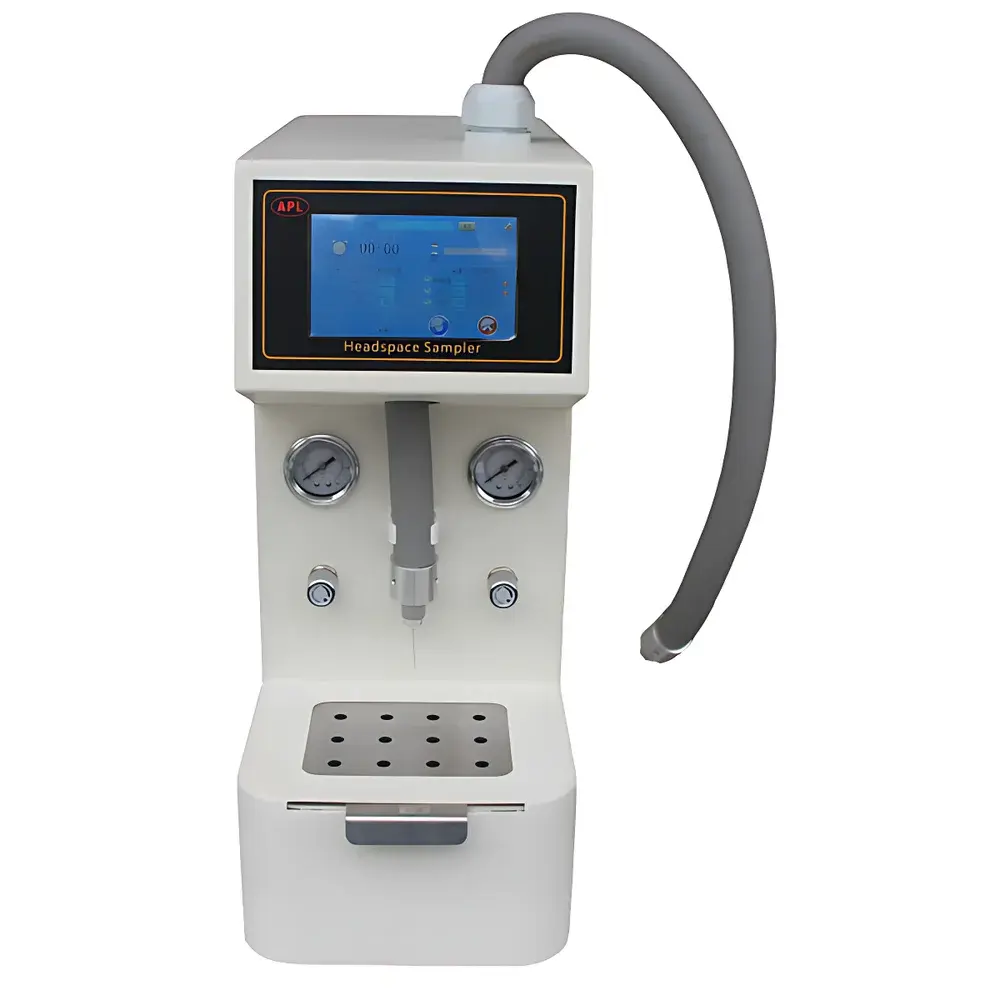
APL HS-12 Automated Static Headspace Sampler
| Brand | APL |
|---|---|
| Origin | Sichuan, China |
| Manufacturer Type | Original Equipment Manufacturer (OEM) |
| Product Category | Domestic |
| Model | HS-12 |
| Instrument Type | Static Headspace Sampler |
| Automation Level | Semi-Automatic |
| Sample Vial Heating Range | Ambient to 250 °C |
| Valve Temperature Control Range | Ambient to 220 °C |
| Loop Volume | 2 mL |
| Vial Capacity | 12 positions |
| Vial Size | 20 mL |
Overview
The APL HS-12 Automated Static Headspace Sampler is a precision-engineered thermal desorption interface designed for reliable coupling with gas chromatography (GC) systems. It operates on the static headspace principle—where volatile analytes partition from a liquid or solid matrix into the equilibrated vapor phase above the sample—and enables quantitative transfer of this headspace gas into the GC inlet via a thermostatted six-port switching valve and heated transfer line. Engineered for reproducibility and method robustness, the HS-12 supports regulated analytical workflows in quality control, environmental monitoring, pharmaceutical testing, and forensic toxicology laboratories. Its compact footprint, intuitive touchscreen interface, and programmable time-sequence control (including pressurization, equilibration, sampling, injection, and post-injection purge) make it suitable for routine high-throughput applications without compromising thermal stability or carryover performance.
Key Features
- 12-position heated sample carousel with independent temperature control (ambient to 250 °C, ±0.1 °C accuracy), enabling parallel equilibration of multiple vials under identical conditions
- Full-system thermal management: independently controlled heating zones for the six-port valve (ambient to 220 °C) and transfer line (ambient to 220 °C), minimizing condensation and adsorption losses
- Inert flow path constructed from silanized stainless steel and deactivated fused silica tubing throughout the sample loop (2 mL), valve, and gas pathway to ensure low memory effect and minimal analyte interaction
- Programmable pressure-assisted sampling: adjustable headspace pressurization (0–0.4 MPa) ensures consistent volume delivery across varying matrix viscosities and vapor pressures
- Integrated backflush capability: adjustable purge gas flow (0–20 mL/min) for automated cleaning of the loop and valve between injections, reducing cross-contamination risk
- Touchscreen HMI with time-based method programming—supports full automation of equilibration, pressurization, loop fill, injection, and post-run purge cycles
- GC synchronization interface: compatible with TTL trigger signals for coordinated start-up with major GC platforms (Agilent, Thermo Fisher, Shimadzu, PerkinElmer) and third-party data systems
Sample Compatibility & Compliance
The HS-12 accommodates standard 20 mL crimp-top headspace vials (with optional customization for 10 mL or other formats upon request). Its design conforms to widely adopted analytical standards governing volatile organic compound (VOC) analysis, including ASTM D6866 (biobased content), EPA Method 502.2 (halogenated organics in water), USP (residual solvents in pharmaceuticals), and ISO 11843-7 (detection capability for headspace-GC methods). All temperature-controlled modules meet IEC 61010-1 safety requirements for laboratory equipment. While not inherently 21 CFR Part 11 compliant, the system supports audit-trail-ready operation when integrated with validated chromatography data systems (CDS) that enforce electronic signature, user access control, and change history logging per GLP/GMP guidelines.
Software & Data Management
The HS-12 operates autonomously via its embedded firmware and 7-inch capacitive touchscreen. Methods—including temperature setpoints, equilibration time, pressurization duration, loop fill time, injection dwell, and purge parameters—are stored locally and recalled by name or number. No proprietary PC software is required; however, the device provides RS-232 and digital I/O interfaces for bidirectional communication with external GC controllers or LIMS environments. Time-programmed sequences can be exported as CSV for version control and backup. When used with compliant CDS platforms (e.g., OpenLab CDS, Chromeleon, Empower), all instrument events—including start/stop timestamps, temperature logs, valve actuation status, and error flags—are captured as metadata, supporting traceability and regulatory review.
Applications
- Petrochemical QA/QC: Analysis of residual monomers (e.g., styrene, vinyl chloride), catalyst solvents, and volatile impurities in polymer feedstocks and coatings
- Environmental testing: Quantification of chlorinated hydrocarbons (e.g., chloroform, carbon tetrachloride), BTEX compounds, and trihalomethanes in drinking water, wastewater, and soil extracts
- Pharmaceutical development: Residual solvent testing per ICH Q3C guidelines—particularly Class 2 and 3 solvents (e.g., acetone, ethanol, ethyl acetate, toluene)
- Food & beverage safety: Ethanol and acetaldehyde screening in alcoholic beverages; solvent migration assessment in packaging films and laminates
- Clinical toxicology: Headspace-GC determination of ethanol, methanol, isopropanol, and acetone in blood and urine specimens
- Forensic chemistry: Detection of ignitable liquid residues (ILRs) in fire debris samples per ASTM E1492
- Consumer product compliance: VOC emissions profiling from adhesives, inks, and cleaning agents under EU REACH and California Proposition 65 frameworks
FAQ
Is the HS-12 fully automatic or semi-automatic?
The HS-12 is classified as semi-automatic: it automates all thermal and pneumatic steps (heating, pressurization, sampling, injection, purge), but requires manual loading/unloading of vials. No robotic arm or auto-sampler tray is included.
Can the HS-12 be used with cryogenic GC inlets?
Yes—provided the GC inlet temperature is stabilized prior to injection and the transfer line remains above the dew point of target analytes. The 220 °C maximum valve and line temperature supports most common cryo-focused applications.
What maintenance is recommended for long-term reliability?
Quarterly inspection of septa integrity, annual calibration of temperature sensors using NIST-traceable probes, and periodic replacement of the 2 mL sampling loop if exposed to highly reactive or particulate-laden matrices.
Does the HS-12 support method transfer from older HS-9 protocols?
Yes—the HS-12 maintains backward compatibility with HS-9 method parameters, including timing logic and temperature ramp profiles. Minor adjustments may be needed for optimized equilibration due to improved thermal uniformity across 12 positions.
Is custom vial size support available?
Standard configuration uses 20 mL vials; 10 mL and 22 mL variants are available as factory-configured options with corresponding carousel inserts and method presets.



