
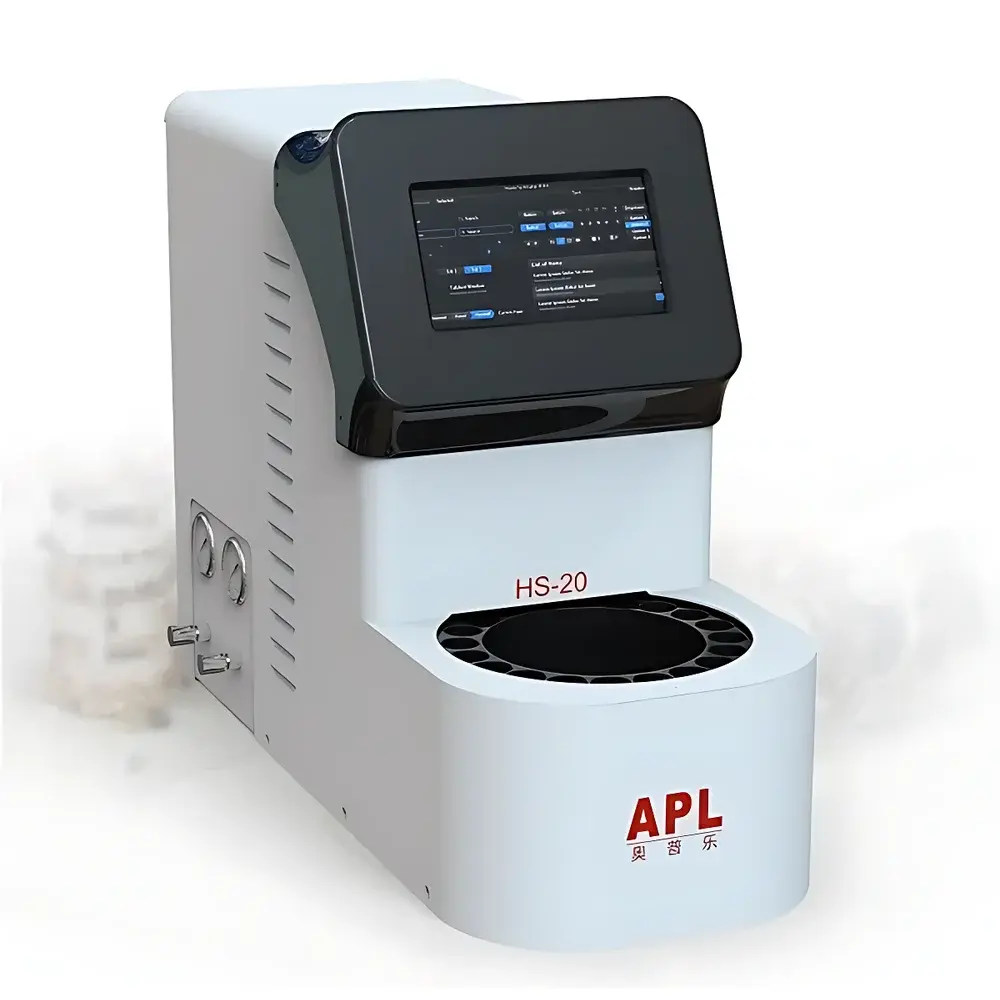
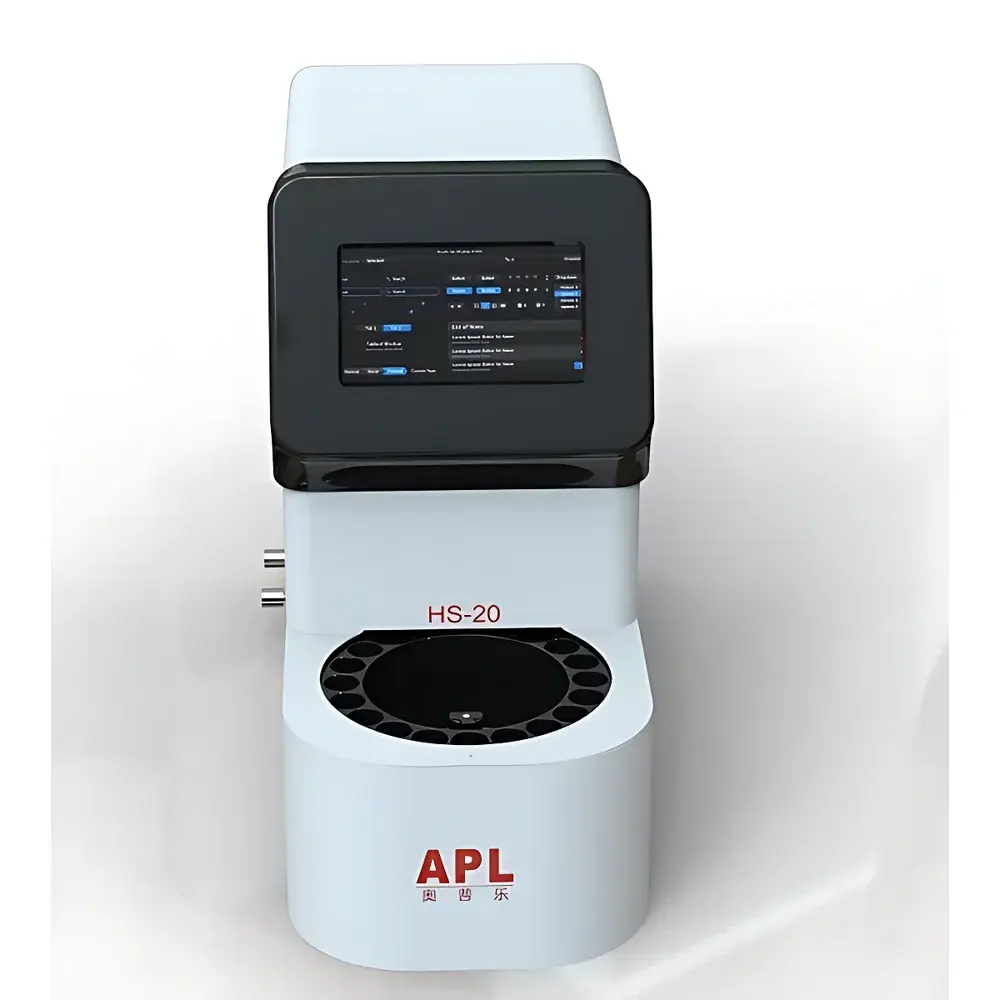
APL HS-20 Fully Automated Static Headspace Sampler
| Brand | APL |
|---|---|
| Origin | Sichuan, China |
| Manufacturer Type | Direct Manufacturer |
| Instrument Type | Static Headspace Sampler |
| Automation Level | Fully Automatic |
| Sample Tray Capacity | 20 positions |
| Vial Size | 20 mL (also compatible with 10 mL) |
| Oven Temperature Range | Ambient to 260 °C |
| Valve & Transfer Line Temperature Range | Ambient to 220 °C |
| Quantitative Loop Volume | 1 mL |
| Pressure Control Range | 0–0.4 MPa (adjustable) |
| Backflush Flow Rate | 0–400 mL/min (adjustable) |
| Temperature Stability | < ±0.1 °C |
| Precision | RSD ≤ 1% (200 ppm ethanol in water, n = 5) |
Overview
The APL HS-20 Fully Automated Static Headspace Sampler is an engineered solution for reproducible, unattended volatile organic compound (VOC) analysis in conjunction with gas chromatography (GC). It operates on the principle of static headspace equilibrium—where a sealed sample vial is heated to a defined temperature, allowing analytes to partition between the liquid/solid matrix and the vapor phase above it. Once equilibrium is reached, a precise volume of headspace gas is transferred to the GC injector via pressure-driven sampling or quantitative loop injection. Designed for laboratories requiring high-throughput, regulatory-compliant VOC analysis—including environmental testing, pharmaceutical residual solvent quantification (per ICH Q2(R2) and USP <467>), food flavor profiling, and forensic toxicology—the HS-20 delivers robust thermal control architecture, independent three-zone heating, and deterministic sequence execution without operator intervention.
Key Features
- Fully automated batch processing of up to 20 samples per run, supporting unattended overnight operation and integration into routine QC workflows.
- Triple-zone independent temperature control: sample oven (ambient to 260 °C), valve manifold (ambient to 220 °C), and transfer line (ambient to 220 °C), each adjustable in 1 °C increments with stability better than ±0.1 °C.
- Programmable pressure-assisted sampling with continuous 0–0.4 MPa regulation, enabling precise control over sample volume and transfer kinetics—critical for method robustness across diverse matrices.
- Integrated backflush functionality for both the transfer line and sampling valve, with flow adjustable from 0 to 400 mL/min, minimizing carryover and ensuring analytical integrity between injections.
- Modular needle interface compatible with all major GC inlets (Agilent, Thermo Fisher, Shimadzu, PerkinElmer), eliminating vendor lock-in and simplifying lab-wide deployment.
- Self-diagnostic startup sequence with real-time fault detection, positional calibration of the sample carousel, and audible/visual alerting—ensuring operational readiness prior to sequence initiation.
Sample Compatibility & Compliance
The HS-20 accommodates standard 10 mL and 20 mL crimp-top or screw-cap headspace vials, with full thermal uniformity across all 20 heated positions. Its design supports compliance with internationally recognized analytical standards including ASTM D3699 (gasoline hydrocarbons), ISO 11843-2 (detection capability), and pharmacopeial methods such as USP <467> and EP 2.4.24 for residual solvents. When operated under documented SOPs and paired with audit-trail-enabled GC data systems (e.g., OpenLab CDS or Chromeleon), the instrument supports GLP and GMP environments, including 21 CFR Part 11 requirements when used with appropriate electronic signature and system validation protocols.
Software & Data Management
The HS-20 executes method-defined sequences via embedded firmware—no external PC required for basic operation. Time-based programming enables precise orchestration of vial pressurization, equilibration delay, sampling duration, GC trigger signal output, and post-injection purge cycles. Optional RS-232 or USB connectivity allows synchronization with third-party chromatography data systems (CDS) for automatic run initiation and metadata tagging. All parameter settings—including temperature ramps, pressure profiles, and valve timing—are stored in non-volatile memory with timestamped change logs, facilitating traceability during internal audits or regulatory inspections.
Applications
- Residual solvent analysis in active pharmaceutical ingredients (APIs) and excipients per ICH Q3C guidelines.
- VOC screening in drinking water, wastewater, and soil extracts (EPA Methods 502.2, 524.4, 8260D).
- Flavor and fragrance compound profiling in beverages, dairy, and plant extracts.
- Quality control of polymer monomers and packaging leachables.
- Toxicological screening for blood alcohol, volatile drug metabolites, and inhalant abuse markers.
FAQ
Is the HS-20 compatible with my existing GC system?
Yes—the instrument features a universal needle interface and provides TTL-level GC start triggers, making it interoperable with all mainstream GC models.
Can I use 10 mL vials in addition to 20 mL vials?
Yes—both vial sizes are supported without hardware modification; the carousel accommodates either format with consistent thermal performance.
What level of method reproducibility can be expected?
Typical RSD is ≤1% for repeated analysis of 200 ppm ethanol in water (n = 5), meeting stringent QC requirements for regulated laboratories.
Does the system support audit trail and electronic signature capabilities?
While the HS-20 itself does not host user authentication or electronic signatures, its time-stamped parameter logs and deterministic sequence execution enable compliant integration into validated CDS platforms that meet 21 CFR Part 11 requirements.
How is carryover mitigated between samples?
Through programmable backflush cycles applied to both the transfer line and sampling valve, using inert carrier gas at user-defined flow rates up to 400 mL/min.





