
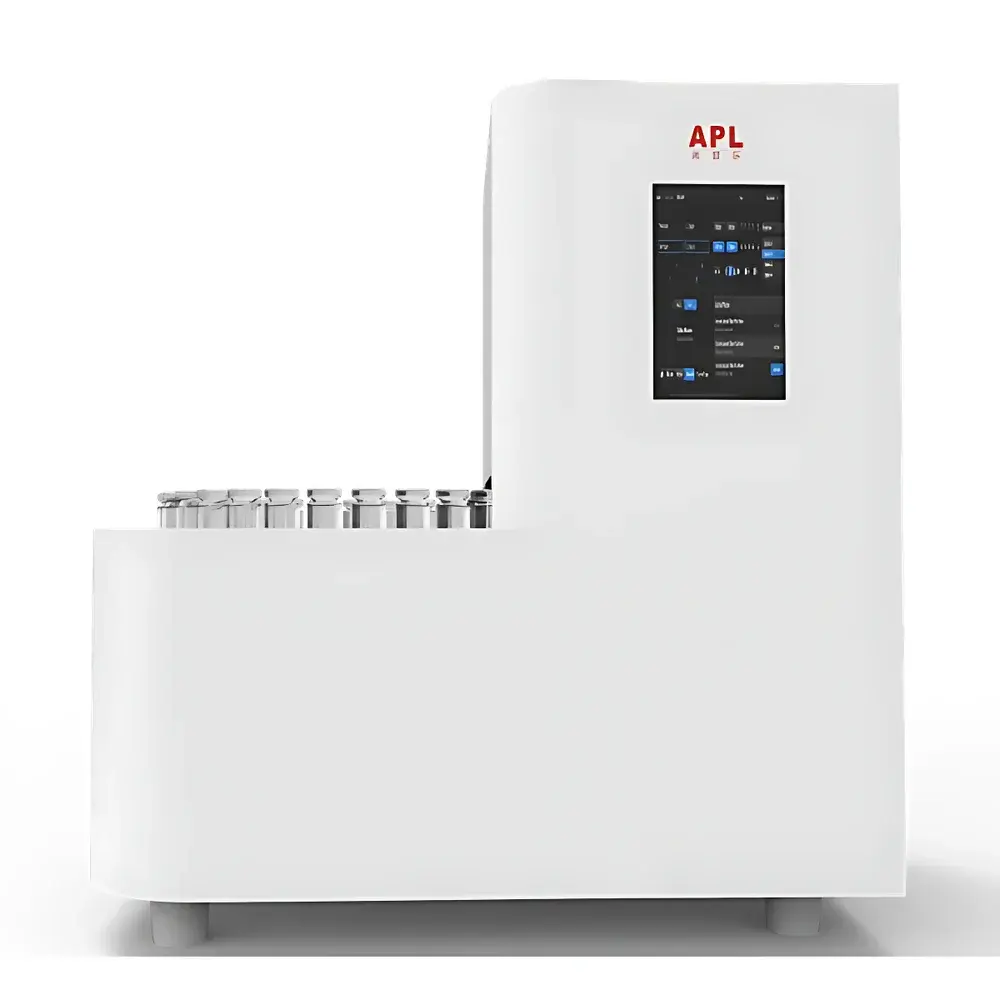
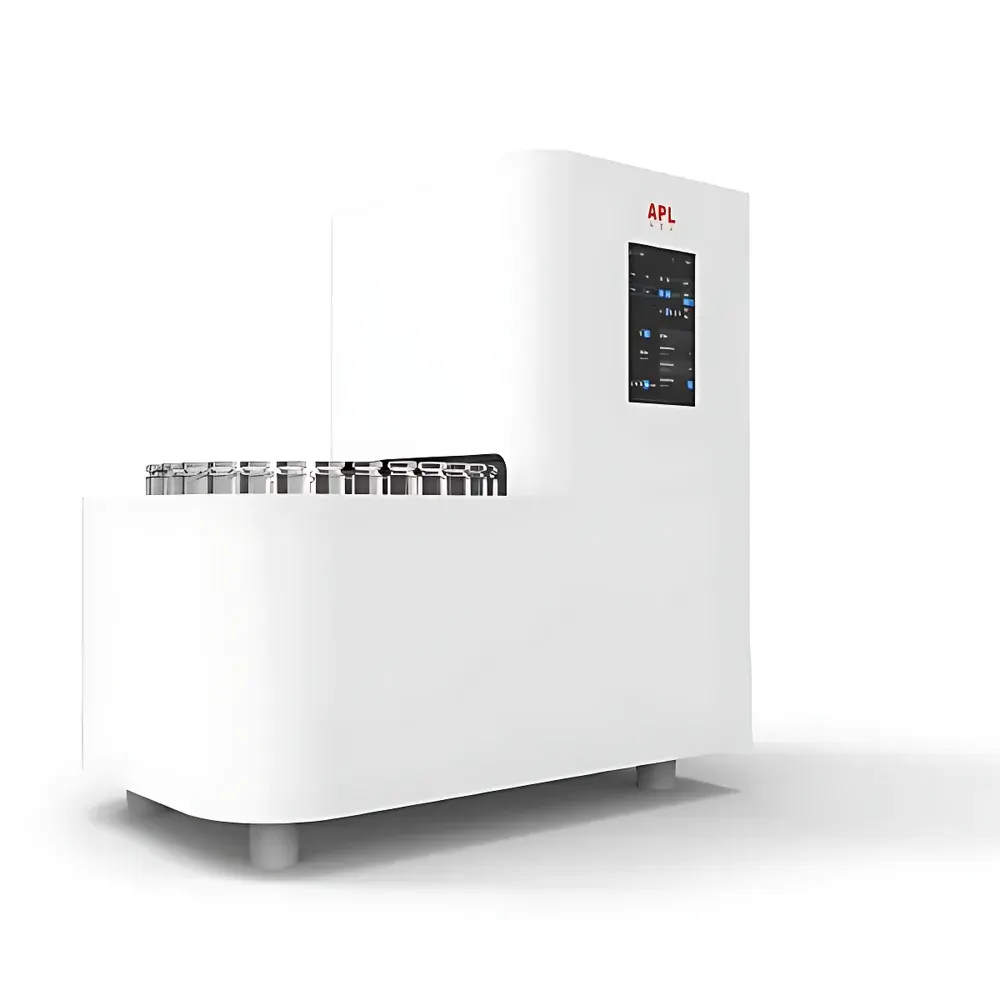
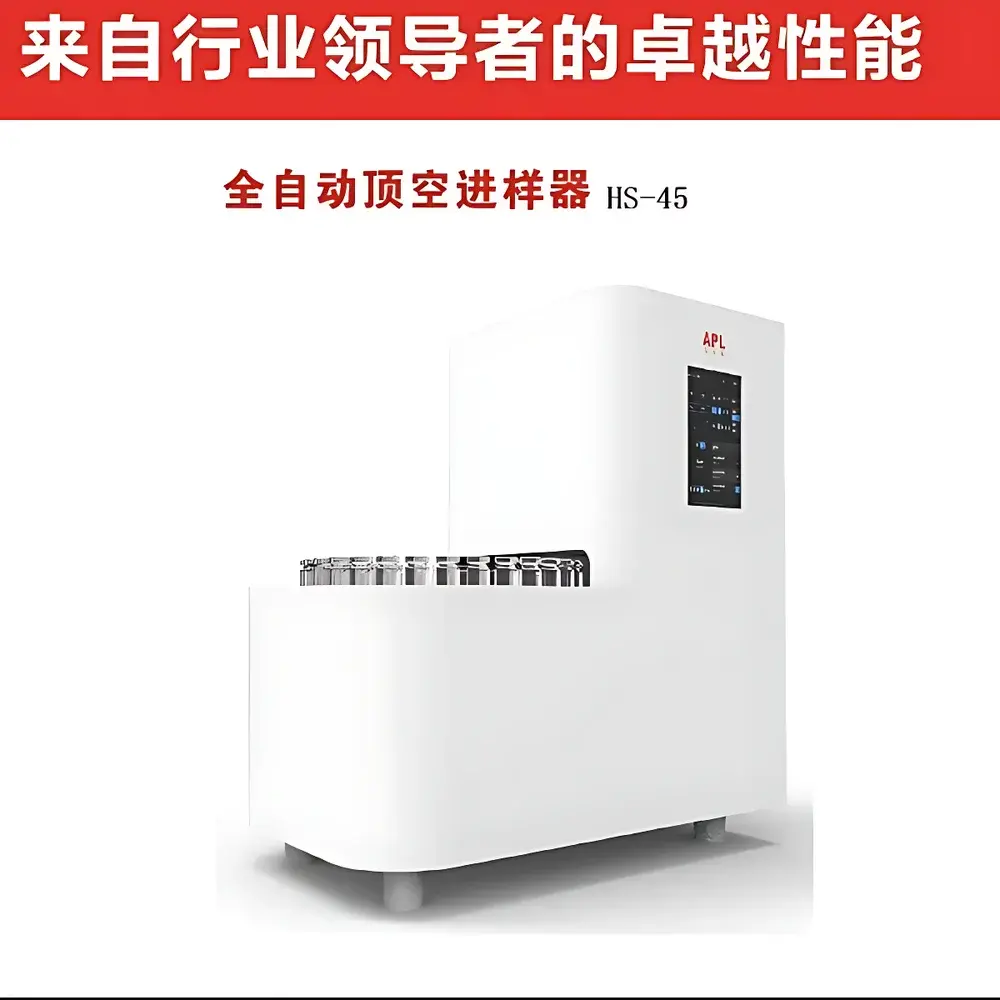
APL HS-80 Fully Automated Static Headspace Sampler
| Brand | APL |
|---|---|
| Origin | Sichuan, China |
| Manufacturer Type | Direct Manufacturer |
| Instrument Type | Static Headspace Sampler |
| Automation Level | Fully Automated |
| Sample Tray Capacity | 80 positions |
| Vial Sizes Supported | 10 mL and 20 mL |
| Oven Temperature Range | Ambient to 260 °C (1 °C increments) |
| Valve Temperature Range | Ambient to 240 °C (1 °C increments) |
| Loop Volume | 1 mL |
| Temperature Control Accuracy | ±0.1 °C |
| Independent Heated Zones | Sample oven, injection valve, transfer line, and needle |
| Agitation | Adjustable speed, integrated into each of 15 heated positions |
| System Purge | Automatic inert gas flush after each injection |
| Leak Detection | Real-time vial presence verification |
| Software Interface | 7-inch touchscreen with bilingual (English/Chinese) UI, method storage, real-time GC status display (carrier gas & pressurization pressure), AFM-based flow monitoring |
| Compliance Support | Designed for GLP/GMP environments with audit-ready method logging, event timestamping, and system self-test at power-on |
| Mechanical Architecture | Dual three-axis rotary gantry for precise vial handling, piercing, sampling, and injection |
Overview
The APL HS-80 Fully Automated Static Headspace Sampler is an engineered solution for high-throughput, reproducible volatile compound analysis in regulated and research laboratories. It operates on the principle of static headspace equilibrium—where a sealed sample vial is heated to promote partitioning of analytes from the liquid or solid matrix into the vapor phase above it. Following thermal equilibration, a precisely metered volume of headspace gas (1 mL loop) is transferred under controlled pressure directly into the inlet of a gas chromatograph (GC) or GC–MS system. Its fully automated architecture eliminates manual intervention across all operational stages—including vial loading, temperature ramping, agitation, pressurization, loop filling, injection, and post-injection purging—enabling unattended overnight or multi-day sequences. The system’s triple-zone independent heating (sample oven, valve, transfer line) and heated needle eliminate cold spots, minimizing analyte condensation, peak broadening, and retention time drift—critical for quantitative accuracy in pharmacopeial (USP , EP 2.2.48), environmental (EPA 502.2, 8260), and food safety (AOAC 993.19) applications.
Key Features
- Fully automated 80-position sample carousel with dual three-axis robotic gantry—ensuring repeatable vial positioning, puncturing, sampling, and return-to-origin motion without positional drift.
- 15 independently controllable heated zones (each with adjustable agitation) guarantee uniform thermal equilibration time across all samples in sequence, enhancing inter-sample reproducibility (RSD <1.5% for replicate standards).
- Triple-zone active heating: sample oven (ambient–260 °C), injection valve (ambient–240 °C), and transfer line—including heated needle—maintained within ±0.1 °C stability to preserve volatile integrity.
- Real-time vial presence detection prevents sequence interruption due to missing or misloaded vials; system halts and alerts before pressurization.
- Dynamic queue management allows addition of new samples during active runs without disrupting ongoing analysis—ideal for urgent QC submissions amid routine batches.
- Post-injection automatic inert gas (N₂ or He) purge of loop, needle, and transfer path reduces carryover to <0.01% (measured via blank injections following high-concentration standards).
- Chemically inert, silanized internal surfaces and thermally insulated fluidic pathways minimize adsorption and degradation of reactive volatiles (e.g., aldehydes, organic acids, sulfur compounds).
Sample Compatibility & Compliance
The HS-80 accommodates standard 10 mL and 20 mL crimp-top or screw-cap headspace vials, compatible with widely used septa materials (PTFE/silicone, BTO). Its firmware supports method parameter locking, electronic signature capability, and time-stamped audit trails—aligning with FDA 21 CFR Part 11 requirements when deployed in validated workflows. Built-in system self-test at startup verifies motor calibration, temperature sensor functionality, pressure transducer response, and vial gripper actuation—documented in the event log. All thermal and timing parameters are traceable to NIST-traceable references via factory calibration certificates. The instrument meets electromagnetic compatibility (EMC) standards IEC 61326-1 and safety standard IEC 61010-1 for laboratory use.
Software & Data Management
Controlled via a 7-inch capacitive touchscreen with bilingual (English/Chinese) interface, the HS-80’s embedded software enables full method definition—including temperature ramps, equilibration times, agitation speed profiles, pressurization setpoints, loop fill duration, injection dwell, and post-run cleaning cycles. Methods are stored locally with version control and user access levels (Operator, Supervisor, Administrator). Real-time GC status integration displays carrier gas flow, column head pressure, and auxiliary gas values using AFM (Advanced Flow Monitoring) technology—synchronizing GC readiness with sampler execution. Data export is supported via USB 2.0 to CSV or PDF reports containing run logs, error events, temperature histories, and vial position maps. Optional Ethernet connectivity enables remote monitoring and integration into LIMS via ASCII command protocol (HS-80 Command Set v2.3).
Applications
The HS-80 delivers robust performance in regulated quality control labs requiring compliance with USP residual solvents testing in pharmaceuticals, EP 2.2.48 for genotoxic impurities, and ISO 11843-7 for detection limit validation. It is routinely deployed for EPA Method 8260D analysis of volatile organic compounds (VOCs) in wastewater and soil extracts; ASTM D7622 for ethanol in gasoline; AOAC 993.19 for residual monomers in polymer packaging; and ISO 17072-1 for formaldehyde release from textiles. Its agitation function significantly improves sensitivity and precision for low-volatility analytes (e.g., chlorinated benzenes, nitroaromatics) in complex matrices such as blood, sludge, or viscous polymers.
FAQ
Does the HS-80 support dynamic headspace or only static mode?
The HS-80 is designed exclusively for static headspace analysis. It does not incorporate purge-and-trap or thermal desorption modules.
Can it be integrated with third-party GC systems beyond Agilent and Thermo Fisher?
Yes—it provides universal TTL and relay-trigger interfaces compatible with all major GC brands, including Shimadzu, PerkinElmer, and Bruker, via standardized start/stop and ready signals.
Is method validation documentation available?
APL supplies IQ/OQ protocols, calibration certificates, and a comprehensive User Requirements Specification (URS) template aligned with GAMP5 guidelines.
What maintenance intervals are recommended for long-term reliability?
Quarterly inspection of septum piercer alignment, annual recalibration of temperature sensors and pressure transducers, and biannual replacement of vial gripper elastomers—detailed in the Maintenance Logbook included with shipment.






