
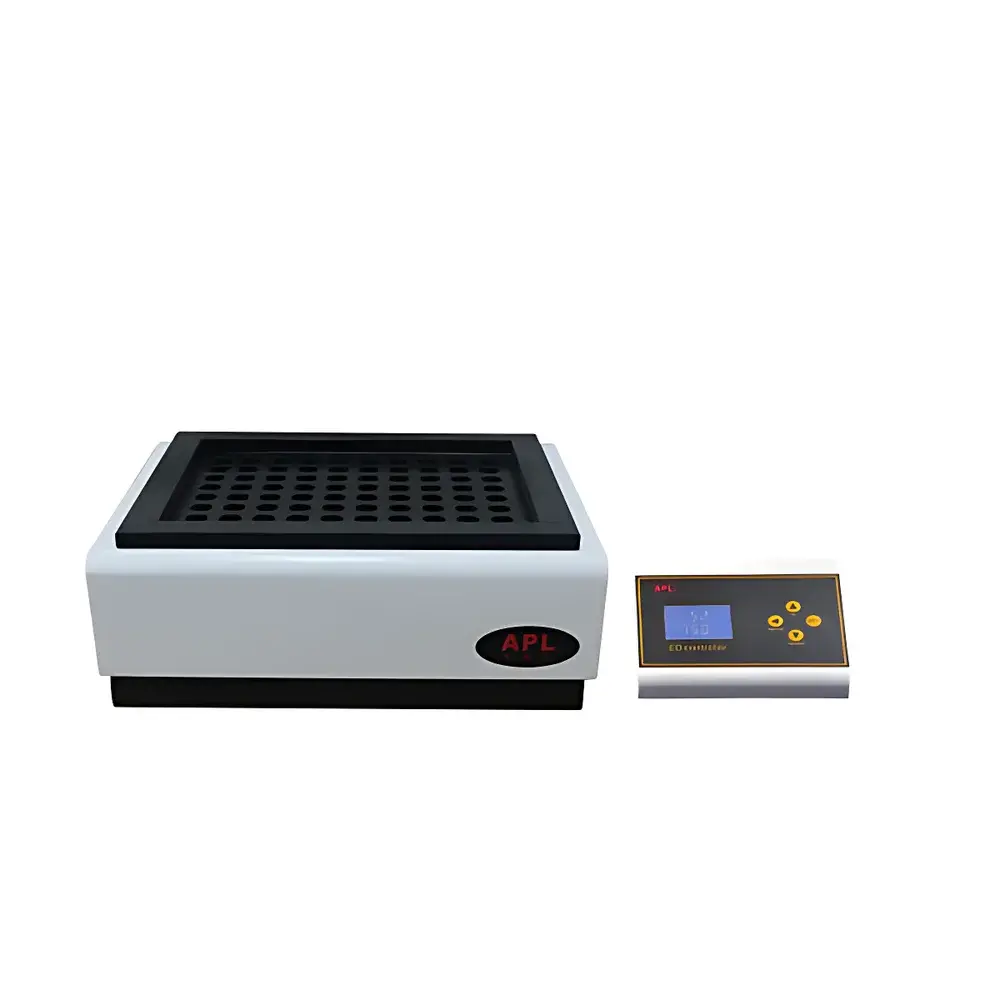
APL Optol ND60 Constant-Temperature Urinary Iodine Digestion System
| Brand | APL Optol |
|---|---|
| Origin | Sichuan, China |
| Manufacturer Type | Direct Manufacturer |
| Regional Classification | Domestic (China) |
| Model | ND60 |
| Instrument Type | Graphite Block Digestion System |
| Automation Level | Semi-Automatic |
| Digestion Positions | 60 |
| Max Heating Temperature | 250 °C |
| Temperature Control Accuracy | ±0.1 °C |
| Heating Medium | High-Purity Graphite with PFA Coating |
| Reagent Dispensing Channels | None |
Overview
The APL Optol ND60 Constant-Temperature Urinary Iodine Digestion System is a purpose-engineered graphite block digestion instrument designed specifically for compliant sample preparation in iodine quantification workflows per Chinese health industry standards WS/T 107–2006 and WS/T 107–1999. It implements precise conductive heating via a monolithic high-purity graphite block, uniformly coated with perfluoroalkoxy (PFA) polymer to ensure chemical inertness during aggressive acid digestion—particularly critical for urine matrix processing involving perchloric, nitric, or sulfuric acid mixtures. Unlike open-vessel hot plates or ceramic heaters, the ND60 utilizes full-perimeter thermal coupling between the graphite block and digestion tubes, minimizing radial and axial thermal gradients across all 60 positions. This architecture supports reproducible, matrix-matched digestion kinetics essential for trace-level iodine analysis by catalytic spectrophotometry (arsenocerium method), where incomplete oxidation or volatile loss directly compromises analytical accuracy.
Key Features
- 60-position digestion capacity with standardized 16 mm (diameter) × 50 mm (depth) wells—optimized for common 15 mL polypropylene or quartz digestion tubes used in urinary iodine protocols.
- High-purity graphite heating block with electrosprayed PFA coating: delivers exceptional corrosion resistance against concentrated HNO₃, HClO₄, and H₂SO₄ at temperatures up to 250 °C; eliminates metal leaching and surface degradation over extended operational cycles.
- PID-based digital temperature control system with ±0.1 °C stability across the full 30–250 °C operating range; supports programmable ramp-hold profiles, real-time temperature logging, and dual-stage over-temperature cutoff (audible + automatic power cut-off).
- Integrated corrosion-resistant control enclosure constructed from epoxy-coated steel and chemically stabilized gaskets—rated for continuous operation in fume hoods with ambient exposure to acidic vapors and condensates.
- Uniform thermal distribution: inter-well temperature deviation ≤ ±1.0 °C across all 60 positions under steady-state conditions (30–250 °C), verified per ISO/IEC 17025 calibration practices using NIST-traceable PT100 probes.
Sample Compatibility & Compliance
The ND60 accommodates standard 15 mL digestion vessels—including borosilicate glass, quartz, and acid-resistant polypropylene—without requiring vessel-specific adapters. Its design aligns with key regulatory expectations for sample preparation in clinical and public health laboratories: it supports GLP-compliant documentation of digestion parameters (time, temperature, ramp rate), facilitates audit-ready traceability when paired with external data loggers, and meets structural requirements outlined in WHO Guidelines for Iodine Nutrition Assessment (2020). While not certified to UL/CSA or CE for general-purpose lab use, its construction adheres to GB/T 13993–2012 (Chinese national standard for laboratory heating equipment safety) and incorporates fail-safes consistent with ISO 15195:2018 (requirements for reference measurement laboratories).
Software & Data Management
The ND60 operates via an embedded microcontroller interface with tactile keypad and backlit LCD display. All temperature setpoints, ramp rates, hold durations, and alarm thresholds are configurable without PC dependency. Optional RS-485 serial output enables integration with LIMS or SCADA systems for centralized parameter monitoring and event logging (e.g., start time, max temp reached, fault codes). Though no proprietary software suite is bundled, the device outputs ASCII-formatted timestamped logs compatible with Excel, LabArchives, or electronic lab notebook platforms supporting CSV ingestion. For FDA-regulated environments, users may configure external validation protocols satisfying 21 CFR Part 11 requirements through third-party audit trail modules.
Applications
- Routine urinary iodine quantification in national iodine deficiency disorder (IDD) surveillance programs operated by CDCs and provincial health institutes.
- Method validation and QC/QA sample preparation for arsenocerium catalytic spectrophotometry (WS/T 107–2006), including reagent blank digestion and certified reference material (CRM) processing.
- High-throughput batch digestion of pooled urine samples prior to ICP-MS or ICP-OES analysis where organic matrix removal and iodine stabilization are prerequisites.
- Research applications requiring controlled oxidative digestion of biological fluids under reproducible thermal histories—e.g., thyroid hormone metabolite studies or iodine speciation workflows.
FAQ
Is the ND60 compatible with EPA Method 3050B or USP <231> heavy metal digestion protocols?
Yes—the 250 °C maximum temperature and PFA-coated graphite block support most open-vessel acid digestion procedures for metals analysis, though users must verify tube compatibility and venting configuration per method-specific safety requirements.
Does the system include temperature calibration certificates or traceable documentation?
Factory calibration is performed using NIST-traceable reference thermometers; a Certificate of Conformance (CoC) is supplied with each unit. Full ISO/IEC 17025 calibration services are available through APL Optol’s authorized metrology partners upon request.
Can the ND60 be integrated into automated liquid handling workflows?
As a semi-automatic platform, it lacks robotic arm interfaces or auto-lid mechanisms; however, its programmable timer and stable thermal plateau enable synchronization with external autosamplers via dry-contact relay triggers (optional accessory).



