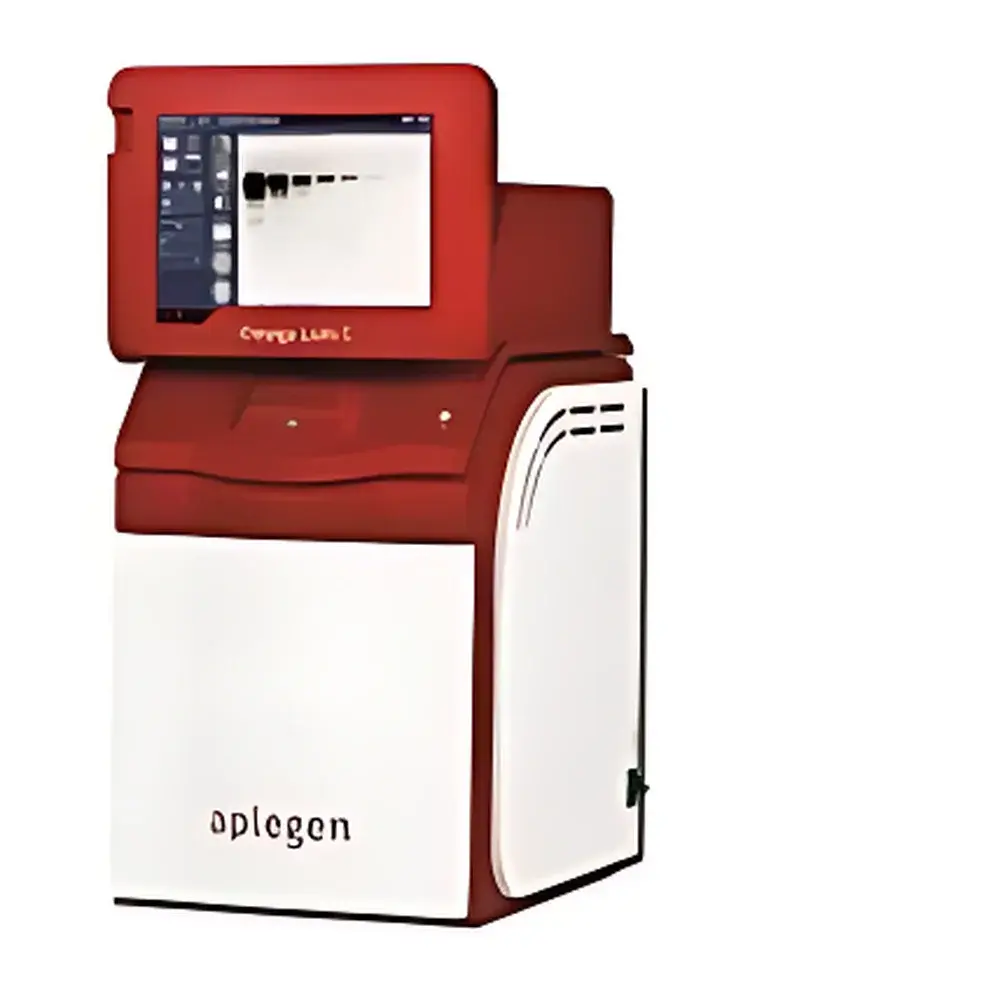
Aplegen Omega LumC Chemiluminescence Gel Imaging System
| Brand | Aplegen |
|---|---|
| Origin | USA |
| Manufacturer Type | Authorized Distributor |
| Product Category | Imported Instrument |
| Model | Omega LumC |
| Instrument Type | Chemiluminescence Gel Imaging System |
| CCD Resolution | 8.4 MP |
| Bit Depth | 16-bit |
| Dynamic Range | 0–4.8 OD |
| Lens Aperture | f/0.95 |
Overview
The Aplegen Omega LumC Chemiluminescence Gel Imaging System is a compact, integrated benchtop imager engineered for high-sensitivity detection of chemiluminescent, fluorescent, and visible-light signals in nucleic acid and protein gels. It operates on the principle of low-noise, cooled charge-coupled device (CCD) imaging with optimized optical path design—leveraging quantum-efficient micro-lens-enhanced sensors, ultra-fast f/0.95 fixed-focal-length optics, and precision-controlled illumination sources. Unlike conventional UV transilluminators or uncooled imagers, the Omega LumC achieves sub-picogram detection limits for Western blots using ECL-based substrates, while maintaining quantitative linearity across a 4.8 optical density (OD) dynamic range—critical for comparative densitometry and publication-grade data acquisition in molecular biology laboratories.
Key Features
- 8.4-megapixel, thermoelectrically cooled CCD sensor operating at –50 °C to minimize dark current and thermal noise, enabling long-exposure chemiluminescence capture without signal degradation
- f/0.95 wide-aperture, motorized prime lens with fixed focal length—maximizing photon collection efficiency and eliminating focus drift during multi-channel acquisition
- Motorized 6-position filter wheel supporting standardized emission bandpass filters for SYBR® Safe, SYBR® Gold, SYBR® Green, ethidium bromide, and Coomassie-compatible dyes
- Dual-wavelength UV transilluminator (254 nm and 302 nm) with uniform intensity distribution and built-in safety interlock
- Non-damaging dual-side blue light excitation (470 nm) optimized for nucleic acid stains with reduced photobleaching and DNA damage compared to UV exposure
- Integrated Android-based tablet with pre-installed Aplegen ImageStudio software—enabling standalone operation without external PC dependency
- Compact footprint (32 × 46 × 61 cm) designed for standard laboratory benches; fully enclosed optical chamber with light-tight sealing and black anodized sample stage to suppress ambient stray light
Sample Compatibility & Compliance
The Omega LumC supports standard electrophoretic formats including mini-gels (up to 15 × 15 cm), SDS-PAGE, native PAGE, agarose gels, and blot membranes (PVDF and nitrocellulose). It accommodates common staining modalities: ethidium bromide, SYBR® series dyes, silver stain, Coomassie Brilliant Blue R-250/G-250, and immunodetection substrates including luminol/peroxide-based ECL reagents. The system complies with ISO/IEC 17025 general requirements for competence of testing and calibration laboratories, and its hardware architecture meets electromagnetic compatibility (EMC) standards per FCC Part 15 and IEC 61326-1. While not a regulated medical device, its imaging performance aligns with GLP-relevant documentation practices—including timestamped image metadata, user-access logs, and non-destructive raw file export (TIFF, 16-bit)—supporting audit readiness in academic and industrial research environments.
Software & Data Management
Aplegen ImageStudio software provides intuitive, modular workflow control directly from the embedded tablet interface. Core functions include auto-exposure optimization, pixel binning (1×1 to 4×4), rolling-ball background subtraction, lane/profile analysis, molecular weight estimation, and relative band intensity quantification. All images are saved in lossless 16-bit TIFF format with embedded EXIF metadata (exposure time, lens aperture, filter position, temperature). Software supports batch processing, report generation (PDF/Excel), and export of analysis results with traceable parameters. For labs operating under FDA 21 CFR Part 11 requirements, optional network-connected configurations enable integration with LIMS platforms via DICOM or FTP protocols—though local tablet operation does not include electronic signature or audit trail features by default.
Applications
- Quantitative chemiluminescent Western blot analysis using HRP- or AP-conjugated secondary antibodies
- DNA/RNA gel documentation under UV (254/302 nm) and blue-light (470 nm) excitation—compatible with mutagenicity-sensitive applications
- Fluorescent protein gel imaging with SYBR® Gold (nucleic acids) and Deep Purple™ (proteins)
- Visible-light documentation of Coomassie- and silver-stained gels without UV exposure
- Time-course luminescence monitoring with programmable multi-frame acquisition and kinetic overlay
- Preparative gel documentation prior to excision and mass spectrometry analysis
FAQ
What is the maximum gel size supported by the Omega LumC?
The system accommodates gels up to 15 × 15 cm with full-frame coverage at native 8.4 MP resolution.
Does the Omega LumC support fluorescence multiplexing?
Yes—via the motorized 6-position filter wheel and user-selectable excitation sources (UV, blue light), enabling sequential imaging of multiple fluorophores with spectral separation.
Is the –50 °C CCD cooling actively maintained during extended exposures?
Yes—the thermoelectric cooler maintains stable sensor temperature throughout acquisition, critical for low-background chemiluminescence imaging.
Can raw 16-bit image files be exported for third-party analysis?
Yes—TIFF files retain full bit depth and metadata; no proprietary compression or format locking is applied.
Is service and technical support available outside the United States?
Aplegen authorizes regional distributors with certified field service engineers; warranty and maintenance contracts are region-specific and require direct coordination through local partners.