
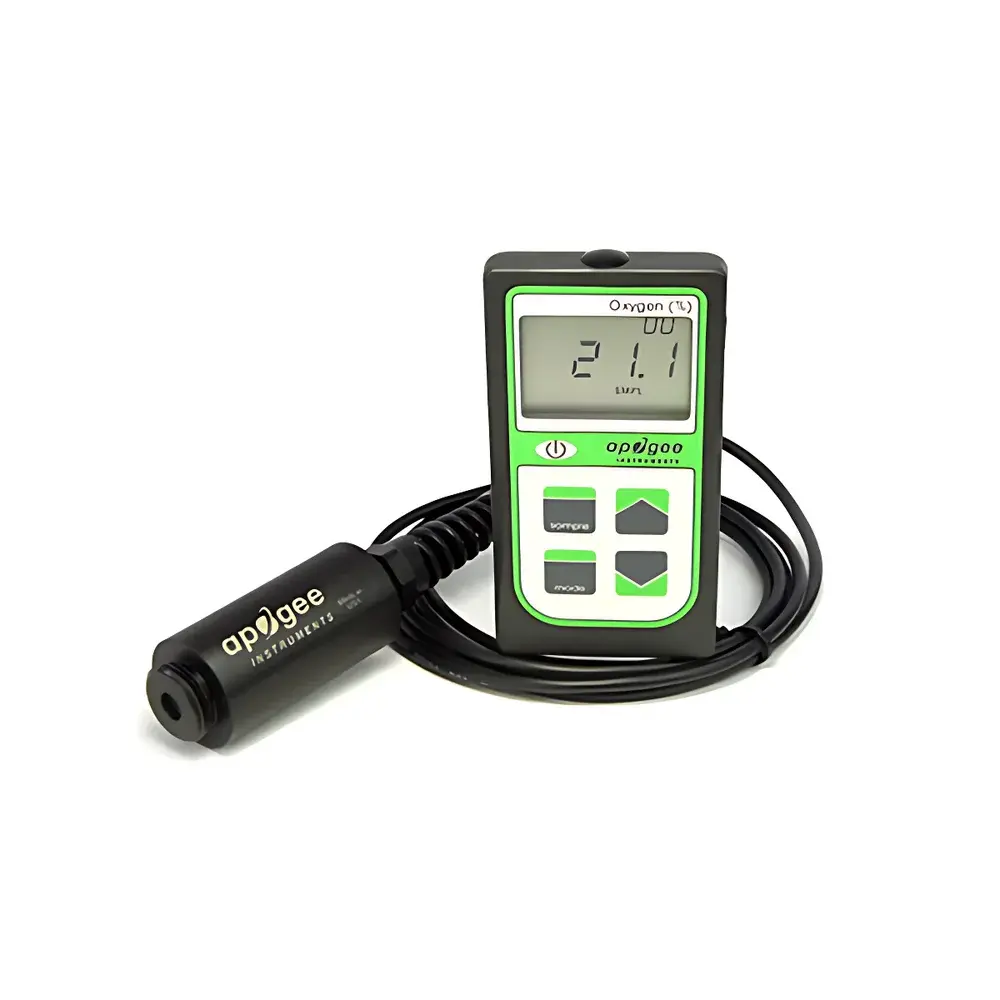
Apogee MO-200 Soil Oxygen Concentration Analyzer
| Brand | Apogee |
|---|---|
| Origin | USA |
| Model | MO-200 |
| Measurement Principle | Galvanic Electrochemical Cell (Pb/Au, Teflon Membrane) |
| O₂ Range | 5–100 % vol |
| Repeatability | ±0.1 % at 20.9 % O₂ |
| Nonlinearity | <1 % FS |
| Response Time (t₉₀) | 14 s |
| Operating Temp. | 0–50 °C, RH <90 %, 60–150 kPa |
| Interference | Immune to CO₂, CO, NO, NO₂, H₂S, H₂, CH₄ |
| Probe Diameter | 32 mm, Length: 68 mm |
| Diffusion Cap (A0-001) | Ø35 mm × 35 mm |
| Flow-Through Cap (A0-002) | Ø32 mm × 91 mm |
| Cable Length | 2 m |
| Data Logger | 99 manual entries, 99 × 30-min averages, 99 daily means |
| Logger Dimensions | 126 × 70 × 24 mm |
| Integrated Temperature Sensor | Yes |
| Housing Material | Chemically resistant polymer (acid-stable) |
| Heating Function | On-sensor membrane heater for condensation mitigation |
Overview
The Apogee MO-200 Soil Oxygen Concentration Analyzer is a field-deployable, galvanic electrochemical sensor system engineered for precise, real-time quantification of molecular oxygen (O₂) in heterogeneous solid and semi-solid matrices—including undisturbed soil profiles, compost piles, tailings deposits, and confined bioreactor environments. Unlike optical or paramagnetic methods, the MO-200 employs a self-powered, lead–gold galvanic cell with a gas-permeable polytetrafluoroethylene (PTFE) membrane. Oxygen diffusing across the membrane drives an electrochemical reaction at the cathode (Au), generating a current linearly proportional to partial pressure—converted internally via a precision bridge resistor into a stable analog voltage output (0–2.5 V). This principle ensures zero power consumption at the sensor tip, eliminating drift associated with external biasing and enabling long-term unattended operation in remote or low-power settings. The instrument is calibrated traceably to NIST-standard gas mixtures and conforms to ASTM D5127–22 guidelines for electrochemical O₂ sensing in environmental solid-phase applications.
Key Features
- Integrated PTFE-membrane galvanic cell with Pb anode and Au cathode—no external power required at sensing element
- On-sensor heating element prevents water condensation on diffusion membrane during high-humidity deployments (e.g., saturated soils, compost cores)
- Acid-resistant polymer housing rated for prolonged exposure to pH ≤ 3.5 environments (e.g., acid mine drainage soils, sulfidic tailings)
- Dual-configurable probe interface: A0-001 diffusion cap for in-situ soil insertion; A0-002 flow-through cap for inline gas stream monitoring (e.g., soil respiration chambers, landfill gas lines)
- Embedded Pt1000 temperature sensor enables automatic thermal compensation of O₂ signal per ISO 11358-2:2021 protocols
- Ruggedized 2-meter shielded cable with IP67-rated connectors for field durability and EMI rejection
Sample Compatibility & Compliance
The MO-200 is validated for direct insertion into mineral and organic soils (clay to sandy loam), mature and active compost matrices, anaerobic digestate slurries, and oxidized/sulfidic mine waste. It meets EPA Method 9045D requirements for redox-sensitive gas profiling in vadose zone characterization and supports GLP-compliant data acquisition when paired with Apogee’s optional SDI-12-compatible dataloggers. Sensor output is unaffected by common atmospheric interferents including CO₂ (up to 10 %), CO, NOₓ, H₂S, CH₄, and H₂—making it suitable for landfill cover monitoring and bioremediation site assessment. Cross-sensitivity to NH₃, HCl, and benzene remains below 1 % of full scale, while SO₂ exposure >1 ppm requires post-exposure recalibration. Ozone (O₃) irreversibly degrades the PTFE membrane and must be excluded upstream via activated carbon filtration.
Software & Data Management
The handheld readout unit provides local display, manual logging (99 points), and automated time-series storage: 99 sets of 30-minute moving averages and 99 daily mean values—each timestamped and temperature-tagged. Data export occurs via USB-C to CSV format, compatible with Excel, R, Python (pandas), and industry-standard environmental data platforms (e.g., EnviroData, EQuIS). Firmware supports user-defined calibration offsets and slope adjustments traceable to internal reference checks. When integrated into networked systems, the MO-200 complies with FDA 21 CFR Part 11 requirements for audit trails, electronic signatures, and data integrity—validated for use in regulated ecological risk assessments under USACE ER 1110-2-1156 and EU Soil Thematic Strategy reporting frameworks.
Applications
- Soil respiration rate quantification via closed-chamber O₂ depletion kinetics (aligned with ISO 16072:2021)
- Vadose zone O₂ profiling for delineating aerobic/anaerobic boundaries in contaminated aquifer remediation
- In-situ redox potential estimation in constructed wetlands and denitrification beds
- Compost maturity monitoring through aerobic phase O₂ drawdown trends
- Tailings storage facility (TSF) oxidation state surveillance to predict acid rock drainage onset
- Root-zone hypoxia detection in precision agriculture trials and controlled-environment plant physiology studies
FAQ
Does the MO-200 require periodic polarization or warm-up time before measurement?
No. As a galvanic sensor, it operates immediately upon connection with no warm-up delay or polarization step.
Can the probe be sterilized for repeated use in microbiological soil assays?
Yes—autoclaving is not recommended, but surface disinfection with 70 % ethanol or 0.5 % sodium hypochlorite is validated without membrane degradation.
Is the readout unit capable of real-time graphing or Bluetooth transmission?
The standard unit lacks onboard graphing or wireless modules; however, Apogee offers OEM integration kits for RS-485 and SDI-12 output to third-party SCADA and IoT gateways.
What is the expected service life of the sensor under continuous soil burial?
Typical functional lifespan is 12–18 months in neutral pH soils; 6–9 months in acidic (pH <4.5) or high-sulfide environments—electrolyte depletion is the primary failure mode.
How does temperature compensation affect accuracy across the full operating range?
The embedded Pt1000 sensor corrects O₂ output using a second-order polynomial algorithm per IEC 60751, maintaining ±0.15 % O₂ accuracy from 5–45 °C.
Related Products







