
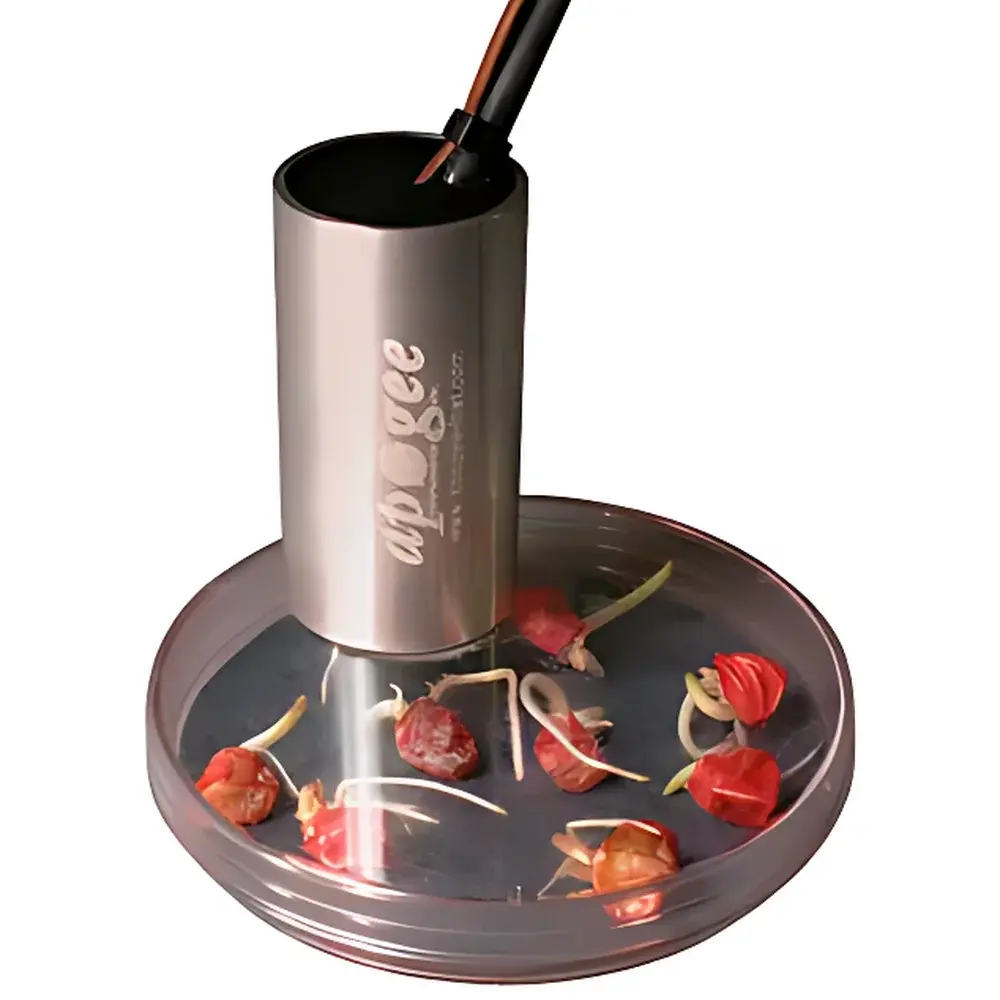
Apogee O2S-F and O2S-D Electrochemical Oxygen Sensors
| Origin | USA |
|---|---|
| Manufacturer Type | Authorized Distributor |
| Origin Category | Imported |
| Model | Apogee O2S-F / O2S-D |
| Price | Upon Request |
Overview
The Apogee O2S-F and O2S-D are precision electrochemical oxygen sensors engineered for long-term, stable measurement of oxygen partial pressure (pO₂) in gaseous environments. Based on the principle of galvanic cell operation, each sensor integrates a lead anode, gold–silver cathode, aqueous electrolyte, and a hydrophobic polytetrafluoroethylene (PTFE) membrane. Oxygen diffuses through the membrane and undergoes reduction at the cathode, generating a diffusion-limited current proportional to the partial pressure of O₂ in the sample gas. This current is converted to a voltage output via an integrated Wheatstone bridge resistor network. As true amperometric devices, they consume trace quantities of O₂ during operation—approximately 2.2 µmol O₂ per day at ambient air conditions (20.95% O₂, 23 °C, 101.3 kPa)—ensuring minimal perturbation to the measured environment. Output voltage scales linearly with pO₂, expressed in kilopascals (kPa), and is readily convertible to % O₂ or ppm using standard gas law relationships. Calibration is referenced to dry air (20.95% O₂), with atmospheric pO₂ at sea level approximating 21.2 kPa.
Key Features
- Two operational configurations: Flow-through (O2S-F) for inline gas stream monitoring and Diffusion-type (O2S-D) for static or soil-gas applications
- Robust mechanical design: O2S-D features a 1.375″ (34.9 mm) diameter × 1.375″ height cylindrical housing with 125-mesh stainless-steel diffusion barrier; O2S-F employs a 35 mm × 35 mm cylindrical body with 1/8″ NPT gas inlet/outlet ports
- High-resolution analog output: ~50 mV at 20.95% O₂ (O2S-D); ~12 mV at 20.95% O₂ (O2S-F Fast Response variant)
- Extended service life: >10 years continuous operation for standard O2S-D; >5 years for O2S-F Fast Response (FR) configuration
- Thermal compensation architecture: Integrated thermistor (TM) enables real-time temperature correction; optional thermocouple (TC) input supports dual-differential channel logging for environmental thermal profiling
- Low-drift performance: <0.01% O₂/day baseline drift; repeatability ±0.001% O₂ (10 ppm) under controlled conditions
- Wide operating range: 0–50 °C ambient temperature; 0–100% O₂ measurement range with full-scale linearity
Sample Compatibility & Compliance
The O2S-F and O2S-D sensors are validated for use in non-corrosive, non-condensing gaseous matrices including ambient air, soil interstitial gas, incubation headspace, and laboratory-controlled atmospheres. They are not suitable for direct immersion in liquids or exposure to solvents, H₂S, SO₂, Cl₂, or high-humidity (>95% RH) environments without external drying or filtration. The PTFE membrane provides inherent chemical resistance to common atmospheric contaminants. While no formal ISO/IEC 17025 certification is held by the sensor itself, system-level validation against ASTM D6925 (Standard Test Method for Determining Oxygen Content in Gases) and ISO 8573-3 (Compressed Air – Part 3: Test Methods for Oil Vapor and Gas) is achievable when paired with traceable calibration standards and documented procedures. Data integrity complies with GLP and GMP-aligned workflows when used with data loggers supporting audit-trail functionality (e.g., Campbell Scientific CR series with firmware ≥v2.0).
Software & Data Management
These analog-output sensors interface seamlessly with industry-standard data acquisition systems requiring one differential and one single-ended input (O2S-D + TM) or two differential inputs (O2S-F + TC). Apogee provides comprehensive technical documentation—including transfer functions, temperature compensation equations, and wiring schematics—for integration into LabVIEW, Python (via PySerial or NI-DAQmx), MATLAB, or proprietary SCADA platforms. Raw voltage outputs are converted to % O₂ using the equation: %O₂ = (Vout / Vref) × 20.95, where Vref is the calibrated output at 20.95% O₂. Temperature correction applies a linear coefficient derived from onboard thermistor resistance (RT). No proprietary software or drivers are required; all signal conditioning and conversion logic resides within the user’s DAQ environment.
Applications
- Soil respiration studies: Quantifying CO₂/O₂ exchange dynamics in ecological and agricultural field plots using O2S-D embedded in soil gas probes
- Controlled-environment chambers: Real-time O₂ monitoring in plant growth rooms, bioreactor headspaces, and hypoxia/hyperoxia research setups
- Food packaging headspace analysis: Non-destructive verification of modified atmosphere packaging (MAP) integrity
- Industrial safety: Low-cost backup sensing for confined-space entry protocols (supplemental to certified safety instruments)
- Environmental monitoring networks: Long-duration deployment in unattended stations measuring atmospheric O₂ gradients and diurnal variation
- Lab-based kinetic assays: Coupling with respirometers or microbial activity platforms requiring sub-ppm resolution and thermal stability
FAQ
What is the recommended calibration frequency?
For research-grade accuracy, perform two-point calibration (0% N₂ and 20.95% air) every 6 months; annual recalibration suffices for environmental monitoring where ±0.1% O₂ tolerance is acceptable.
Can the sensor be used underwater or in saturated soil?
No—direct liquid contact damages the PTFE membrane and electrolyte. For saturated soils, install behind a ceramic or sintered stainless-steel moisture barrier with capillary break design.
Is the output signal ratiometric or absolute?
It is an absolute DC voltage output referenced to system ground; no excitation reference is required beyond stable 5 V supply for the thermistor circuit.
How does temperature affect measurement accuracy?
Uncorrected readings deviate by ~0.15% O₂ per 10 °C change; integrated thermistor compensation reduces this to <±0.02% O₂ across 0–50 °C.
What power supply specifications are required?
12 V DC (±10%) for heater circuits (if enabled); 5 V DC (±1%) regulated for thermistor excitation; total current draw <15 mA per sensor.
Related Products







