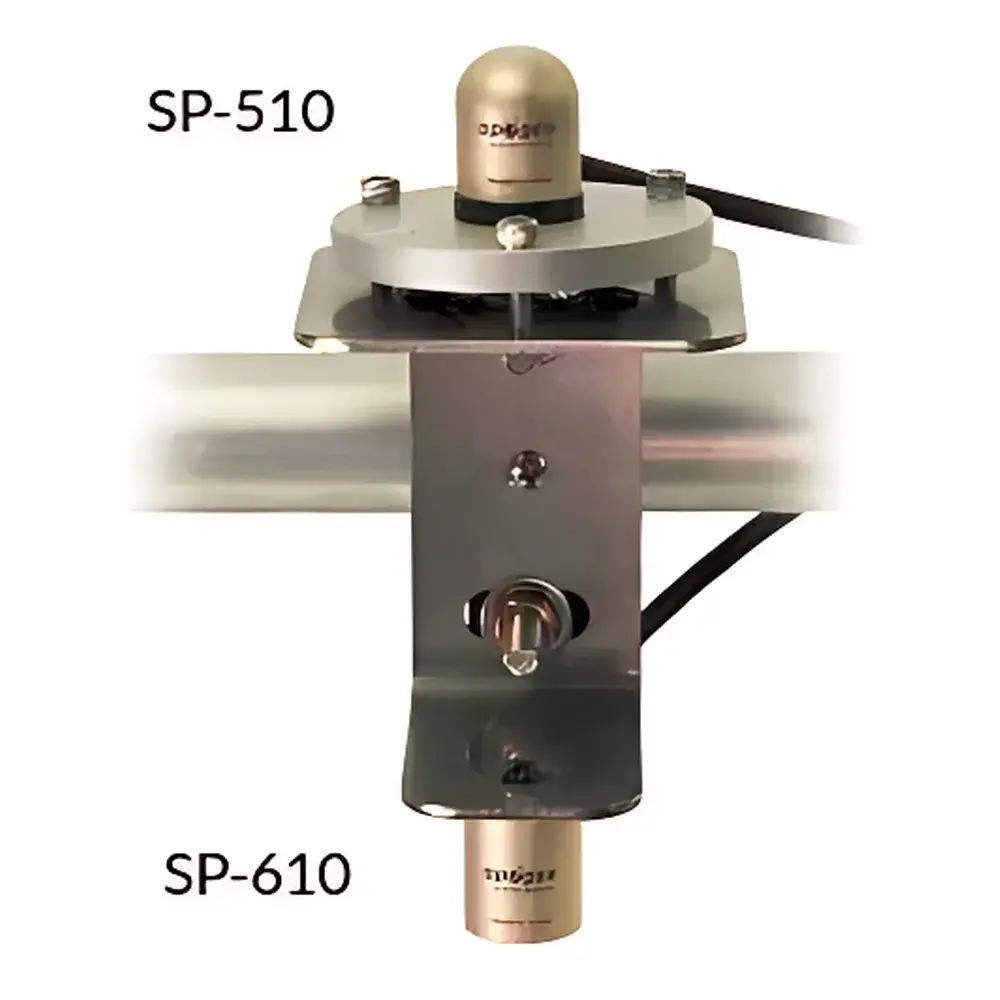
Apogee SP Series Shortwave Radiation Sensors
| Brand | Apogee |
|---|---|
| Origin | USA |
| Model Numbers | SP510 |
| Measurement Range | 0–2000 W/m² (shortwave net radiation) |
| Spectral Range | 385–2105 nm (SP510), 295–2685 nm (SP610), 360–1120 nm (silicon photodiode models) |
| Output Options | 0–114 mV, 0–300 mV, 0–400 mV, 0–2.5 V, 4–20 mA, 0–5 V, USB, SDI-12 |
| Uncertainty | ±5% |
| Cosine Response Error | <30 W/m² at 80° zenith angle (SP510) |
| Response Time | ≤0.5 s (thermopile), <1 ms (silicon) |
| Operating Temperature | −50 to +80 °C (thermopile), −40 to +70 °C (silicon, submersible to 30 m) |
| Long-Term Drift | <2% per year |
| IP Rating | IP68 (silicon models), IP67 (thermopile models) |
Overview
The Apogee SP Series Shortwave Radiation Sensors are precision-calibrated, field-deployable instruments engineered for continuous measurement of downward or upward shortwave solar and sky radiation across terrestrial and aquatic environments. Designed in accordance with ISO 9060:2018 classification standards for solar radiometers, the series comprises two fundamental detector technologies: thermopile-based sensors (SP510, SP610) and silicon photodiode-based sensors (SPP110, SP212, SP214, SP215, SP230, SP420, SP421). Thermopile models operate on the principle of thermal equilibrium—absorbing broadband shortwave radiation via a blackened thermopile junction and generating a millivolt-level output proportional to incident irradiance (W/m²). Silicon photodiode variants utilize spectrally matched photovoltaic response within the 360–1120 nm range, optimized for high-speed sampling and compatibility with low-power data loggers. All models feature ruggedized aluminum housings, hermetically sealed optical windows, and temperature-compensated electronics to ensure metrological stability under variable environmental conditions—including freezing temperatures, high humidity, and prolonged UV exposure.
Key Features
- Thermopile and silicon photodiode architectures co-located in a unified product family for application-specific spectral and dynamic response selection
- Compliant with ISO 9060:2018 “Secondary Standard” classification for thermopile models (SP510/SP610) and “Spectrally Flat” classification for silicon models
- Calibration traceable to the World Radiometric Reference (WRR) via Apogee’s NIST-traceable laboratory
- Integrated cosine correction optics achieving <30 W/m² error at 80° zenith angle (SP510) and ±5% deviation up to 75° (silicon models)
- Submersible capability (up to 30 m depth) for aquatic albedo and underwater PAR studies (SPP110, SP212–SP421)
- Low-power operation: self-powered option (SPP110), microamp quiescent current (SP212: 10 µA), and SDI-12 compatibility for battery-operated networks
- Heated variants (SP230, SP510, SP610) mitigate dew, frost, and snow accumulation with 12 VDC input and <0.2 W heating power
- Rugged mechanical design: IP67-rated (thermopile) and IP68-rated (silicon) enclosures; operating temperature range from −50 °C to +80 °C
Sample Compatibility & Compliance
The SP Series is validated for long-term deployment in unattended environmental monitoring networks adhering to WMO Guide to Meteorological Instruments and Methods of Observation (CIMO Guide), USDA ARS micrometeorology protocols, and FAO-56 evapotranspiration modeling frameworks. Thermopile sensors (SP510/SP610) meet ASTM E892–22 requirements for broadband solar irradiance measurement in solar energy system performance validation. Silicon photodiode models comply with IEC 61724-1:2021 for PV system monitoring, supporting spectral mismatch correction factors when used with crystalline silicon reference cells. All units undergo factory calibration with documented uncertainty budgets per ISO/IEC 17025:2017, including contributions from cosine response, temperature dependence, linearity, and zero-offset drift. Calibration certificates include serial-numbered traceability, spectral responsivity curves, and temperature compensation coefficients for post-acquisition correction in MATLAB, Python, or Campbell Scientific LoggerNet environments.
Software & Data Management
While the SP Series sensors are analog/digital transducers without embedded firmware, they integrate natively with industry-standard data acquisition platforms. Analog-output models (mV, V, mA) interface directly with Campbell Scientific CR1000X, Onset HOBO RX3000, or Delta-T Devices DL2e loggers using configurable excitation and scaling parameters. Digital variants (SP420 USB, SP421 SDI-12) support plug-and-play connectivity: SP420 includes Apogee’s free PC-based SensorView software for real-time visualization, manual calibration coefficient entry, and CSV export; SP421 implements full SDI-12 v1.3 protocol—including addressable multi-sensor daisy-chaining, asynchronous polling, and automatic range detection. All models support audit-ready data workflows: raw voltage/current values, user-applied calibration factors (e.g., sensitivity in mV/(W/m²)), and derived irradiance values can be logged with timestamp, logger ID, and sensor metadata—enabling compliance with GLP and 21 CFR Part 11 requirements when paired with validated logging systems.
Applications
- Solar resource assessment for photovoltaic and concentrated solar power plant siting and performance ratio analysis
- Surface energy balance modeling in eddy covariance flux towers (net radiation partitioning with paired longwave sensors)
- Agricultural phenology monitoring: calculation of daily photosynthetically active radiation (PAR) integrals and light-use efficiency metrics
- Hydrological modeling: snowmelt prediction, evaporation estimation, and reservoir heat budget quantification
- Ecological research: canopy transmittance profiling, albedo mapping across land-cover gradients, and climate change impact studies
- Underwater irradiance profiling in limnological and marine optics applications (submersible silicon models)
- Urban meteorology: shortwave loading on building envelopes and pavement surface temperature forecasting
FAQ
What is the difference between thermopile and silicon photodiode shortwave sensors?
Thermopile sensors (SP510/SP610) measure total shortwave irradiance (300–3000 nm) with flat spectral response and minimal temperature dependence, making them suitable for reference-grade measurements. Silicon photodiode sensors cover 360–1120 nm and offer faster response, lower cost, and higher signal-to-noise ratio—but require spectral mismatch correction when comparing to thermopile references or modeling broadband energy budgets.
Can SP-series sensors be used for net radiation measurement?
No. Net radiation requires simultaneous measurement of both downward and upward shortwave *and* longwave components. The SP series measures only downward or upward shortwave irradiance. For net radiation, pair an SP510 (upward shortwave) with an SP610 (downward shortwave) and two longwave sensors (e.g., Apogee SI-111), then compute Rnet = (K↓ − K↑) + (L↓ − L↑).
How often should SP sensors be recalibrated?
Apogee recommends recalibration every two years for critical applications (e.g., solar farm PPA verification) and every three years for research-grade environmental monitoring, based on observed long-term drift of <2% per year under typical field conditions.
Are SP sensors compatible with third-party weather stations?
Yes. Analog-output models interface with any data logger supporting differential voltage, current, or single-ended voltage inputs. SDI-12 (SP421) and USB (SP420) variants are certified for interoperability with Vaisala, Davis, and MetOne weather station controllers via standard communication protocols.
Does the heating function affect measurement accuracy?
No. The low-power heater (0.2 W) operates independently of the detector element and maintains the sensor dome above dew point without inducing thermal gradients across the sensing surface. Zero offset shift during heating is specified as <10 W/m²—well within the ±5% overall uncertainty budget.