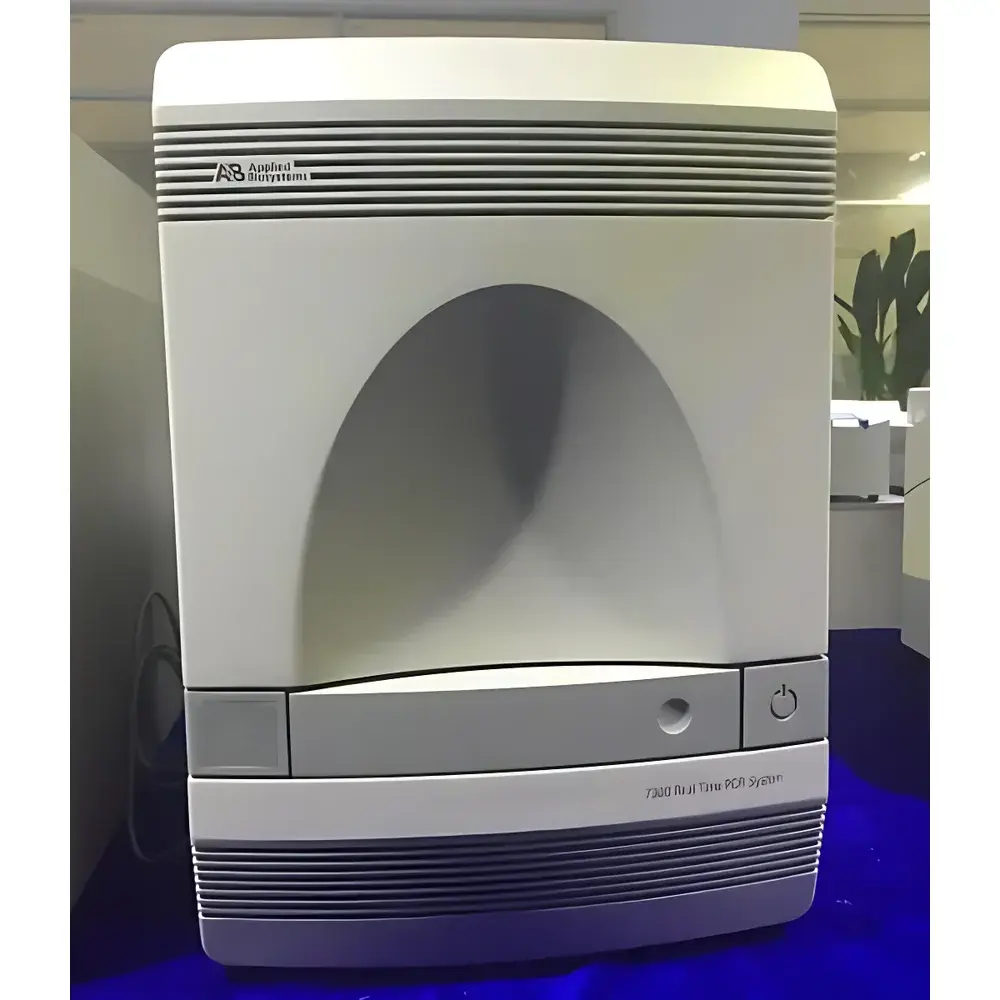
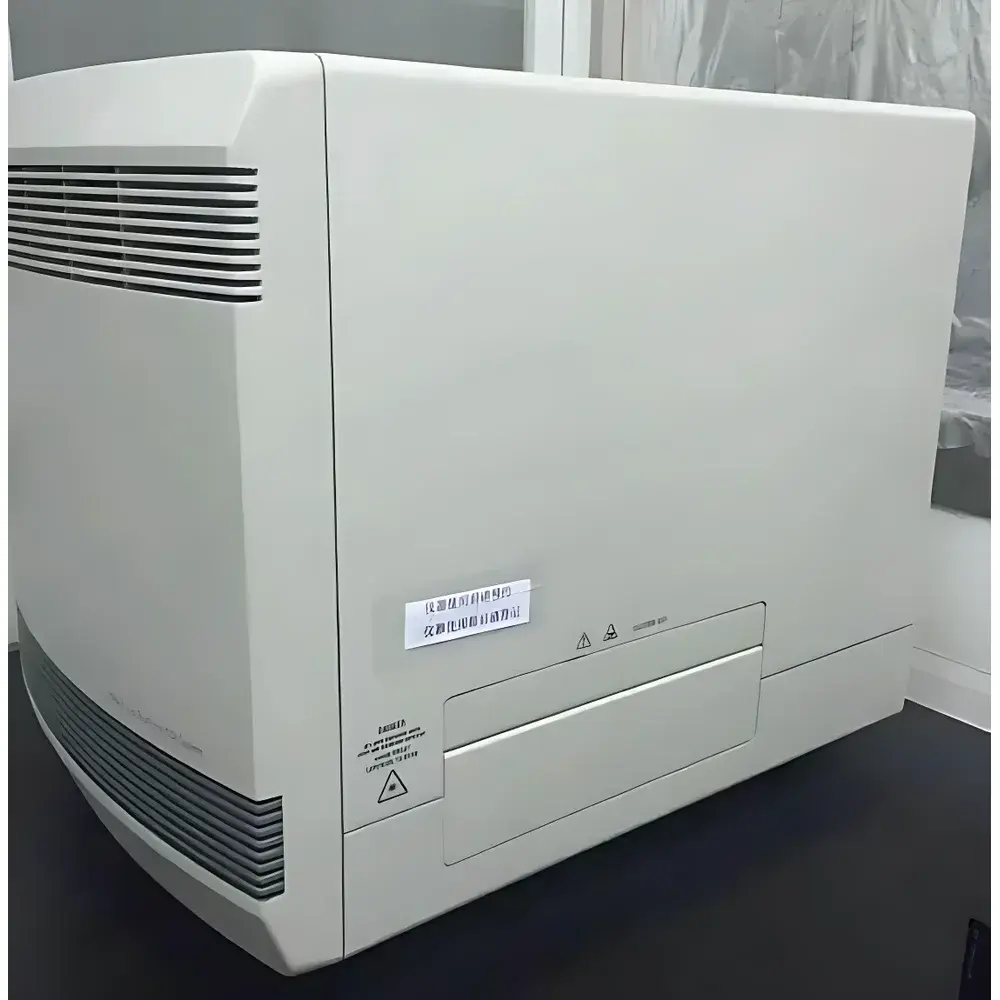
Applied Biosystems ABI 7300 Real-Time Fluorescent Quantitative PCR System
| Brand | Applied Biosystems |
|---|---|
| Origin | USA |
| Model | ABI 7300 |
| Instrument Type | Real-Time Fluorescent Quantitative PCR System |
| Sample Throughput | 96-well format |
| Maximum Heating Rate | 12°C/s |
| Temperature Accuracy | ±0.1°C (at 55°C) |
| Well-to-Well Temperature Uniformity | <0.3°C (at 55°C) |
| Reaction Volume | 25–100 µL |
| Detection Channels | 4-color fluorescence detection |
Overview
The Applied Biosystems ABI 7300 Real-Time Fluorescent Quantitative PCR System is a robust, benchtop thermal cycler engineered for precise nucleic acid quantification using sequence-specific fluorescent probe chemistries—including SYBR® Green I dye and hydrolysis (TaqMan®) probes. Introduced in early 2004, the system integrates thermocycling, optical detection, and data analysis into a single platform operating on the principle of real-time monitoring of amplicon accumulation via fluorescence emission during each PCR cycle. Unlike endpoint assays requiring post-PCR electrophoresis or hybridization, the ABI 7300 delivers quantitative results immediately upon run completion—enabling absolute quantification via standard curves or relative quantification using reference genes (e.g., ΔΔCT method). Its design reflects foundational engineering principles in real-time PCR instrumentation: uniform thermal control across all 96 wells, low-noise photodetection with cooled CCD imaging, and multi-component spectral unmixing to resolve overlapping emission spectra from up to four fluorophores simultaneously.
Key Features
- Four-channel fluorescence detection supporting multiplexed assays (FAM™, VIC™, NED™, ROX™ dyes) with automatic spectral compensation
- High-precision semiconductor-based thermal module delivering rapid ramping (up to 12°C/s) and tight temperature control (±0.1°C at 55°C)
- Optimized optical path incorporating excitation LEDs, bandpass filters, and a thermoelectrically cooled CCD camera for high signal-to-noise ratio detection
- 96-well reaction format compatible with standard PCR plates and 0.2 mL tubes; supports reaction volumes from 25 to 100 µL
- Integrated software suite enabling automated baseline setting, threshold determination, melt curve acquisition, and CT value calculation
- Compact footprint designed for space-constrained laboratory environments without compromising thermal or optical performance
Sample Compatibility & Compliance
The ABI 7300 accommodates diverse sample types—including genomic DNA, cDNA, RNA (after reverse transcription), and synthetic oligonucleotides—across applications ranging from clinical diagnostics to academic research. It supports common assay chemistries compliant with ISO/IEC 17025 requirements for testing laboratories and aligns with analytical validation frameworks referenced in USP Chapter 111 and CLSI EP17-A2 for limit of detection and precision assessment. While not FDA 21 CFR Part 11–certified out-of-the-box, its data export architecture (CSV, SDM, RQML) facilitates integration into validated LIMS or ELN systems under GLP/GMP environments when paired with appropriate audit trail and user access controls.
Software & Data Management
The system operates on Windows XP Professional–based software (v1.4.x), providing instrument control, real-time data visualization, and post-run analysis. Core modules include: (i) Plate Setup Wizard for intuitive assay configuration—including passive reference dye normalization (ROX); (ii) Amplification Plot Viewer with dynamic CT assignment and automatic baseline adjustment; (iii) Standard Curve Manager for absolute quantification workflows; (iv) Relative Quantification Module supporting multi-gene, multi-sample comparisons with inter-run calibration; (v) Melt Curve Analyzer for HRM-compatible genotyping; and (vi) SNP Genotyping Module offering cluster plot visualization and quality scoring (QC metrics: call rate, cluster separation, reproducibility). Raw fluorescence data (.eds files) and analysis reports are exportable in formats compatible with third-party statistical tools (e.g., R, GraphPad Prism).
Applications
- Gene expression profiling (relative quantification across tissue or treatment conditions)
- Pathogen load determination (e.g., viral/bacterial DNA/RNA copy number estimation)
- Single nucleotide polymorphism (SNP) genotyping using allele-specific probes
- MicroRNA quantification with stem-loop RT primers
- Copy number variation (CNV) analysis via comparative CT methods
- Quality control of nucleic acid preparations (e.g., degradation assessment via 3′/5′ assay ratios)
FAQ
Is the ABI 7300 compatible with modern Windows operating systems?
The original software was developed for Windows XP Professional. Operation on newer OS versions (Windows 10/11) requires virtualization or compatibility mode configuration; full native support is not guaranteed.
What maintenance is required for long-term reliability?
Regular optical alignment verification, LED intensity calibration using factory-supplied standards, and thermal block cleaning per manufacturer guidelines are recommended every 6–12 months depending on usage frequency.
Can the system perform high-resolution melt (HRM) analysis?
Yes—the ABI 7300 supports continuous fluorescence acquisition during gradual temperature ramping (0.1–0.3°C/s), enabling discrimination of sequence variants based on melting profile differences.
Does it support digital PCR or droplet-based workflows?
No—this is an analog real-time PCR platform. Digital PCR capabilities require dedicated instrumentation such as the QuantStudio™ 3D or Bio-Rad QX200 systems.
Are service contracts or refurbished unit certifications available?
Third-party service providers offer extended warranty options and ISO 13485–aligned refurbishment protocols including full thermal/optical recalibration, firmware updates, and traceable performance verification reports.