
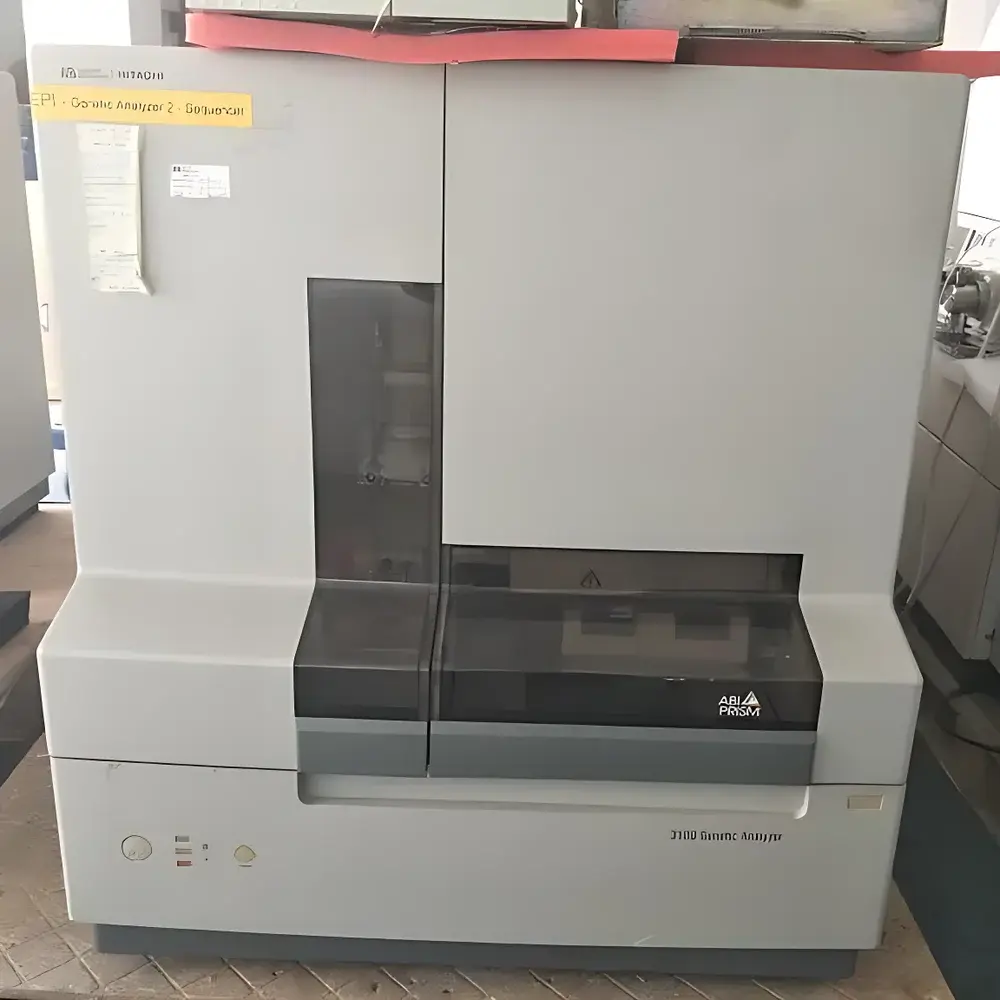
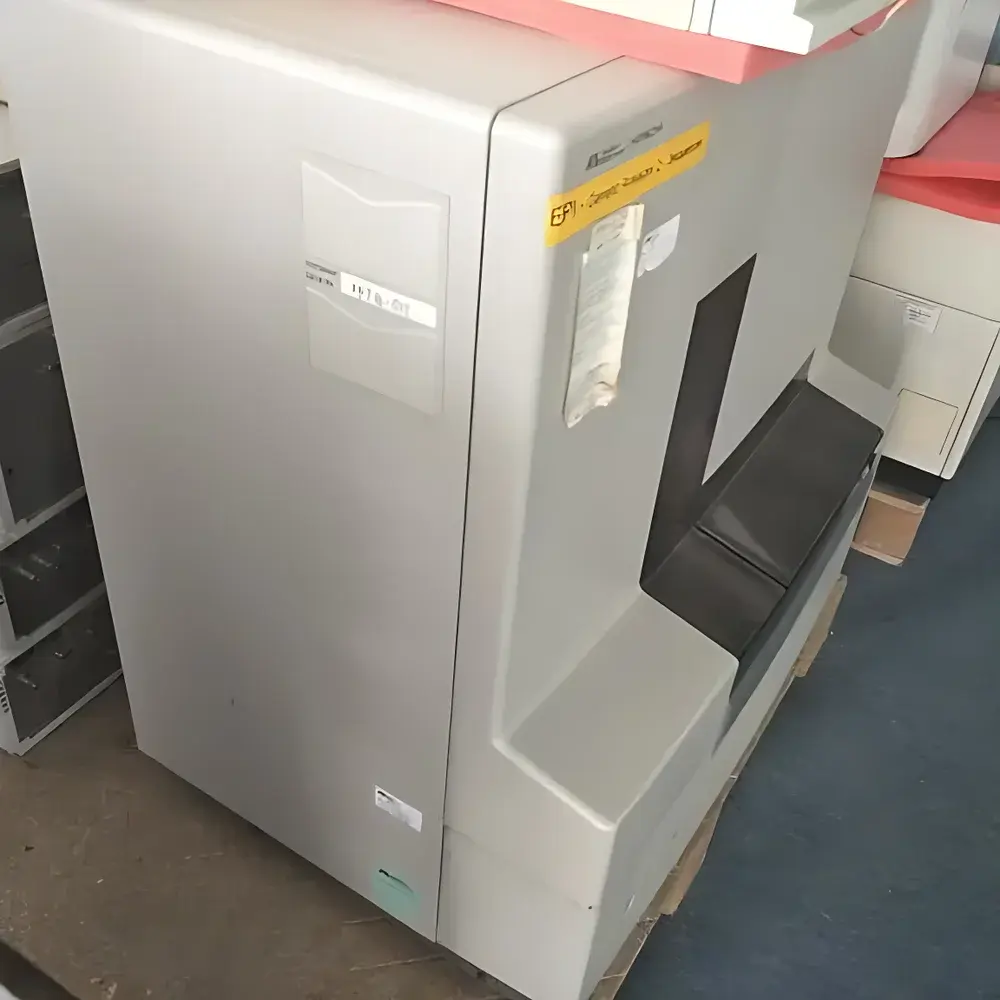
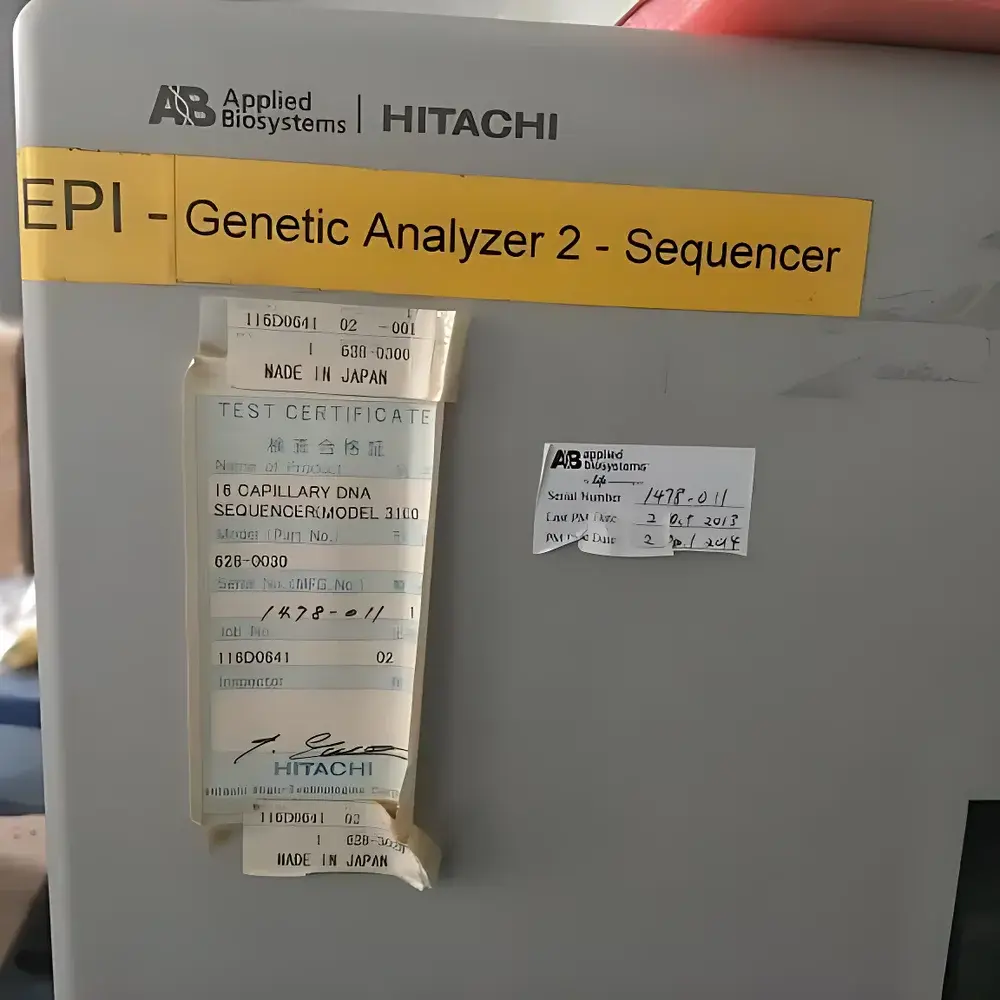
Applied Biosystems ABI3100 Genetic Analyzer (Refurbished)
| Brand | Applied Biosystems |
|---|---|
| Origin | USA |
| Model | ABI3100 |
| Instrument Type | First-Generation Capillary Electrophoresis Sequencer |
| Sample Throughput | Up to 768 samples per unattended run (2 × 384-well plates or 4 × 96-well plates) |
| Capillary Array | 16-capillary array |
| Excitation Source | Single 488 nm argon-ion laser |
| Detection | Dual-side illumination with grating-based full-spectrum fluorescence detection using CCD camera |
| Voltage Range | Up to 20 kV |
| Operating Temperature | 18–65 °C |
| Dimensions (W×D×H, door closed) | 74 × 54.8 × 81 cm |
| Weight | 130 kg |
| Power Requirement | 200–240 V AC, 50/60 Hz, ≤15 A, 2000 W |
| Environmental Conditions | 15–35 °C ambient, 20–80% non-condensing humidity |
Overview
The Applied Biosystems ABI3100 Genetic Analyzer is a refurbished first-generation capillary electrophoresis (CE)-based platform engineered for high-fidelity DNA fragment separation and Sanger sequencing. It operates on the principle of electrokinetic migration of fluorescently labeled DNA fragments through polymer-filled fused-silica capillaries under high-voltage electric fields (up to 20 kV). The system integrates automated sample loading, polymer matrix injection, electrophoretic separation, real-time fluorescence detection, and base-calling—enabling unattended operation for up to 24 hours. Its 16-capillary array architecture supports parallel analysis of 16 samples per injection cycle, delivering scalable throughput for mid-volume academic, clinical, and core facility laboratories performing de novo sequencing, resequencing, microsatellite analysis, SNP genotyping, and fragment length polymorphism assays.
Key Features
- 16-capillary parallel detection architecture with dual-side laser illumination—enhancing signal uniformity and reducing inter-capillary variability.
- Grating-based spectral dispersion coupled with a cooled CCD imaging system enables simultaneous multi-dye detection (e.g., FAM™, VIC™, NED™, PET™) without hardware modification when switching chemistries.
- Automated polymer replenishment, capillary conditioning, and sample injection—minimizing manual intervention and operator-dependent variability.
- Thermostatically controlled capillary cartridge (18–65 °C) ensures consistent electrophoretic mobility and resolution across diverse fragment sizes (50–1000 bp typical).
- Integrated data acquisition and base-calling via ABI PRISM® Data Collection Software v1.0 and Sequence Analysis Software v5.2—supporting trace quality assessment, editing, and consensus generation.
- Rugged industrial design with CE-compliant electrical safety, thermal management, and vibration-damped optical housing for long-term operational stability.
Sample Compatibility & Compliance
The ABI3100 accepts standard 96-well and 384-well microtiter plates pre-loaded with purified, fluorescently labeled PCR products or sequencing reactions. It is compatible with ABI BigDye® Terminator v1.1/v3.1 chemistry and alternative dye-terminator kits validated for capillary electrophoresis. While not designed for regulatory submission under current FDA 21 CFR Part 11 requirements, the system supports GLP-aligned workflows when paired with audit-trail-enabled LIMS integration and documented instrument qualification (IQ/OQ/PQ). Data files are generated in standard .fsa (fluorescence sequence analysis) format—interoperable with open-source tools (e.g., FinchTV, BioEdit) and commercial packages (e.g., Geneious, CLC Genomics Workbench). The platform conforms to IEC 61010-1 for laboratory equipment safety and meets electromagnetic compatibility standards per EN 61326-1.
Software & Data Management
Data acquisition, real-time electropherogram visualization, and automated base-calling are performed using factory-installed ABI PRISM® Data Collection Software. Raw .fsa files contain time-resolved fluorescence intensity traces for each dye channel, along with embedded metadata (capillary ID, voltage, temperature, polymer lot, run date/time). Sequence Analysis Software provides manual trace review, quality-score filtering (Phred Q20/Q30), polyphasic alignment, and export to FASTA, GenBank, or AB1 formats. For laboratory informatics integration, the system supports file-level export via network share or removable media; however, native database connectivity or electronic signature functionality is not implemented. Users are advised to implement local backup protocols and version-controlled software deployment in accordance with ISO/IEC 17025 documentation requirements.
Applications
- Sanger sequencing: De novo sequencing of plasmid inserts, PCR amplicons, and cloned fragments (read lengths typically 700–1000 bases with BigDye v3.1).
- Fragment analysis: Microsatellite (STR) profiling, loss-of-heterozygosity (LOH) studies, and AFLP fingerprinting using size-standard referenced binning.
- SNP genotyping: Allele discrimination via fragment-length or color-coded probe assays (e.g., TaqMan® OpenArray®-compatible workflows).
- Mutation screening: Heteroduplex analysis (HA) and conformation-sensitive gel electrophoresis (CSGE)-equivalent resolution for detecting single-base substitutions.
- Educational use: Teaching core principles of electrophoresis, fluorescence detection, and sequence bioinformatics in undergraduate and graduate molecular biology curricula.
FAQ
Is the ABI3100 compliant with current FDA 21 CFR Part 11 requirements?
No—the original software lacks electronic signature capability, audit trail logging, and role-based access control required for regulated GxP environments. It may be used for research-only applications or as part of a validated workflow with supplemental procedural controls.
What is the typical read length and accuracy achievable with this system?
Under optimized conditions using BigDye Terminator v3.1 chemistry and standard POP-6 polymer, average read lengths of 750–900 bases with Phred Q20 ≥99% base-call accuracy are routinely observed.
Can the system be upgraded to support newer chemistries or software versions?
Hardware limitations—including fixed optical path geometry and legacy Windows NT 4.0 dependency—preclude official firmware or software upgrades beyond v5.2. Third-party polymer and dye compatibility must be empirically verified.
What maintenance is required prior to deployment?
Refurbished units undergo capillary array replacement, high-voltage power supply calibration, optical alignment verification, and full functional testing per Applied Biosystems Service Bulletin SB-3100-01. A 90-day hardware warranty is included.
Is training provided with purchase?
Yes—remote operator training covering instrument startup, run setup, troubleshooting common electropherogram artifacts (e.g., dye blobs, pull-up peaks), and basic data export is included with all refurbished systems.
Related Products



