
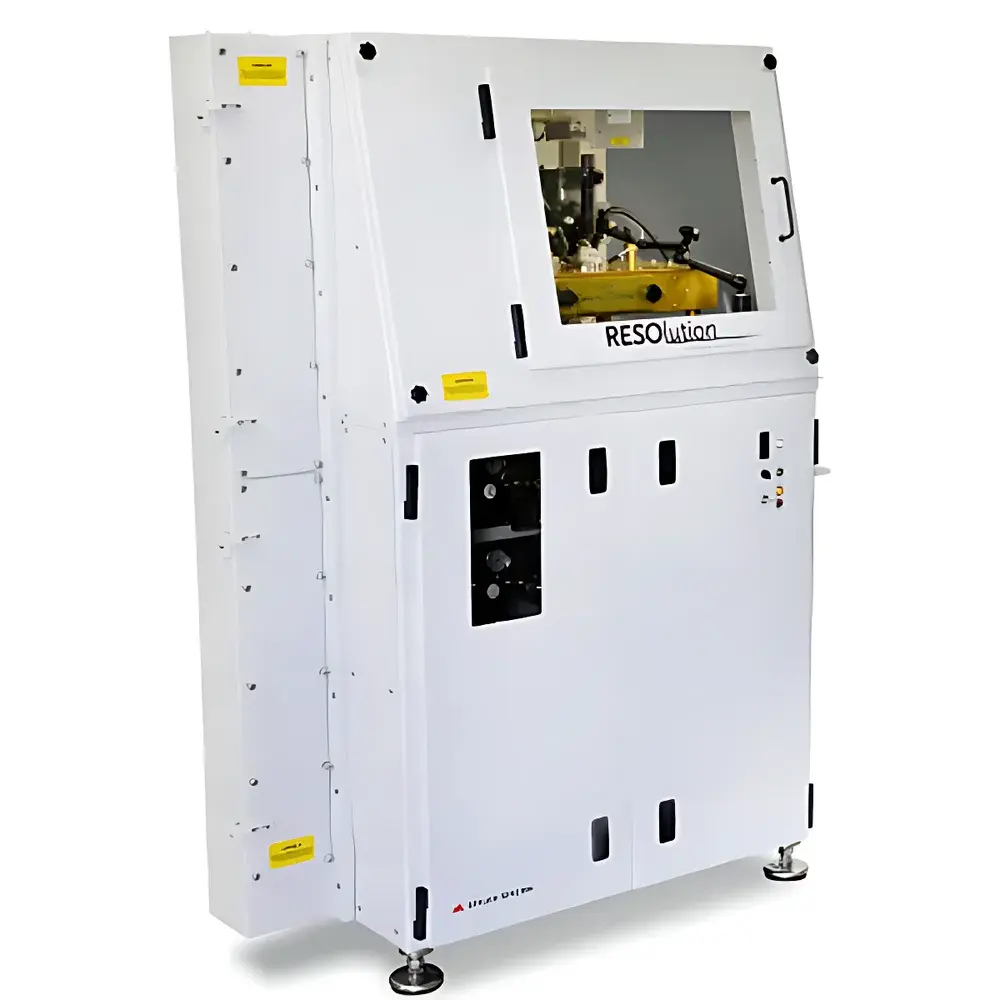
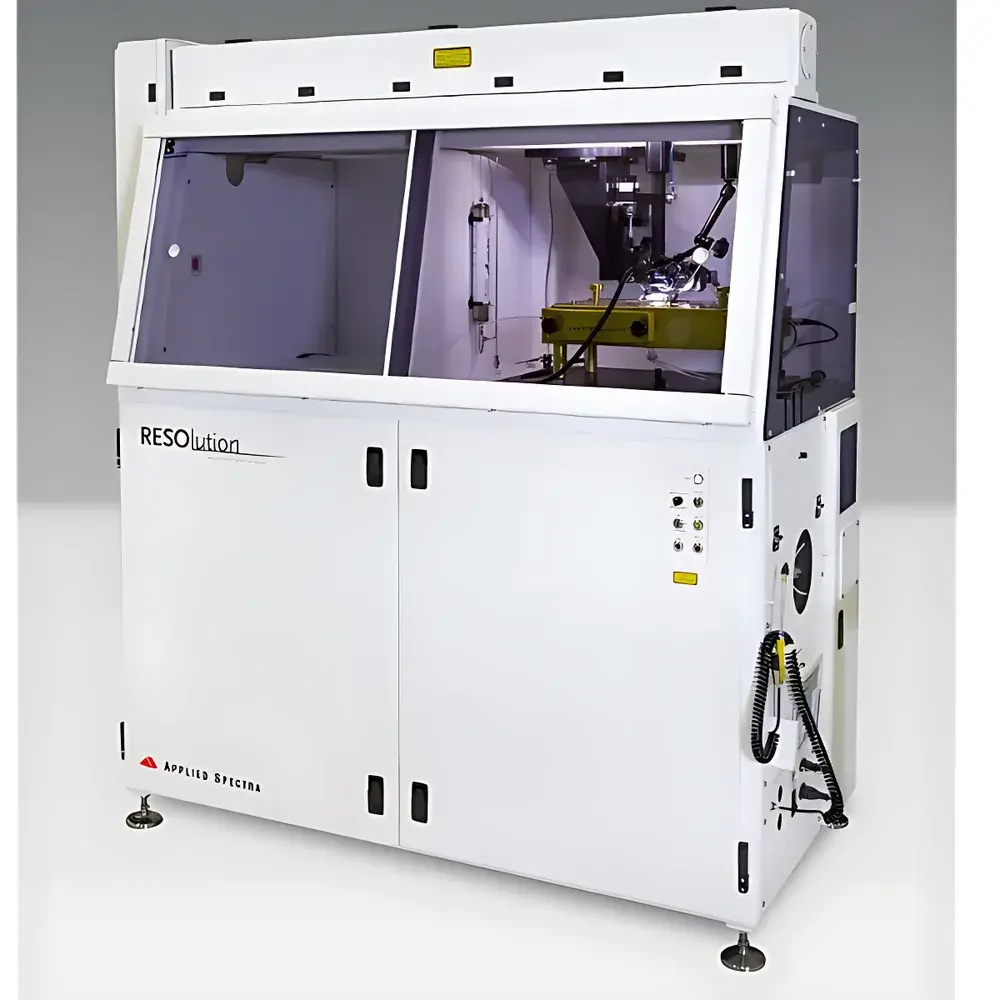
Applied Spectra RESOlution SE/LR 193 nm Laser Ablation Sampling System
| Brand | Applied Spectra |
|---|---|
| Origin | USA |
| Model | RESOlution SE/LR |
| Laser Wavelength | 193 nm |
| Pulse Width (SE) | 5 ns |
| Pulse Width (LR) | 20 ns |
| Repetition Rate (SE) | 300 Hz |
| Repetition Rate (LR) | 20 Hz |
| Fluence (SE) | 20 J/cm² |
| Fluence (LR) | 45 J/cm² |
| Ablation Spot Size | 2–300 µm (SE), 2–380 µm (LR) |
| Sample Cell | S-155 Dual-Volume Constant-Volume Chamber |
| Software | GeoStar μGIS |
| Signal Smoothing | Integrated SQUID Device |
| Flame Monitoring | Real-time ICP torch status detection with automatic laser shutdown |
| Mercury Trap Mounting | Pre-installed position |
| Compliance | Compatible with GLP/GMP workflows, supports 21 CFR Part 11–compliant audit trails via optional software configuration |
Overview
The Applied Spectra RESOlution SE/LR is a high-precision 193 nm excimer laser ablation (LA) sampling system engineered for quantitative elemental and isotopic microanalysis in tandem with inductively coupled plasma mass spectrometry (ICP-MS). Operating on the fundamental principle of photolytic ablation—where ultraviolet photons directly break atomic bonds in solid matrices without significant thermal diffusion—the system delivers spatially resolved, matrix-matched sampling with minimal fractionation. Its dual-platform architecture (SE for high-speed, high-repetition analysis; LR for high-fluence, low-frequency ablation of refractory phases) enables method flexibility across geological, environmental, metallurgical, and nuclear materials. Designed for integration into regulated laboratory environments, the RESOlution SE/LR meets the physical and operational requirements for trace-element mapping, U–Pb geochronology, and multi-isotope ratio profiling under ISO/IEC 17025 and ASTM D7691–22 guidelines.
Key Features
- Constant-volume S-155 dual-chamber sample cell: Eliminates pulse-to-pulse washout variability and ensures reproducible aerosol transport kinetics—critical for transient signal quantification in time-resolved ICP-MS.
- Integrated SQUID signal smoothing module: Reduces high-frequency noise in ablation transients while preserving true signal amplitude and temporal fidelity—distinct from passive filtering approaches used in competitive systems.
- GeoStar μGIS software platform: Provides full instrument orchestration—including laser firing, stage motion, gas flow control, and real-time image overlay—with scriptable automation for sequences exceeding 5,000 ablation sites per run.
- Optimized beam delivery architecture: Features long-working-distance optics with diffraction-limited flat-top beam profile generation, enabling stable ablation across variable sample topographies without refocusing.
- Real-time flame monitoring system: Monitors ICP torch emission at 350–450 nm; triggers immediate laser interlock upon flame extinction to prevent sample damage and plasma destabilization.
- Dual-pulse parameter sets: SE configuration (5 ns, 300 Hz, 20 J/cm²) optimized for rapid rastering and depth profiling; LR configuration (20 ns, 20 Hz, 45 J/cm²) suited for high-yield ablation of zircon, monazite, and silicate glasses.
Sample Compatibility & Compliance
The RESOlution SE/LR accommodates planar solids up to 50 mm × 50 mm × 30 mm (W × L × H) and accepts standard 1-inch petrographic thin sections, polished metallographic mounts, and pressed powder pellets. Its modular S-155 chamber design supports optional cryogenic cooling (–180°C), large-sample expansion (RESO-EX), and LA-LIBS hybrid operation (PRISM module). From a regulatory standpoint, the system’s deterministic signal timing, hardware-enforced safety interlocks, and configurable audit-trail logging (via GeoStar’s optional 21 CFR Part 11 module) align with FDA, EPA, and ISO 17025 quality assurance frameworks. All firmware and software revisions are version-controlled and documented per GLP-compliant change management protocols.
Software & Data Management
GeoStar μGIS employs a structured, tab-based interface with dedicated modules for sample navigation, ablation sequence definition, energy calibration, and geometric correction. Its μGIS engine supports vector-based graphic import (DXF, SVG), enabling direct overlay of geological maps or SEM-EDS element distributions onto optical images for guided targeting. X–Y–Z calibration routines include one-click cumulative error compensation—correcting for mechanical drift over extended acquisition sessions. Raw ablation data (intensity vs. time) are exported in standardized .csv and .mzML formats compatible with ICP-MS vendor software (e.g., Thermo Fisher Qtegra, Agilent MassHunter, Nu Instruments NuScript). Metadata embedding follows IUPAC-recommended conventions for LA-ICP-MS reporting.
Applications
- High-spatial-resolution U–Pb dating of zircon, baddeleyite, and titanite using multi-collector ICP-MS (MC-ICP-MS) or single-collector systems with external calibration.
- Trace-element mapping in meteoritic olivine and pyroxene to constrain nebular condensation histories.
- Isotopic heterogeneity screening in nuclear fuel particles (U/Pu isotopic ratios) for safeguards verification.
- Depth-resolved analysis of corrosion layers on archaeological bronzes and modern aerospace alloys.
- Quantitative halogen (Cl, Br, I) and volatile element profiling in volcanic glass using reaction-cell ICP-MS.
FAQ
What distinguishes the RESOlution SE from the LR configuration?
The SE model prioritizes speed and repetition rate (300 Hz, 5 ns pulses), making it ideal for fast rastering and high-throughput screening. The LR model delivers higher per-pulse energy (45 J/cm², 20 ns pulses) for efficient ablation of highly refractory minerals with minimal thermal stress.
Can the RESOlution interface with non-Thermo or non-Agilent ICP-MS instruments?
Yes—the system communicates via TTL-triggered digital I/O and analog voltage outputs, supporting synchronization with all major ICP-MS platforms, including Nu Instruments, Element XR, and PlasmaQuant MS.
Is GeoStar μGIS validated for use in regulated laboratories?
GeoStar includes optional 21 CFR Part 11 compliance features (electronic signatures, audit trail, role-based access), and validation documentation packages are available upon request for IQ/OQ/PQ execution.
How does the S-155 chamber minimize memory effects between samples?
Its constant-volume dual-chamber geometry maintains fixed residence time and eliminates pressure-dependent aerosol dilution—reducing carryover by >95% compared to single-volume designs, as verified per ASTM E2923–21.
Does the system support automated depth profiling?
Yes—GeoStar enables programmable Z-axis stepping synchronized with laser firing, allowing layer-by-layer ablation with sub-micron depth resolution and real-time feedback on crater morphology via integrated CCD imaging.
Related Products



