
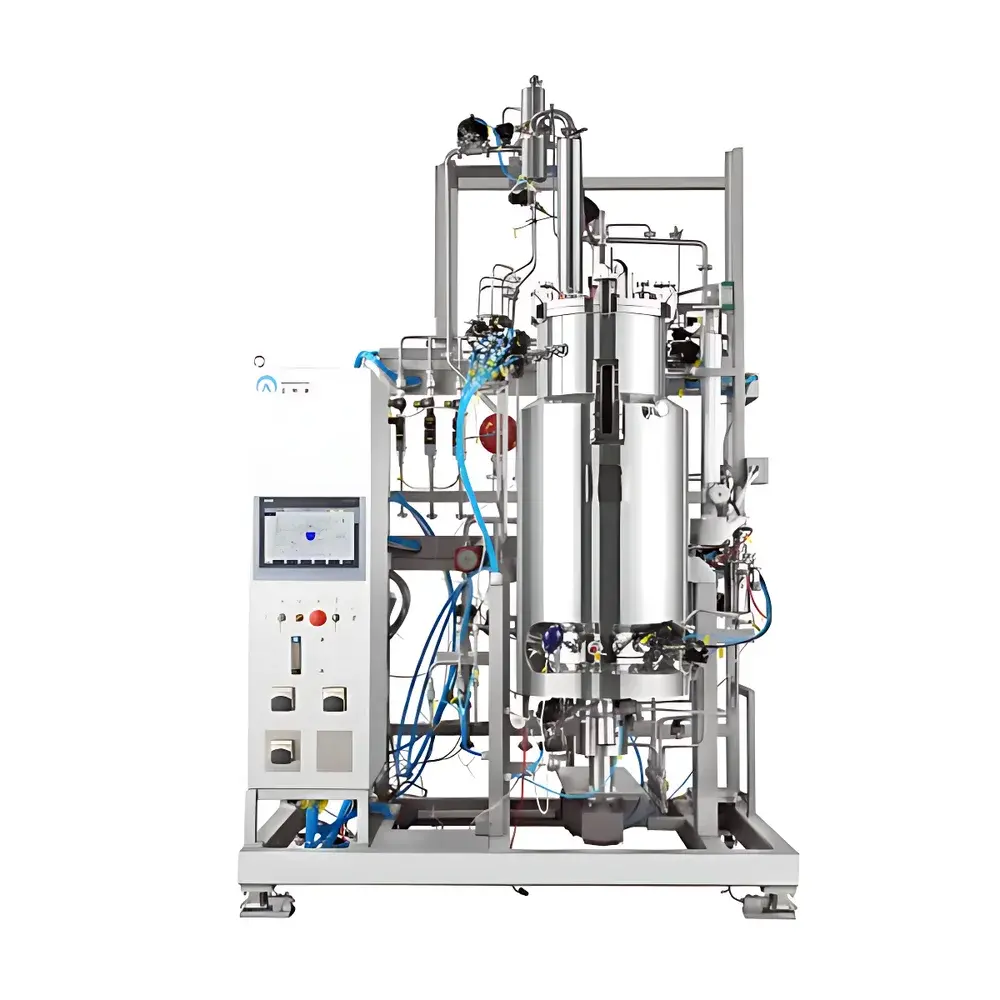
Applitech AbioPilot Stainless Steel Bioreactor
| Brand | Applitech |
|---|---|
| Origin | Guangdong, China |
| Manufacturer Type | Manufacturer |
| Product Origin | Domestic |
| Model | AbioPilot |
| Quotation | Upon Request |
| Working Volume Range | 30–270 L |
| Material | 316L Stainless Steel |
| Surface Finish | Electropolished (Ra < 0.4 µm) for Wetted Parts |
| External Finish | Brushed or Mirror-Polished |
| Design Standard | ASME BPE-2023 Compliant |
Overview
The Applitech AbioPilot Stainless Steel Bioreactor is an ASME BPE-compliant, GMP-oriented bioprocessing platform engineered for robust, reproducible, and scalable cultivation of mammalian, insect, plant, and microbial cells—including bacteria, yeast, fungi, and recombinant strains—across clinical and commercial manufacturing environments. Designed using computational fluid dynamics (CFD) modeling and validated 3D engineering workflows, the AbioPilot integrates core bioreactor principles—including controlled mass transfer (kLa), precise dissolved oxygen (DO) regulation via cascade control, pH-stat and feed-peristaltic dosing, and temperature-stabilized jacketed vessel operation—into a single, rigorously documented hardware architecture. Its working volume range of 30–270 L targets critical mid-scale process development, tech transfer, and early-phase clinical manufacturing, bridging the gap between laboratory-scale glass vessels and full-scale production bioreactors. The system supports batch, fed-batch, perfusion, and continuous culture modes, with mechanical agitation, sparging, and antifoam control fully integrated and configurable per USP , ISO 13485, and ICH Q5D guidelines.
Key Features
- 316L stainless steel construction with electropolished wetted surfaces (Ra < 0.4 µm), compliant with ASME BPE-2023 surface finish requirements for pharmaceutical-grade bioprocessing
- Modular, open-frame mechanical design enabling rapid access to impellers, sensors, ports, and tubing manifolds—reducing maintenance downtime and simplifying qualification activities
- Integrated CIP (Clean-in-Place) and SIP (Sterilize-in-Place) systems with validated thermal and chemical cycle profiles, traceable via embedded temperature/pressure loggers
- CFD-optimized impeller geometry and sparger configuration to ensure uniform mixing, low shear stress, and high oxygen transfer efficiency across the entire volume range
- GMP-ready instrumentation suite including calibrated DO, pH, temperature, level, and pressure transmitters with 4–20 mA/HART outputs and redundant sensor options
- Scalable architecture supporting custom configurations up to 20,000 L, with consistent geometric similarity and power/volume (P/V) ratios maintained across scales
Sample Compatibility & Compliance
The AbioPilot accommodates diverse cell types and microbial cultures under strictly controlled physicochemical conditions: suspension-adapted CHO, HEK293, and CAP-T cells; adherent lines on microcarriers; filamentous fungi (e.g., Aspergillus, Penicillium); aerobic and anaerobic bacteria (e.g., E. coli, Bacillus); and yeast (S. cerevisiae, P. pastoris). All wetted materials comply with USP Class VI biocompatibility testing and FDA 21 CFR Part 11–ready audit trail functionality when paired with AbioExpert GMP software. Vessel design conforms to ASME BPE-2023 Sections 3 (Materials), 4 (Surface Finishes), and 5 (Valves & Fittings), and supports IQ/OQ/PQ execution per ASTM E2500 and GAMP 5. Documentation packages include DQ, FDS, SDS, and FAT/SAT protocols aligned with EU Annex 15 and WHO TRS 986.
Software & Data Management
The AbioPilot is natively supported by Applitech’s AbioExpert Bioprocess Information Management System—a modular, validation-ready software platform available in Lite, Standard, Advanced, and GMP editions. AbioExpert GMP provides full 21 CFR Part 11 compliance—including electronic signatures, role-based access control, immutable audit trails, and change control logs—with data archiving compliant with ALCOA+ principles. It acquires real-time process data from AbioPilot vessels as well as third-party devices (e.g., Nova BioProfile Flex, Kaiser Raman probes, Applikon my-Control controllers) via OPC UA, Modbus TCP, and analog I/O. The system enables cross-site data federation, trend analysis, PAT integration, and automated report generation for regulatory submissions (e.g., IND, BLA, MAA). Batch records are structured to support electronic batch record (EBR) implementation and alignment with ISA-88/ISA-95 standards.
Applications
- Clinical-stage manufacturing of monoclonal antibodies (mAbs), bispecifics, and Fc-fusion proteins
- Process development and scale-up studies for viral vector production (lentivirus, AAV) in suspension or adherent formats
- Upstream process qualification for vaccine candidates—including whole-pathogen, subunit, and mRNA-LNP platforms
- Cell therapy manufacturing: expansion of T-cells, NK cells, and mesenchymal stromal cells (MSCs) under cGMP conditions
- Microbial fermentation of therapeutic enzymes, antibiotics, and biosynthetic intermediates
- Bioprocess training, tech transfer, and facility commissioning in contract development and manufacturing organizations (CDMOs)
FAQ
Does the AbioPilot support both mammalian and microbial cultivation?
Yes—the system is configured with interchangeable impeller sets, sparger types, and control strategies optimized for low-shear mammalian culture or high-shear microbial fermentation.
Is the vessel design certified to ASME BPE standards?
Yes—vessels are designed, fabricated, and documented per ASME BPE-2023, with full material traceability, weld maps, and surface roughness verification reports provided.
Can AbioExpert integrate with existing MES or SCADA systems?
Yes—AbioExpert supports OPC UA server/client mode, RESTful API endpoints, and SQL Server database replication for enterprise-level interoperability.
What validation documentation is included with the system?
Standard delivery includes DQ, FDS, IQ/OQ protocols and executed reports, FAT/SAT summaries, calibration certificates, and ASME BPE compliance dossiers.
Is remote monitoring and troubleshooting supported?
Yes—via secure TLS-encrypted web interface and optional VPN-enabled remote desktop access for qualified service engineers.






