
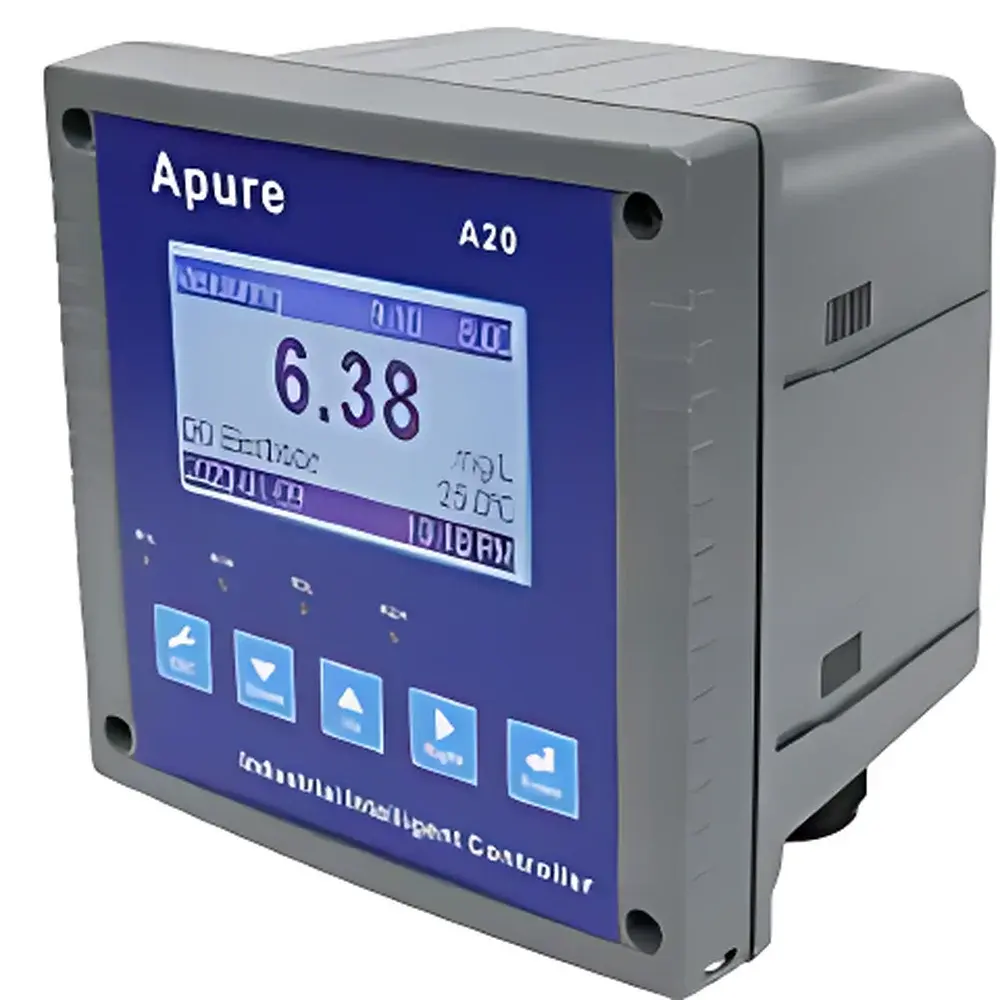
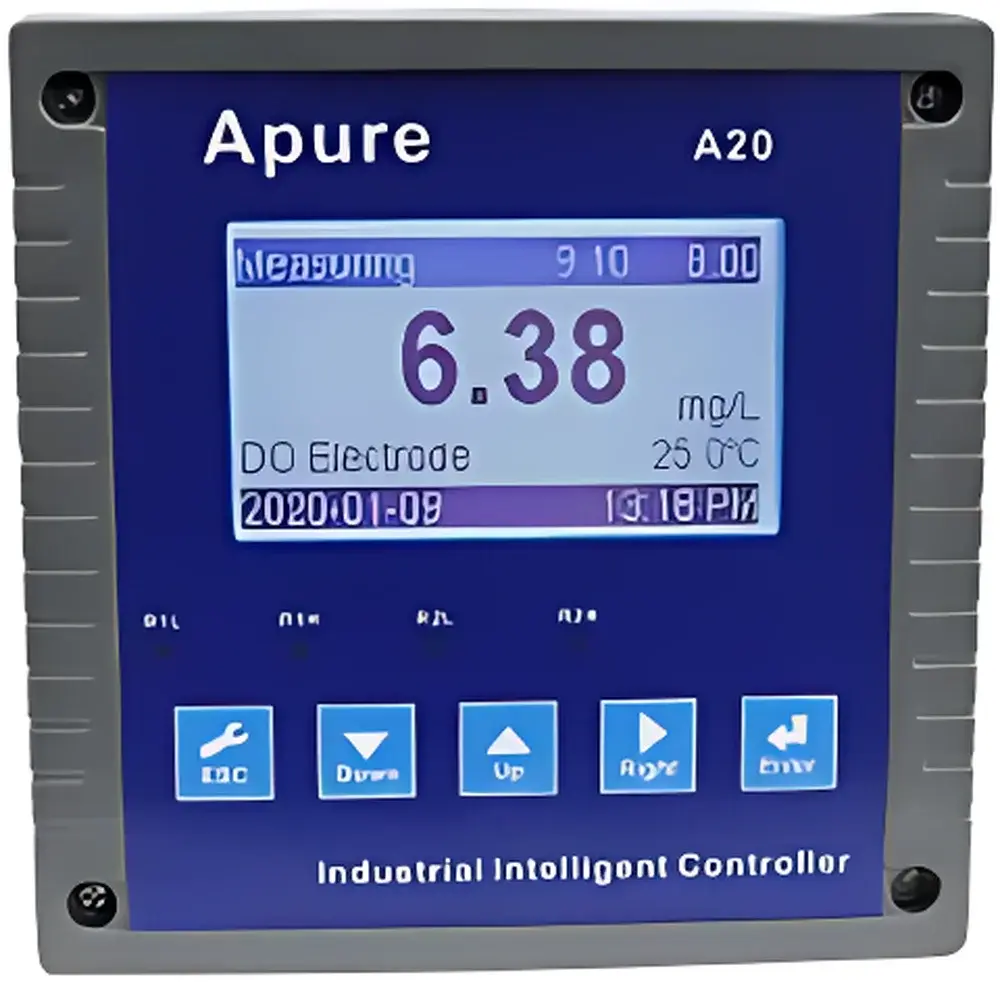
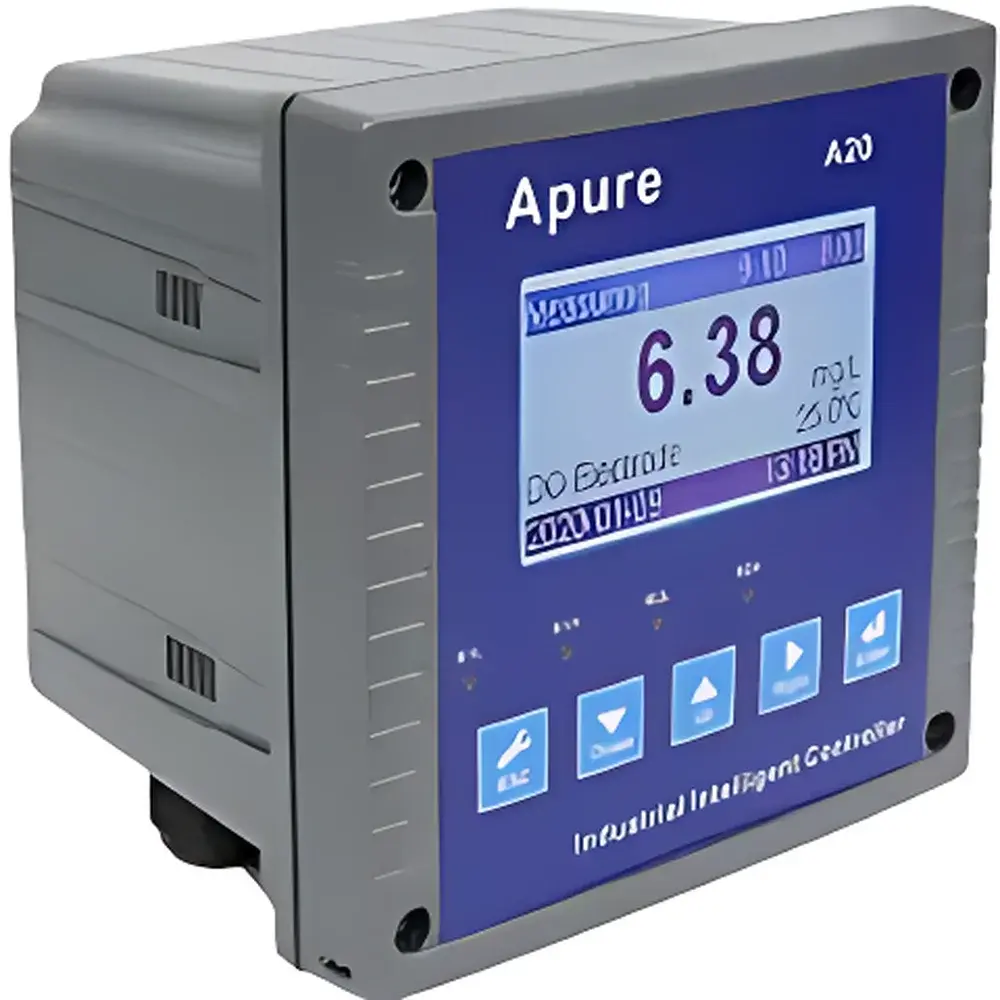
Apure A20DO-AA1 Online Dissolved Oxygen Controller
| Brand | Apure |
|---|---|
| Origin | Shanghai, China |
| Manufacturer Type | Original Equipment Manufacturer (OEM) |
| Product Category | Domestic |
| Model | A20DO-AA1 |
| Instrument Type | Online |
| Measurement Principle | Electrochemical Probe — Clark-type Polarographic |
| Measurement Range | 0.00–20.00 ppm |
| Accuracy | ±0.01 ppm |
| Resolution | 0.01 ppm |
| Stability | ≤0.02 ppm/24 h |
| Temperature Compensation | 0–100 °C (Manual / Automatic with PT1000 or NTC10K sensor) |
| Output Signals | Dual isolated 4–20 mA outputs (independently assignable to DO and temperature), max. load 500 Ω |
| Relay Outputs | Two programmable SPST relays (3 A / 250 V AC, NO contact), adjustable hysteresis |
| Power Supply | AC 220 V ±10% or DC 24 V ±10% |
| Power Consumption | ≤5 W |
| Operating Environment | 0–60 °C, ≤85% RH |
| Enclosure Dimensions | 96 × 96 × 132 mm (H × W × D) |
| Panel Cutout | 92.5 × 92.5 mm (H × W) |
| Display Language | English / Chinese (user-selectable) |
Overview
The Apure A20DO-AA1 Online Dissolved Oxygen Controller is an industrial-grade electrochemical measurement system engineered for continuous, high-stability monitoring of dissolved oxygen (DO) concentration in aqueous process streams. It operates on the Clark-type polarographic principle: a cathode (typically gold or platinum) and anode (silver/silver chloride) are immersed in an electrolyte-filled membrane capsule; molecular oxygen diffuses through a gas-permeable Teflon membrane and undergoes reduction at the cathode surface, generating a current linearly proportional to the partial pressure of O₂—converted in real time to concentration units (ppm). Integrated temperature compensation ensures thermodynamic accuracy across dynamic thermal conditions typical in wastewater treatment, potable water distribution, aquaculture recirculation systems, and bioreactor feed control loops.
Key Features
- True dual-channel isolation: Independent 4–20 mA analog outputs for DO and temperature, each galvanically isolated to eliminate ground-loop interference and ensure signal integrity in electrically noisy plant environments.
- Flexible temperature compensation architecture: Supports automatic compensation via external PT1000 or NTC10K sensors—or manual input—enabling precise correction across 0–100 °C without requiring recalibration of the probe itself.
- Programmable relay logic: Two SPST relays configurable as high/low alarms or control outputs, with user-defined setpoints and adjustable hysteresis (0.01–5.00 ppm) to prevent chattering during transient DO fluctuations.
- Bilingual operational interface: Factory-default Chinese UI with one-touch toggle to English—designed for multinational engineering teams and multilingual maintenance personnel without firmware reflash.
- Secure access control: Hierarchical password protection (operator vs. engineer levels) restricts calibration, configuration, and relay parameter changes to authorized personnel—supporting audit-ready operational discipline.
- Robust front-panel design: IP65-rated enclosure with 96×96 mm DIN-standard faceplate; compact depth (132 mm) enables installation in space-constrained control cabinets or wall-mounted enclosures.
Sample Compatibility & Compliance
The A20DO-AA1 is validated for use with standard polarographic DO probes (e.g., Apure DO-100 series or third-party 12-mm shaft probes with BNC or DIN connectors). It complies with IEC 61000-6-2 (immunity) and IEC 61000-6-4 (emission) for industrial electromagnetic compatibility. While not certified for SIL or ATEX zones, its 24 V DC option supports integration into intrinsically safe loop-powered systems when paired with appropriate barriers. The controller meets functional requirements referenced in ISO 5814:2012 (water quality — determination of dissolved oxygen — electrochemical probe method) and supports traceable calibration documentation per GLP-aligned lab practices.
Software & Data Management
No embedded PC software or cloud connectivity is provided; all configuration and diagnostics occur locally via the front-panel keypad and LCD. However, the dual 4–20 mA outputs are fully compatible with industry-standard SCADA platforms (e.g., Siemens Desigo, Honeywell Experion, Rockwell FactoryTalk) and DCS systems. Each analog channel includes linearization and damping settings (0–30 s) to suppress noise-induced spikes. Event logs—including relay state changes, power interruptions, and out-of-range alerts—are retained in non-volatile memory for post-event forensic review. Calibration timestamps and operator IDs (via password login) are recorded to satisfy basic FDA 21 CFR Part 11 traceability expectations where electronic records are maintained.
Applications
- Municipal wastewater treatment: Real-time DO feedback control in activated sludge basins to optimize aeration energy consumption while maintaining nitrification efficiency.
- Drinking water distribution: Monitoring DO at clearwell outlets and booster pump stations to detect early-stage corrosion risk or biofilm formation potential.
- Industrial cooling towers: Preventing microbially influenced corrosion (MIC) by sustaining DO within specified thresholds for biocide dosing algorithms.
- Aquaculture and hatchery operations: Maintaining species-specific DO minima (e.g., ≥5.0 ppm for salmonids) in recirculating aquaculture systems (RAS).
- Pharmaceutical water-for-injection (WFI) loops: Supporting USP compliance through trending of dissolved oxygen as an indirect indicator of system integrity and deaeration performance.
FAQ
What type of DO probe is compatible with the A20DO-AA1?
The controller accepts standard polarographic DO probes with 12-mm diameter shafts and either BNC or DIN 4-pin connectors. It supplies polarizing voltage (−0.7 V DC) and supports built-in zero/span calibration routines.
Can the 4–20 mA outputs be assigned to different parameters?
Yes—each output is independently assignable to either DO concentration (ppm) or temperature (°C), with full range scaling (e.g., 4 mA = 0.00 ppm, 20 mA = 20.00 ppm) and offset adjustment.
Is temperature compensation mandatory during operation?
No—manual temperature entry is supported, but automatic compensation using PT1000 or NTC10K is strongly recommended for applications with >±2 °C/h thermal drift.
Does the unit support Modbus RTU or other digital protocols?
No—the A20DO-AA1 is analog-output focused. For digital communication, Apure offers the A30DO series with RS-485 Modbus RTU as standard.
How often does the probe require calibration?
Field calibration frequency depends on application severity; typical intervals range from daily (critical bioprocess control) to weekly (municipal effluent monitoring), following a two-point (zero-air-saturated water) procedure per ISO 5814 guidelines.







