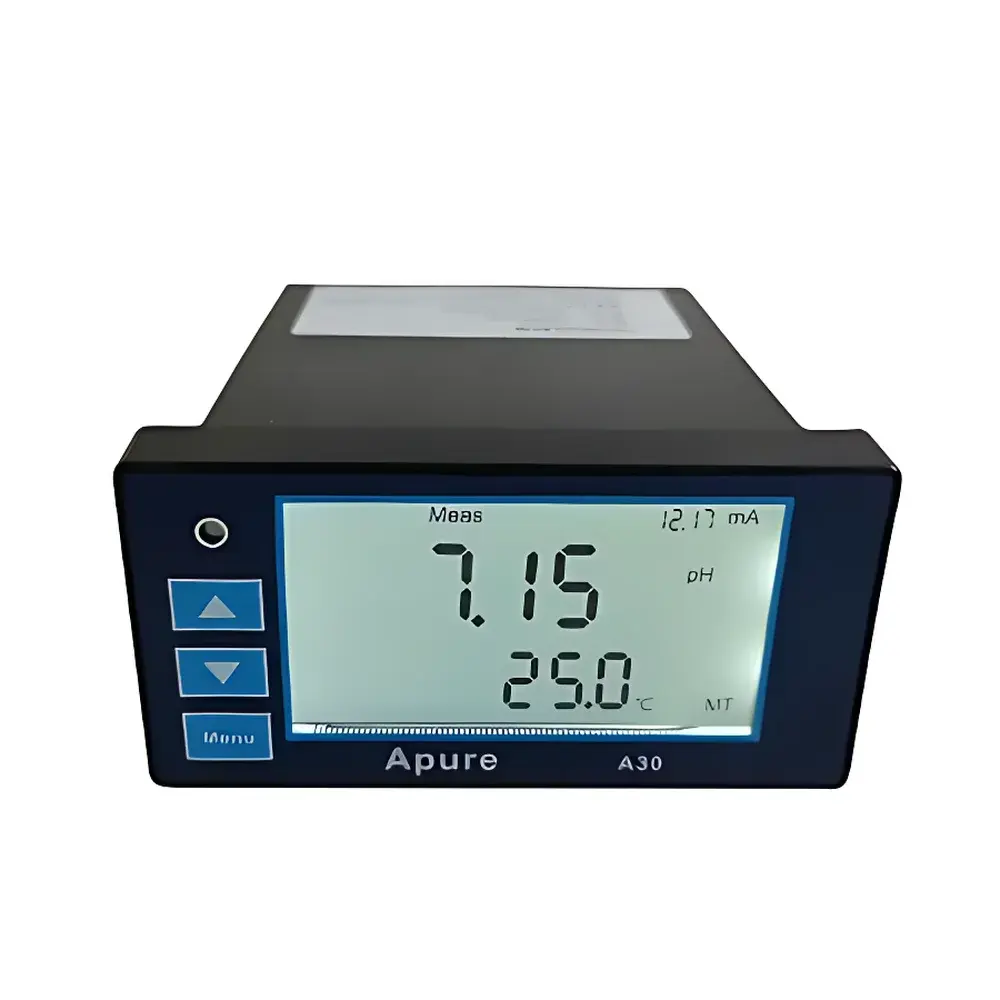
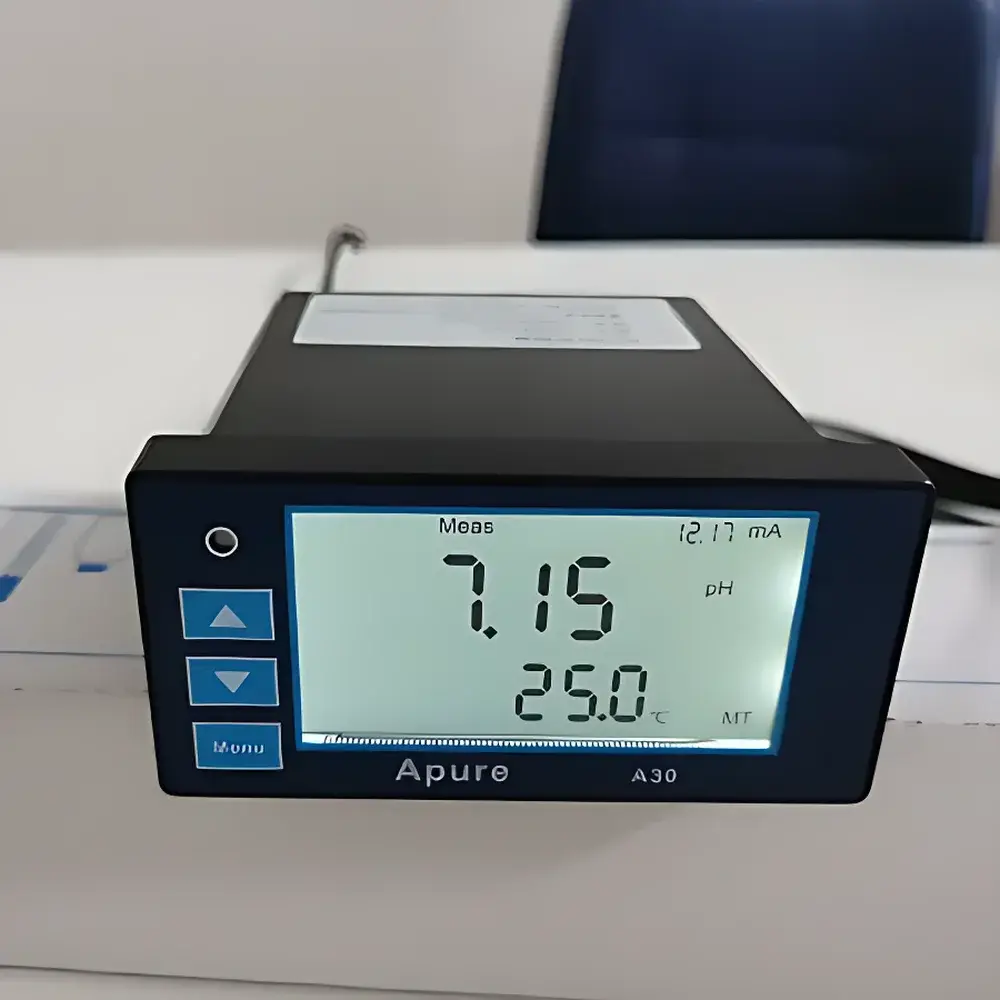
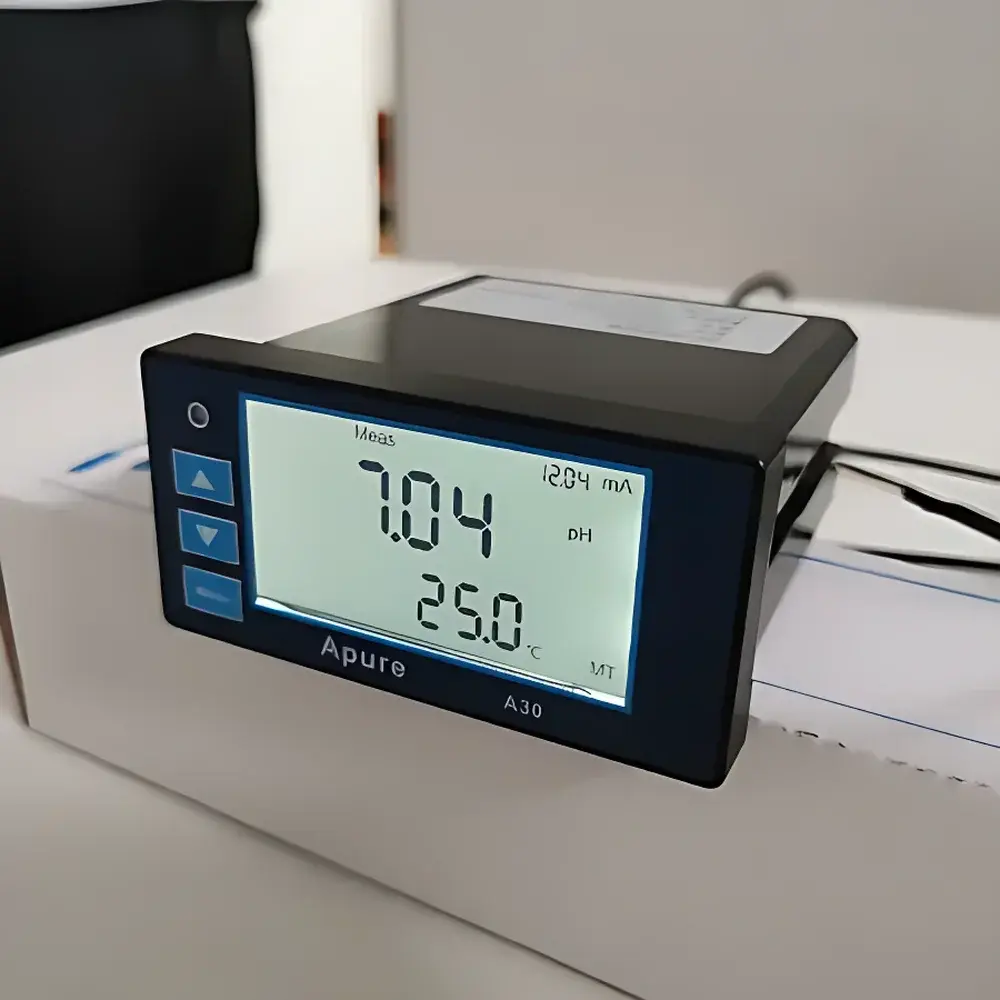
APURE A30PR-AA1 Online pH/ORP Controller
| Brand | APURE |
|---|---|
| Origin | Shanghai, China |
| Manufacturer Type | Manufacturer |
| Model | A30PR-AA1 |
| Price | USD 55 (FOB) |
| pH Range | 0.00–14.00 |
| ORP Range | −1999 to +1999 mV |
| pH Resolution | 0.01 |
| ORP Resolution | 1 mV |
| pH Accuracy | ±0.01 |
| ORP Accuracy | ±1 mV |
| Temperature Compensation | 0–100 °C (Manual / Automatic with PT1000 or NTC10K sensor) |
| Stability | ≤0.02 pH/24 h |
| Output | Isolated 4–20 mA (max. load 500 Ω) |
| Relay Output | 1 × SPDT, 3 A / 250 V AC (configurable high/low alarm with adjustable hysteresis) |
| Display | Custom segment LCD |
| Power Supply | AC 220 V ±10% or DC 24 V ±10% |
| Power Consumption | ≤15 W |
| Operating Environment | 0–60 °C, ≤85% RH (non-condensing) |
| Dimensions (H×W×D) | 48×96×110 mm |
| Panel Cutout | 42×90 mm |
Overview
The APURE A30PR-AA1 Online pH/ORP Controller is an industrial-grade process analyzer engineered for continuous, real-time monitoring and control of aqueous solution acidity (pH) and oxidation-reduction potential (ORP) in demanding production and treatment environments. Based on potentiometric measurement principles—where a glass electrode generates a millivolt signal proportional to hydrogen ion activity (pH), and a noble metal (e.g., platinum or gold) reference electrode measures redox potential relative to a stable reference—the A30PR-AA1 delivers stable, traceable readings under variable flow, pressure, and temperature conditions. Its dual-parameter capability (simultaneous pH and ORP acquisition), combined with integrated temperature compensation and configurable relay logic, enables closed-loop feedback control in dosing, neutralization, disinfection, and effluent compliance applications. Designed for DIN-rail or panel-mount installation, the unit complies with IEC 61000-6-2 (immunity) and IEC 61000-6-4 (emission) standards and supports long-term operation in Class 1 Div 2 / Zone 2 hazardous area-adjacent installations when used with appropriate barrier systems.
Key Features
- Dual-mode measurement architecture supporting both pH (0.00–14.00) and ORP (−1999 to +1999 mV) with independent calibration routines and auto-ranging display.
- Three temperature compensation options: automatic via external PT1000 or NTC10K sensor input, or manual offset entry—ensuring accuracy across dynamic thermal profiles from 0 °C to 100 °C.
- Galvanically isolated 4–20 mA analog output with user-selectable scaling (e.g., 4 mA = pH 2.00 / 20 mA = pH 12.00), optimized for PLC/DCS integration and immune to ground-loop interference.
- Configurable SPDT relay output (3 A / 250 V AC) with programmable setpoints, hysteresis (0.01–2.00 pH or 1–100 mV), and polarity inversion—supporting fail-safe shutdown, pump activation, or chemical feed control.
- High-contrast custom segment LCD with backlight-independent readability, displaying primary parameter, temperature, status icons (CAL, ALARM, ERR), and real-time output current value.
- Robust housing (IP65 front rating) with flame-retardant ABS enclosure, wide-input power flexibility (AC 220 V or DC 24 V), and low thermal drift design ensuring ≤0.02 pH/24 h baseline stability.
Sample Compatibility & Compliance
The A30PR-AA1 is validated for use with aqueous process streams including municipal wastewater, boiler feedwater, pharmaceutical rinse solutions, food-grade cleaning-in-place (CIP) fluids, and electroplating baths. It accepts standard combination pH/ORP electrodes with BNC or DIN connectors and supports common reference systems (Ag/AgCl, calomel). The controller meets CE marking requirements and conforms to ISO 5725 (accuracy verification), ASTM D1293 (pH of water), and USP (pH measurement in pharmaceutical water systems). When deployed in regulated environments, its fixed calibration log structure and non-volatile parameter storage support GLP/GMP audit readiness—though full 21 CFR Part 11 compliance requires external data logging with electronic signature capability.
Software & Data Management
While the A30PR-AA1 operates as a standalone hardware controller without embedded firmware-upgradable software, it provides deterministic analog and relay outputs compatible with industry-standard SCADA platforms (e.g., Siemens WinCC, Rockwell FactoryTalk, Ignition). Calibration history—including date/time stamp, buffer values used (e.g., pH 4.01, 7.00, 10.01), slope (%), and offset (mV)—is retained in non-volatile memory and viewable directly on the LCD. No proprietary configuration tools are required; all setup is performed via intuitive front-panel navigation with tactile membrane keys and visual feedback. For centralized fleet management, optional Modbus RTU (RS-485) communication modules can be added externally to enable remote readout of measured values, relay states, and diagnostic flags.
Applications
- Municipal and industrial wastewater treatment: real-time pH control in equalization tanks, neutralization basins, and post-chlorination monitoring.
- Power generation: continuous monitoring of condensate polishers, demineralizer effluent, and steam cycle chemistry (AVT/R/OVT programs).
- Pharmaceutical manufacturing: inline verification of purified water (PW) and water-for-injection (WFI) pH per EP/USP monographs.
- Food & beverage processing: CIP solution concentration validation, brine pH tracking, and fermentation broth monitoring.
- Chemical synthesis: stoichiometric endpoint detection in acid-base titrations and redox-controlled reactions (e.g., chlorine dioxide generation).
- Swimming pool & spa automation: coordinated dosing of sodium hypochlorite and CO₂ based on pH/ORP feedback loops.
FAQ
Does the A30PR-AA1 support automatic temperature compensation with both PT1000 and NTC10K sensors?
Yes—it detects sensor type automatically upon connection and applies the corresponding resistance-to-temperature conversion algorithm per IEC 60751 (PT1000) or DIN 43760 (NTC10K).
Can the 4–20 mA output be assigned independently to pH or ORP?
Yes—output mapping is fully configurable during setup; users may assign the loop to represent either parameter, with linear scaling across any sub-range.
Is calibration traceable to NIST standards?
The instrument itself does not include built-in traceability, but its calibration protocol aligns with ISO/IEC 17025 requirements when performed using NIST-traceable pH buffers and certified reference electrodes.
What is the maximum cable length between the controller and a remote pH electrode?
For optimal noise immunity, shielded twisted-pair cable is recommended; maximum recommended distance is 30 meters with proper grounding and separation from AC power lines.
Does the relay output support latching or pulse-mode operation?
No—the relay operates in standard on/off mode with user-defined hysteresis; latching functionality requires external logic or PLC coordination.