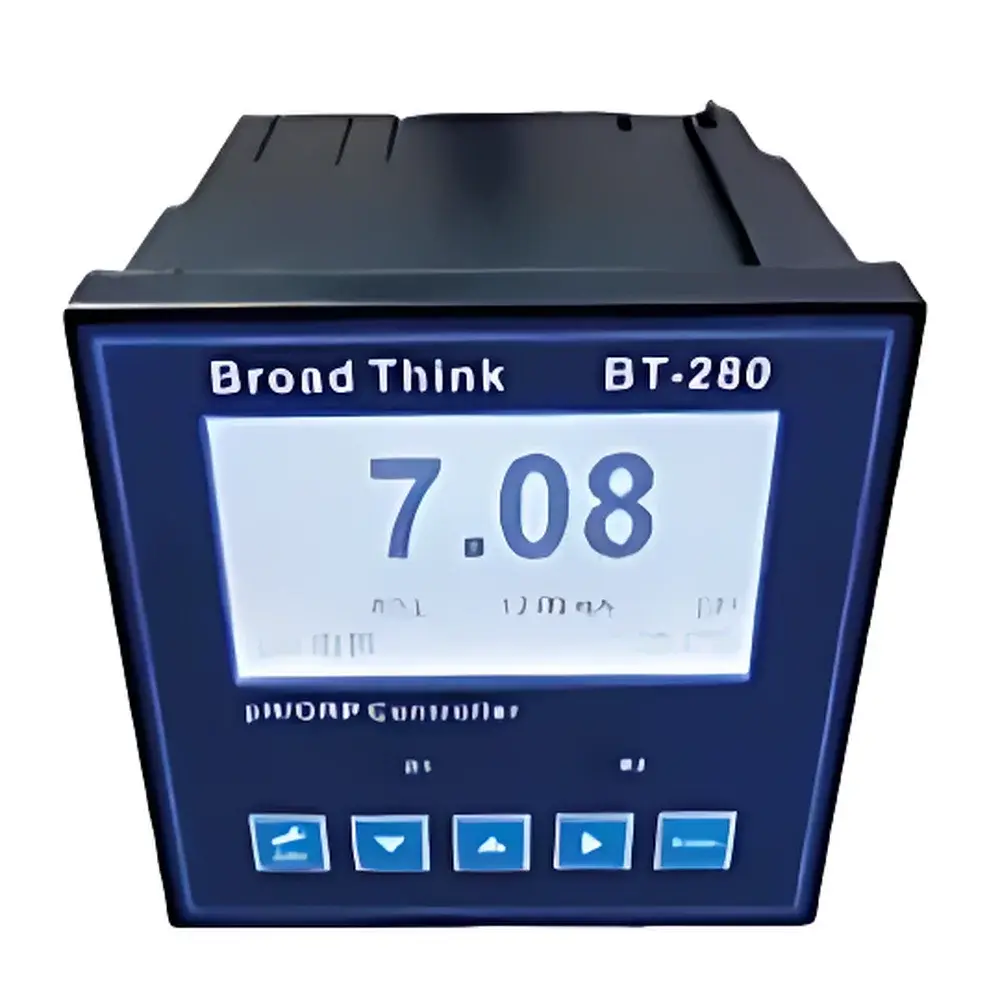
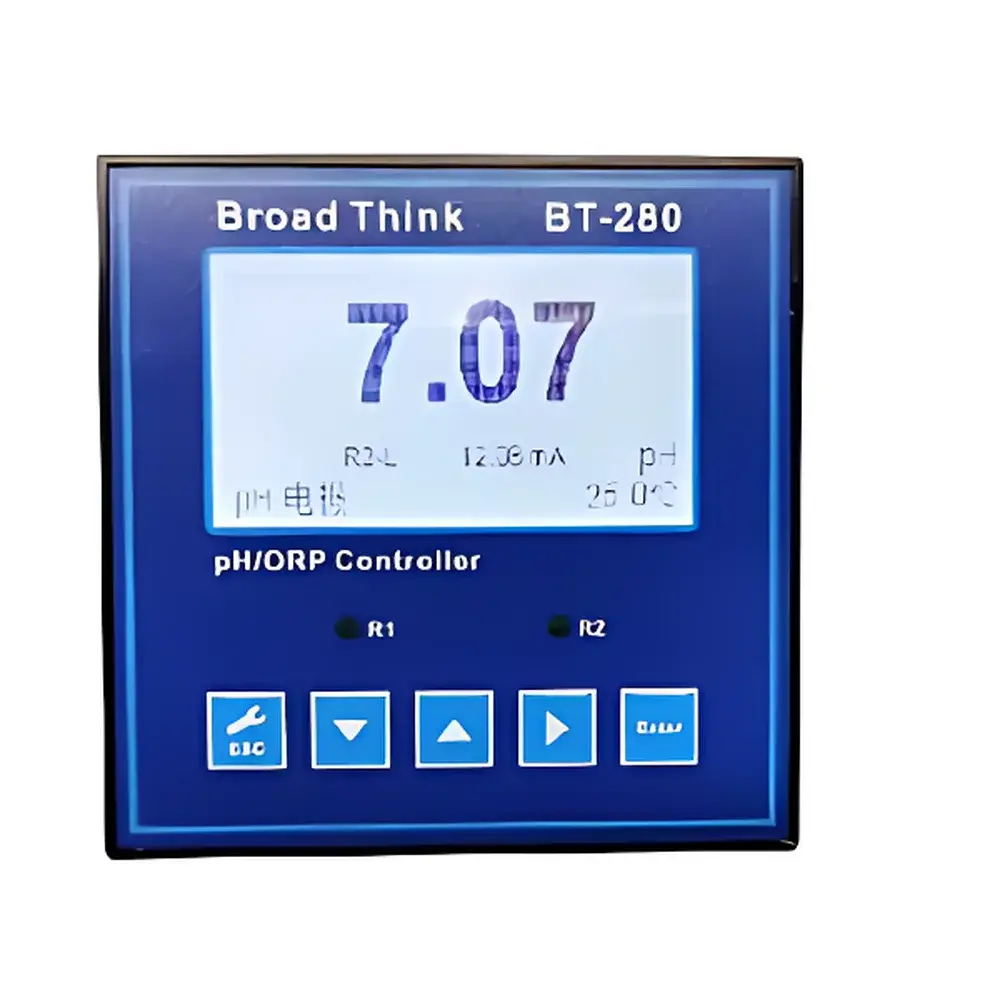
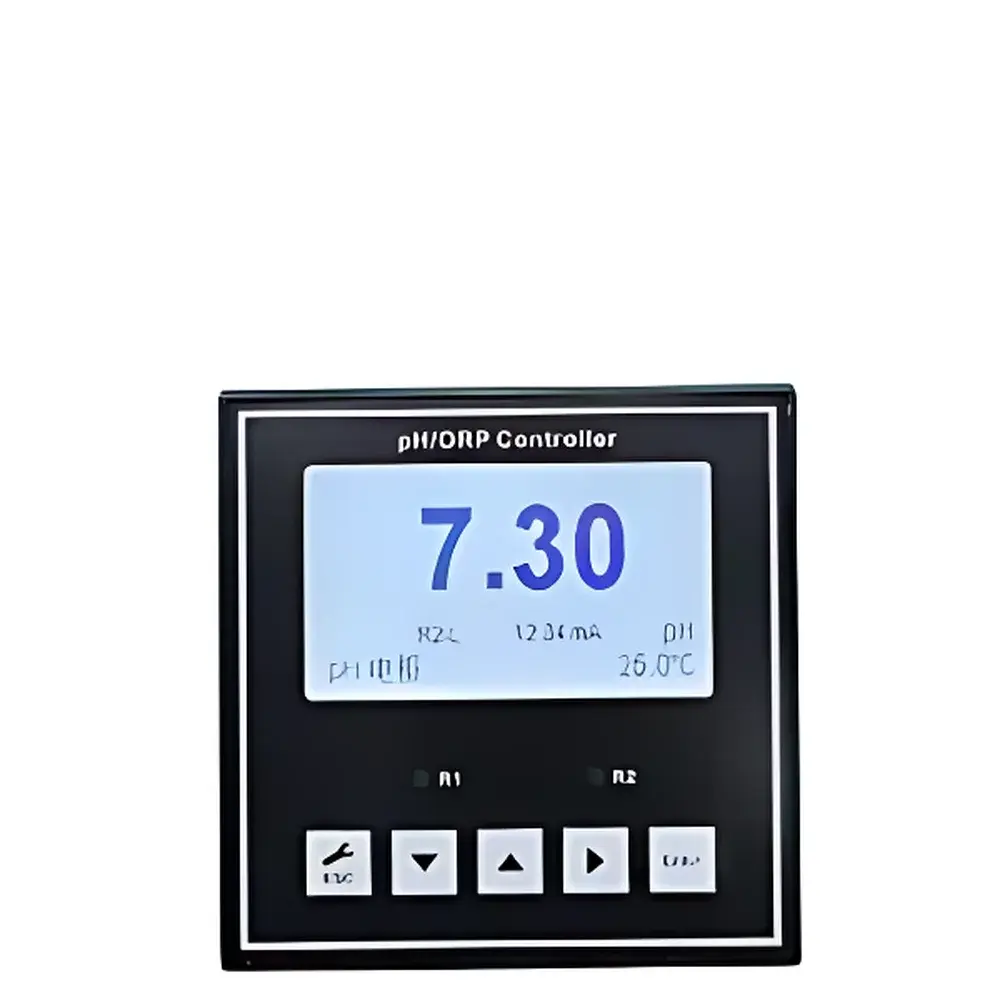
APURE BT-280 Online pH/ORP Analyzer
| Brand | APURE |
|---|---|
| Model | BT-280 |
| Measurement Range | pH 0.00–14.00 |
| Resolution | 0.01 pH |
| Accuracy | ±1% FS ±1 digit |
| Temperature Compensation | 0–100 °C (manual, PT1000, or NTC10K) |
| Output | Isolated 4–20 mA (configurable for pH, ORP, or temperature |
| Relay Outputs | 2 SPST relays (3 A / 250 VAC, NO contact |
| Power Supply | AC 220 V ±10% or DC 24 V ±10% |
| Dimensions | 96 × 96 × 110 mm (H × W × D) |
| panel cutout | 91 × 91 mm |
| Operating Environment | 0–50 °C |
| Stability | ≤0.1 pH/24 h |
Overview
The APURE BT-280 Online pH/ORP Analyzer is a microprocessor-based industrial process analyzer engineered for continuous, real-time monitoring of hydrogen ion activity (pH) and oxidation-reduction potential (ORP) in aqueous solutions. It operates on the principle of potentiometric measurement using glass electrode (for pH) and noble metal redox electrode (for ORP), referenced against a stable Ag/AgCl reference system. The instrument integrates dual-parameter sensing—simultaneously acquiring pH, ORP, and temperature—with automatic or manual temperature compensation to correct for thermal drift in electrode response. Designed for fixed-mount installation in control panels, the BT-280 delivers stable, repeatable measurements under dynamic process conditions typical of municipal wastewater treatment, boiler feedwater systems, pharmaceutical clean-in-place (CIP) cycles, and chemical dosing applications. Its robust architecture meets the mechanical and electrical requirements for Class I, Division 2 hazardous locations when installed with appropriate enclosures.
Key Features
- Multi-language interface: Factory-default Chinese display with seamless toggle to English—no firmware reflash required.
- Flexible temperature compensation: Supports PT1000 RTD, NTC10K thermistor, or manual input (0–100 °C), enabling compatibility with existing plant sensor infrastructure.
- Galvanically isolated 4–20 mA analog output: Configurable per channel to transmit pH, ORP, or temperature signals independently; rated for ≤500 Ω load impedance with <±0.05% FS linearity error.
- Dual programmable relays: SPST contacts rated at 3 A / 250 VAC (NO), fully assignable to high/low alarms for pH, ORP, or temperature—with user-defined hysteresis to prevent chattering during setpoint proximity.
- Secure access control: Hierarchical password protection (operator and engineer levels) restricts calibration, configuration, and relay threshold adjustments to authorized personnel only.
- Context-sensitive menu navigation: On-screen prompts guide users through calibration (1-/2-point pH, mV offset), setup, and diagnostics—reducing training time and operational errors.
Sample Compatibility & Compliance
The BT-280 is validated for use with conductive aqueous streams having conductivity ≥50 µS/cm. It is not intended for non-aqueous solvents, highly viscous slurries, or media containing sulfides, cyanides, or high concentrations of fluoride—substances known to poison glass electrodes or degrade reference junction integrity. The analyzer complies with IEC 61000-4 electromagnetic immunity standards (ESD, EFT, surge), IP65 front-panel rating (when properly gasketed), and RoHS Directive 2011/65/EU. While not certified to SIL or ATEX, its relay outputs and isolation design support integration into safety-rated systems when deployed per IEC 61511 guidelines. Calibration traceability aligns with ASTM D1293 (Standard Test Method for pH of Water) and ISO 7888 (Water Quality – Determination of pH).
Software & Data Management
The BT-280 operates autonomously without external software dependency. All configuration, calibration logs, and alarm history are stored in non-volatile memory with timestamping (real-time clock). Event records—including relay activation/deactivation, calibration events, and sensor fault detection—are retained for ≥30 days. Though it lacks native Modbus TCP or Ethernet connectivity, the 4–20 mA outputs interface directly with DCS, PLC, or SCADA systems supporting HART-enabled I/O modules. For audit-ready environments, the device supports GLP-compliant operation: calibration entries require password entry, and no parameter changes are permitted during active measurement without confirmation. Data integrity is preserved via write-protected EEPROM sectors preventing accidental overwrites.
Applications
The BT-280 serves as a primary analytical node in closed-loop process control architectures. In municipal wastewater plants, it monitors influent alkalinity, anoxic zone denitrification potential, and final effluent compliance (e.g., pH 6–9 per EPA 40 CFR Part 136). In power generation, it safeguards condensate polishing trains by detecting low-pH excursions that accelerate copper alloy corrosion. Within pharmaceutical water-for-injection (WFI) distribution loops, it verifies post-UV ORP stability (>+200 mV) as an indirect indicator of residual oxidant presence. In food & beverage CIP validation, synchronized pH/ORP trending confirms caustic acid concentration and sanitizer efficacy—supporting FDA 21 CFR Part 11 alignment when paired with compliant data acquisition systems.
FAQ
What electrode types are compatible with the BT-280?
The analyzer accepts standard BNC-input combination pH/ORP electrodes with integrated temperature elements (PT1000 or NTC10K). Electrodes must feature double-junction reference systems for chloride-rich or sulfide-laden streams.
Does the BT-280 support automatic calibration?
No—it requires manual 1-point or 2-point pH calibration using NIST-traceable buffer solutions (e.g., pH 4.01, 7.00, 10.01); ORP calibration uses Zobell’s or quinhydrone standards.
Can the 4–20 mA outputs be assigned to different parameters simultaneously?
Yes: Output 1 may be assigned to pH, while Output 2 transmits temperature—both active concurrently with independent scaling.
Is firmware upgrade possible in the field?
Firmware updates require APURE-certified service tools and are performed via RS-232 port under engineering-level access; no over-the-air or USB update capability is provided.
What maintenance intervals are recommended?
Electrode cleaning and calibration verification every 7–14 days in continuous operation; reference electrolyte refill (if applicable) and junction inspection every 90 days.
Related Products